


Post-Event Celebrations
March 16, 2012
In my last posting I praised the high school participant as the best behaved athlete on any level of sport. It’s ironic: based on what we see on higher levels, the older the athlete becomes, the more immature he or she is allowed to behave.
But we do have at least one conduct problem; and it’s one with potential for much bigger problems. It’s post-event celebrations.
Post-event celebrations have led to property damage, and they will lead to personal injuries unless we give the problem more careful attention and supervision.
Post-event celebrations are largely outside of the published playing rules, and they are usually beyond the jurisdiction of contest officials.
So, they will end up being the responsibility of game administration, and injuries will become the liability of game administrators.
This spring, the Representative Council may adopt more policies and procedures to which the MHSAA will direct more attention. The initial focus, as proposed, is on MHSAA team tournaments and to hold participating schools more explicitly accountable for property damage caused by celebrating teams and spectators.
Hopefully, attention to the broader topic and tougher policies for this narrow slice of the problem will reverse what we see as an unhealthy trend in school sports – excessive post-event celebrations.
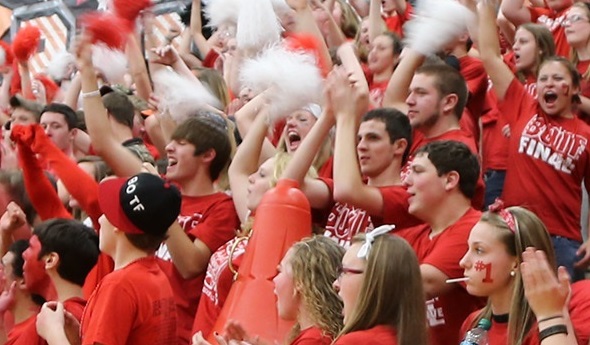
It's Time: Bring on Battle of the Fans IV
December 10, 2014
By Geoff Kimmerly
Second Half editor
Our games have moved inside, and student fan sections have followed. Gyms are jammed, cheers fill the air, and all is merry and bright.
It's that Battle of the Fans time of year, and the MHSAA's Student Advisory Council is again preparing to reward the top high school student cheering section in Michigan.
 Battle of the Fans was started during the 2011-12 school year to promote the opportunity for a fun, positive cheering experience for fans supporting their teams.
Beaverton was named last year’s champion and presented with a banner during the MHSAA Boys Basketball Finals at Michigan State University’s Breslin Center. Sections from Bridgman, Buchanan, Frankfort and Traverse City West also were finalists last winter.
Schools are invited to submit a short video, via YouTube, of their cheering sections in action. Video submissions should be between 90 seconds and three minutes long and explain how that section meets the following contest criteria: positive sportsmanship, student body participation, school spirit, originality of cheers, organization of the group, student section leadership and fun.
The deadline for student-submitted video applications is noon Jan. 10. Five finalists including at least one Class C or D school then will be chosen and visited on a home game night by MHSAA staff and Advisory Council representatives. The MHSAA will produce a video of that finalist after each visit, with the champion being selected by the Student Advisory Council based in part on activity on the MHSAA’s social media sites.
This year’s winner will be announced Feb. 20 and recognized March 27 at the Breslin Center.
Rules, directions for submitting videos, plus links to coverage of finalists from the first three years of the contest can be found on the MHSAA Website. As in the past, this year’s finalist videos plus the announcement of the 2014-15 winner will be published on Second Half.
Make sure to mark all of your social media postings regarding Battle of the Fans III with the hashtag #BOTF – and keep an eye out for more information on the MHSAA's Facebook, Twitter and Instagram sites. Click the links below to see the stories and videos from visits to our first three champions:
Frankenmuth (2012) - Buchanan (2013) - Beaverton (2014)
The Student Advisory Council is made up of eight seniors and eight juniors, who each serve two-year terms. The Council acts as the voice of Michigan's student-athletes; it serves as a student sounding board for the MHSAA's Representative Council, assists in planning Sportsmanship Summits, Captains Clinics and other student leadership events; participates in a yearly focus group about the state of high school sports for Michigan State University's Institute for the Study of Youth Sports and assists with medal ceremonies at MHSAA championship events.