


Post-Event Celebrations
March 16, 2012
In my last posting I praised the high school participant as the best behaved athlete on any level of sport. It’s ironic: based on what we see on higher levels, the older the athlete becomes, the more immature he or she is allowed to behave.
But we do have at least one conduct problem; and it’s one with potential for much bigger problems. It’s post-event celebrations.
Post-event celebrations have led to property damage, and they will lead to personal injuries unless we give the problem more careful attention and supervision.
Post-event celebrations are largely outside of the published playing rules, and they are usually beyond the jurisdiction of contest officials.
So, they will end up being the responsibility of game administration, and injuries will become the liability of game administrators.
This spring, the Representative Council may adopt more policies and procedures to which the MHSAA will direct more attention. The initial focus, as proposed, is on MHSAA team tournaments and to hold participating schools more explicitly accountable for property damage caused by celebrating teams and spectators.
Hopefully, attention to the broader topic and tougher policies for this narrow slice of the problem will reverse what we see as an unhealthy trend in school sports – excessive post-event celebrations.
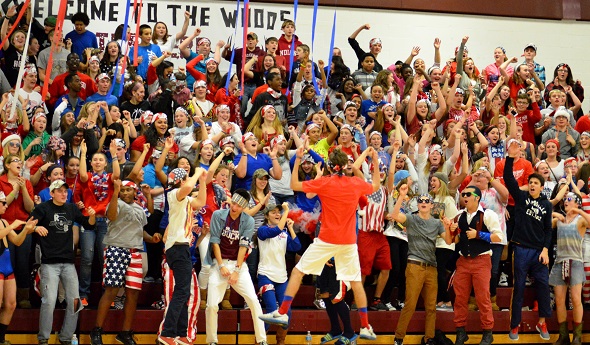
Welcome Back to 'The Woods'
January 17, 2014
By Geoff Kimmerly
Second Half editor
Buchanan, here we come.
The MHSAA and its Student Advisory Council will kick off "Battle of the Fans III" tonight with a return trip to Buchanan, last season's BOTF champion.
Buchanan, tucked into the southwest corner of the Lower Peninsula, is a Class B school of 465 students hailing from a community of roughly 4,400. The Bucks earned voters' hearts in 2013 as most of that student body and community filled the home gym – fittingly referred to as "The Woods" – for the MHSAA's BOTF visit.
 The MHSAA will visit finalists Beaverton, Bridgman, Frankfort and Traverse City West later this month and during the first two weeks of February before crowning a champion on Feb. 21 and inviting representatives from the winning section to a banner presentation during the Boys Basketball Semifinals on March 21 at Michigan State's Breslin Center.
Remember, follow the Battle of the Fans on the MHSAA's Facebook, Twitter and Instagram social media sites by clicking hashtag #BOTF. The MHSAA-produced story and video from tonight's trip will be published Tuesday on Second Half.
Here's Buchanan's application video for this winter's contest.
PHOTO is courtesy of Buchanan High School. Battle of the Fans III is sponsored in part by the United Dairy Industry of Michigan.