


Post-Event Celebrations
March 16, 2012
In my last posting I praised the high school participant as the best behaved athlete on any level of sport. It’s ironic: based on what we see on higher levels, the older the athlete becomes, the more immature he or she is allowed to behave.
But we do have at least one conduct problem; and it’s one with potential for much bigger problems. It’s post-event celebrations.
Post-event celebrations have led to property damage, and they will lead to personal injuries unless we give the problem more careful attention and supervision.
Post-event celebrations are largely outside of the published playing rules, and they are usually beyond the jurisdiction of contest officials.
So, they will end up being the responsibility of game administration, and injuries will become the liability of game administrators.
This spring, the Representative Council may adopt more policies and procedures to which the MHSAA will direct more attention. The initial focus, as proposed, is on MHSAA team tournaments and to hold participating schools more explicitly accountable for property damage caused by celebrating teams and spectators.
Hopefully, attention to the broader topic and tougher policies for this narrow slice of the problem will reverse what we see as an unhealthy trend in school sports – excessive post-event celebrations.
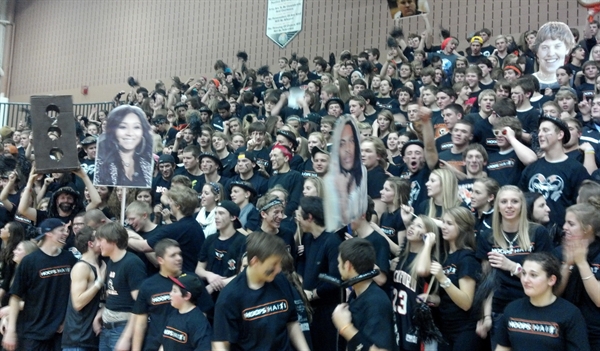
Battle of the Fans: Rockin' in Rockford
February 4, 2012
Representatives from the MHSAA and its Student Advistory Council took the "Battle of the Fans" tour to Rockford on Friday. And what did we find? Roughly 500 members of Ram Nation willing their team to a one-point win over rival Hudsonville.
Check back Tuesday afternoon for the story behind Ram Nation, and video of this "Battle" finalist in action.