Post-Event Celebrations
March 16, 2012
In my last posting I praised the high school participant as the best behaved athlete on any level of sport. It’s ironic: based on what we see on higher levels, the older the athlete becomes, the more immature he or she is allowed to behave.
But we do have at least one conduct problem; and it’s one with potential for much bigger problems. It’s post-event celebrations.
Post-event celebrations have led to property damage, and they will lead to personal injuries unless we give the problem more careful attention and supervision.
Post-event celebrations are largely outside of the published playing rules, and they are usually beyond the jurisdiction of contest officials.
So, they will end up being the responsibility of game administration, and injuries will become the liability of game administrators.
This spring, the Representative Council may adopt more policies and procedures to which the MHSAA will direct more attention. The initial focus, as proposed, is on MHSAA team tournaments and to hold participating schools more explicitly accountable for property damage caused by celebrating teams and spectators.
Hopefully, attention to the broader topic and tougher policies for this narrow slice of the problem will reverse what we see as an unhealthy trend in school sports – excessive post-event celebrations.

SAC Sound-off: Cheers to Remember
January 31, 2012
The Izzone. Cameron Crazies. Maize Rage. All of these student section names are synonymous with energy and enthusiasm. Every school, no matter how big or small, has fans just like these who want to support their schools’ student athletes.
For the MHSAA Student Advisory Council's “Battle of the Fans,” we set out to find high school student  sections that not only supported their schools, but did so in a creative manner. Fifteen council members and I judged the submitted videos on organization, leadership, creativity and noise.
As I watched, some cheers really stuck out. Saginaw Valley Lutheran High had a cheer that praised Jesus not only for its team, but also the opponent. Rockford took the “I Believe” cheer to another level, using roughly 50 bottles of baby powder to create a minute-long haze over the field while screaming "I believe that we will win!"
Not only has this competition been a huge success so far with nearly 20 entries, but it really hit home for me.
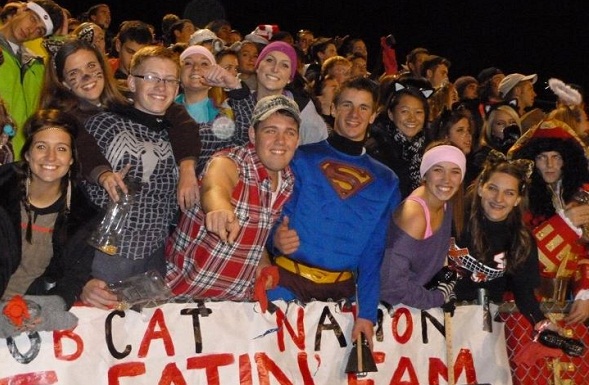
As a senior at Grand Blanc High School, I have waited four years to stand in the front row and lead our student section – with two of my best friends – for football and basketball games. For us, Friday nights at “The Frank,” our home football stadium, are some of the most fun times of the year.
As a student section, we valiantly attempted to create a fun atmosphere and support our fellow students. We did things like costume night over Halloween weekend to get our section going. Although things like this were way past fun, we were at these games to support our classmates and friends.
Throughout my senior year, the times I have had in the student section have created a bond with my fellow students unlike anything I have done before. These moments will last me a lifetime, and the camaraderie has helped me form friendships that will last forever.
After I was done judging all of the videos, it was so difficult for me to pick just five. I knew every single person, in every student section, was having a great time and creating wonderful memories. For that reason, I encourage every student to go out and cheer on your classmates. You will have more fun than you could ever imagine. As one of my favorite quotes exclaims, "It isn't how many breaths you take, but how many moments take your breath away."
It could be the raucous atmosphere created after a triple-overtime playoff win, or a bond forged in the tension of a nail-biter against a cross-town rival. These moments and friendships in a student cheering section will be everlasting.
Bailey Truesdell, Grand Blanc senior
- Sport: Golf
- Non-sports activities: National Honor Society, DECA leadership program, Tutoring
- Favorite class: Student Store
- Must-see TV: "Entourage"
- One shining moment: My best sports moment was winning my first-ever high school golf tournament as a freshman.
- What’s next: After high school, I will be attending Miami University, in Oxford, Ohio, to play golf and study business finance.
- My favorite part of game day is: … the thoughts that run through my mind all day prior to when I take to the course, mostly speculating as to how I will do, and visualizing my plan to succeed.
PHOTO courtesy of Bailey Truesdell (middle, in flannel shirt, with Grand Blanc's cheering section during a football game this fall).