


Post-Event Celebrations
March 16, 2012
In my last posting I praised the high school participant as the best behaved athlete on any level of sport. It’s ironic: based on what we see on higher levels, the older the athlete becomes, the more immature he or she is allowed to behave.
But we do have at least one conduct problem; and it’s one with potential for much bigger problems. It’s post-event celebrations.
Post-event celebrations have led to property damage, and they will lead to personal injuries unless we give the problem more careful attention and supervision.
Post-event celebrations are largely outside of the published playing rules, and they are usually beyond the jurisdiction of contest officials.
So, they will end up being the responsibility of game administration, and injuries will become the liability of game administrators.
This spring, the Representative Council may adopt more policies and procedures to which the MHSAA will direct more attention. The initial focus, as proposed, is on MHSAA team tournaments and to hold participating schools more explicitly accountable for property damage caused by celebrating teams and spectators.
Hopefully, attention to the broader topic and tougher policies for this narrow slice of the problem will reverse what we see as an unhealthy trend in school sports – excessive post-event celebrations.
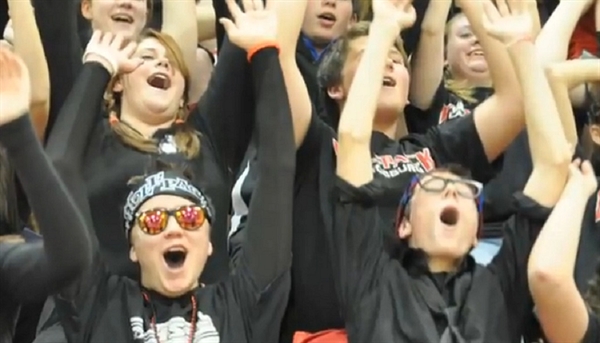
5 Vie for Best Cheering Section in Michigan
January 18, 2012
Five finalists -- Frankenmuth, Grand Rapids Christian, Petoskey, Reese and Rockford -- have been selected for the Michigan High School Athletic Association’s inaugural “Battle of the Fans,” which will recognize the top student cheering section from among member schools and culminate in a video presentation including all five finalists during this season’s Girls and Boys Basketball Finals at Michigan State’s Breslin Center.
The contest, organized by MHSAA staff and its 16-member Student Advisory Council, will reward the cheering section that best creates the positive and festive atmosphere made possible when students show enthusiasm, togetherness and sportsmanship while rooting for their team.
Finalists were selected based on a vote by the Student Advisory Council. MHSAA staff and Student Advisory Council members will visit all five finalists for home games during the second half of this regular season, with the winner being announced Feb. 24. Video of all five sections will be played on the Breslin Center HD scoreboard during the Finals in March.
Sections were invited in December to submit a short video, via YouTube and Facebook, of their cheering sections in action. Video submissions also included explanations on how that section meets the following contest criteria: positive sportsmanship, sound volume, school spirit, originality of cheers, organization of the group and student section leadership. A total of 19 sections submitted videos by the deadline earlier this month.
“The Student Advisory Council decided to put its primary focus this fall on a sportsmanship campaign that would engage and motivate student cheering sections throughout the state,” said Andy Frushour, MHSAA director of brand management and advisor to the Student Advisory Council. “We’re thrilled with the level of participation and look forward to the coming months as we look to crown our first ‘Battle of the Fans’ champion.”
MHSAA staff will produce videos from each stop on its tour of the finalists. Those videos will be posted to the MHSAA’s Facebook page. An online vote Feb. 20-23 will contribute in determining the winner.
Finalists will be visited for the following home boys basketball games:
Jan. 21: Frankenmuth vs. Freeland
Jan. 27: Grand Rapids Christian vs. East Grand Rapids, Reese vs. Cass City
Feb. 3: Rockford vs. Hudsonville
Feb. 17: Petoskey vs. West Branch Ogemaw Heights
To view finalists’ submissions on YouTube, click on http://ow.ly/8y9s3.
The Student Advisory Council is made up of eight seniors and eight juniors, who each serve two-year terms. The Council acts as the voice of Michigan's student-athletes; it serves as a student sounding board for the MHSAA's Representative Council, assists in planning Sportsmanship Summits, Captain's Clinics and other student leadership events; participates in a yearly focus group about the state of high schools sports for Michigan State University's Institute for the Study of Youth Sports and assists with medal ceremonies at MHSAA championship events.
Photo courtesy Laingsburg student cheering section.