


UP Power
November 29, 2016
About five hours after leaving the Michigan High School Athletic Association office building late in October, I pulled into the parking lot of Munising High School on the edge of Lake Superior. It was just after 7 p.m. on this Thursday evening, I saw that there were many cars in the parking lot, and I guessed that there was a high school volleyball game about to be played.
Indeed. It was the last regular season match of the season, and senior night. I was greeted warmly by the match referee and the school's two veteran administrators. And one of Munising's senior players, a member of the MHSAA Student Advisory Council, interrupted her warmups to jog over to welcome me. After the match, we hugged and posed for pictures together. Between the greeting and the posing, I enjoyed a marvelous evening of educational athletics.
There was plenty of cheering, and never a "boo." Not once did I hear a complaint about officiating. In fact, on two occasions the Munising coach corrected officials' calls that resulted in a point being awarded to his opponent.
For a time, every player on the floor for Munising had played more than one sport that season. Every one of the six played tennis as well as volleyball, and one of them also ran cross country this season. At the same time, the other team's participants included two girls who were also playing on their school's 8-player football team this past season.
Here the multi-sport student-athlete is not an endangered species; it's an essential fact of life. Here a school sports event draws the community together in good spirit and sportsmanship. Here is the power of school sports.
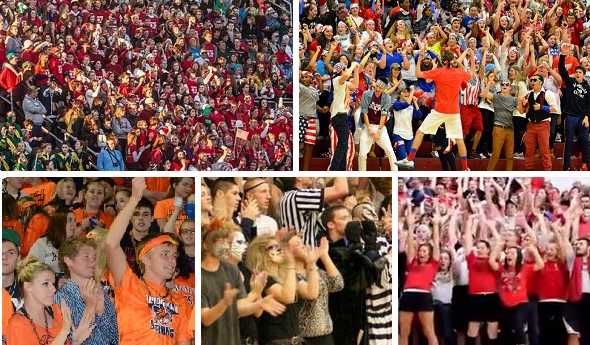
#BOTF Finalists: Prepare for Battle
January 13, 2014
By Geoff Kimmerly
Second Half editor
Buchanan is back to defend its title. But rival Bridgman would love to be the next to hoist the championship banner. And Beaverton, Frankfort and Traverse City West plan to show the best cheering in Michigan isn't reserved for the state's southwest corner.
Those five finalists have been selected for the Michigan High School Athletic Association’s “Battle of the Fans III,” which will again recognize the top student cheering section from among member schools with the winner crowned in March during Boys Basketball Finals weekend at Michigan State University's Breslin Center.
Buchanan won last season’s Battle of the Fans II. Frankenmuth won the inaugural BOTF in 2012.
 The contest, organized by MHSAA staff and its 16-member Student Advisory Council, will reward the cheering section that best creates the positive and festive atmosphere made possible when students show enthusiasm, togetherness and sportsmanship while rooting for their team.
MHSAA staff and Student Advisory Council members will visit all five finalists for home games during the second half of this regular season, with coverage and video from those visits and the announcement of the winner all to be published on Second Half.
Schools were invited in December to submit short videos, via YouTube, of their cheering sections in action. The winner will be announced Feb. 21, and video of all five sections will be played on the Breslin Center HD scoreboard during the Finals in March. The champion also will be recognized during the Boys Semifinals on March 21.
“The Battle of the Fans continues to influence positive cheering at schools throughout the state, and we were excited to see videos come in both from first-time applicants and schools that were not selected in 2013 but came back with strong efforts again this winter,” said Andy Frushour, MHSAA director of brand management and advisor to the Student Advisory Council. “These student sections create a buzz that takes hold of the entire community. The finalists tour is something MHSAA staff look forward to every January, and we’re excited to see what schools have come up with for 2014.”
Video submissions included explanations on how each section met the following contest criteria: positive sportsmanship, student body participation, school spirit, originality of cheers, organization of the group, student section leadership and overall fun.
Click the links below to see the videos submitted by the finalists:
Beaverton - Bridgman - Buchanan - Frankfort - Traverse City West
The finalists were chosen by the Student Advisory Council, and the winner will be selected by another Advisory Council vote based in part on activity on the MHSAA’s social media sites. All social media postings regarding Battle of the Fans III should include the hashtag #BOTF. The MHSAA will post throughout the finalists tour on its Facebook, Twitter and Instagram sites.
Finalists will be visited for the following home basketball games:
- Jan. 17: Buchanan vs. Niles Brandywine
- Jan. 31: Bridgman vs. Niles Brandywine
- Feb. 3: Frankfort vs. McBain
- Feb. 7: Traverse City West vs. Petoskey
- Feb. 14: Beaverton vs. Houghton Lake
Bridgman and Traverse City West both were applicants in 2012 as well. St. Joseph’s student section was the closest to making the finalist cut this year, just missing with a sixth-place finish in the initial Advisory council balloting. Petoskey, a 2012 finalist, finished seventh.
Other 2013 applicants were Ann Arbor Gabriel Richard, Bay City John Glenn, Big Rapids Crossroads Academy, Marlette and Mancelona. Click to view all applications on YouTube.
The contest is sponsored in part by the United Dairy Industry of Michigan, which promotes Michigan's locally-produced dairy products and nutrition education.
Rules plus links to last year’s coverage of the contest can be found on the BOTF page of the MHSAA site.
The Student Advisory Council is made up of eight seniors and eight juniors, who each serve two-year terms. The Council acts as the voice of Michigan's student-athletes; it serves as a student sounding board for the MHSAA's Representative Council, assists in planning Sportsmanship Summits, Captains Clinics and other student leadership events; participates in a yearly focus group about the state of high schools sports for Michigan State University's Institute for the Study of Youth Sports and assists with medal ceremonies at MHSAA championship events.
The MHSAA is a private, not-for-profit corporation of voluntary membership by more than 1,500 public and private senior high schools and junior high/middle schools which exists to develop common rules for athletic eligibility and competition. No government funds or tax dollars support the MHSAA, which was the first such association nationally to not accept membership dues or tournament entry fees from schools. Member schools which enforce these rules are permitted to participate in MHSAA tournaments, which attract more than 1.4 million spectators each year.
PHOTOS: MHSAA Battle of the Fans finalists cheer on their teams, clockwise from top left: Traverse City West, Buchanan, Beaverton, Frankfort and Bridgman.