

MHSAA Teams Up for Leadership Training
October 2, 2014
By Rob Kaminski
MHSAA benchmarks editor
Nothing strengthens a community like neighbors working together. The same can be said for organizations whose missions and goals are closely aligned.
Welcome to East Lansing, where the MHSAA and the Michigan State University Institute for the Study of Youth Sports share geographical boundaries and the same philosophies for educational athletics.
The ISYS mission, as stated on its website, is as follows: “The mission of the Institute for the Study of Youth Sports is to provide leadership, scholarship and outreach that ‘transforms’ the face of youth sports in ways that maximize the beneficial physical, psychological, and social effects of participation for children and youth while minimizing detrimental effects.”
That should sound familiar to athletic leaders within the MHSAA.
Key to the relationship between the MHSAA and the ISYS was the hiring of Dan Gould to the MSU faculty in 2004. Director of the ISYS, he helped to facilitate one of the first major initiatives between the ISYS and the MHSAA, which was to revamp the coaches education program, replacing the PACE program with the Coaches Advancement Program (CAP). Dr. Larry Lauer of the ISYS was heavily involved in creation of the CAP under the direction of MHSAA Assistant Director Kathy Vruggink Westdorp.
At the same time, Dr. Gould also led a study with athletic directors and coaches throughout the state to understand the greatest issues in high school sports. Additionally, to continue the ISYS mission to disseminate research findings, Dr. Marty Ewing, Dr. Gould, and a number of the ISYS graduate students have been presenters at the MHSAA Women in Sport Leadership Conference.
Such services have now become a natural fit into the development of the MHSAA’s student leadership programs, providing huge dividends to those in the ISYS program and the MHSAA.
“The mutually beneficial relationship led to a joint project to enhance student-athlete development with a specific focus on leadership development,” said Scott Westfall, one of two ISYS graduate students who work closely with MHSAA Director of Brand Management Andy Frushour.
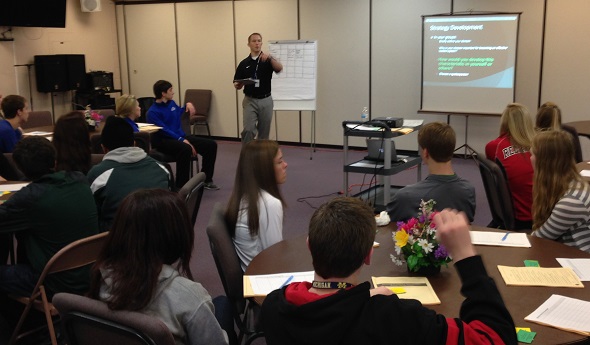
Frushour spearheads the student-based programs at the MHSAA with assistance from Andi Osters and Paige Winne. Among the first ISYS students to work with the MHSAA were Dana Voelker and Jed Blanton, who helped conceptualize the Captains Clinics curriculum. Today at the clinics, ISYS graduate students lead one-day seminars that provide student-athletes with insight on how to understand themselves as leaders, build key leadership skills and handle tough situations on their teams.
Currently, Westfall and Scott Pierce are the ISYS members providing their time and expertise with the MHSAA Student Advisory Council, Captains Clinics, and a new Online Captains Course set to debut this school year.
The Course is student-driven, with two SAC members serving as the faces of the program. Such peer delivery is vital to delivering the messages.
“Students often view leadership from teachers, coaches and administrators as regular, everyday activity. While adults are highly respected figures, students often see adults as outsiders who do not fully understand what it is like to walk a mile in their shoes,” Westfall said.
“The power is rooted in the peer-to-peer relationships and mutual empathy, as student-athletes are very close in age. Student-based leadership is often held with higher validity because the student leader is likely experiencing many of the same adversities and temptations as the peers on his or her team.”
Adding value and credence to the opinions of the ISYS staff is the fact they are steeped in research. The ISYS can gear its efforts to surveys and field studies that the MHSAA, due to staff constraints, cannot. It’s what the ISYS does; it’s the forte of its staff, and the findings help to shape CAP, the SAC and Captains Clinics.
“Research tells us that when kids get to middle school and high school, peer comparison has a really strong influence on how students and student-athletes act and behave,” said Pierce. “Based on this, we believe that student leaders can, and do, act as important role models on the field and in the classroom.
“It is not always easy for students to stand up as leaders because often times this means standing up and being different. So while student-based leadership is vitally important, it doesn't happen automatically. It needs to be talked about and developed over time.”
The MHSAA Captains Clinics and upcoming online course, it is believed, are examples of programs which can develop leaders.
“One of the leadership quotes we used in Tier 1 of the online student leadership course is from Vince Lombardi. It states: ‘Leaders are made, they are not born. They are made by hard effort, which is the price which all of us must pay to achieve any goal that is worthwhile,’” said Westfall. “This type of sentiment, combined with the joint belief between the ISYS and the MHSAA that leadership skills can be taught and cultivated, leads us to believe that leadership can be developed in an individual.”
Through such development, real inroads can be made to promote sportsmanship, teamwork and citizenship in school sports. It’s a worthwhile endeavor for participants, both attendee and instructor.
“Our staff finds the MHSAA Captains Clinics to be some of the most enjoyable and rewarding work that we do,” Pierce said. “The events focus on building leadership in the student-athletes, and give us (ISYS) an ideal opportunity to put our research and scientific knowledge into practice with the students and have a lot of fun doing so.”
Throughout the year, Frushour works with schools and conferences to schedule dates and locations for the clinics. For each day-long clinic, three to five ISYS staff lead a series of workshops for high school student-athletes. The workshops focus on building the four key pillars of leadership – motivation, communication, positive peer-modeling and team cohesion – and have the students involved in discussions, group activities, journaling and role plays.
“We are always trying to find new ways to integrate the new knowledge that we acquire about leadership and trying to reach as many students as possible,” said Pierce, alluding to the forthcoming Online Captains Course. “The online course aims to build off the great things the MHSAA and the ISYS have done with the Captains Clinics.”
A tremendous amount of enthusiasm surrounds the project, and for good reason. The track record of the MHSAA-ISYS partnership reflects a successful venture that might just be hitting stride.
“Over the past 15 years, the relationship between the ISYS and the MHSAA has blossomed. It is to the credit of the forward-thinking MHSAA staff members along with the ISYS faculty and graduate students that this relationship is stronger than ever,” Westfall said. “With the arrival of Dr. Karl Erickson to the ISYS this fall, the upcoming MHSAA coaching requirements for CAP courses, and the launch of the Online Captains Course, the future looks bright for the ISYS-MHSAA team.”
PHOTO: Scott Westfall from the Institute for the Study of Youth Sports conducts a Captains Clinic session as part of his work with the MHSAA.
This Week in High School Sports: 2/21/24
By
Jon Ross
MHSAA Director of Broadcast Properties
February 21, 2024
This week's edition previews this season's MHSAA Boys Basketball Tournament, presents Game Balls to standouts in basketball and bowling, and reviews the weekend's Upper Peninsula Girls & Boys Swimming & Diving Finals.
 The 5-minute program each week includes feature stories from MHSAA.com or network affiliates, along with "Be the Referee," a 60-second look at the fine art of officiating.
"This Week in High School Sports" is powered by MI Student Aid, a division within the Department of Lifelong Education, Advancement, and Potential (MiLEAP).
Listen to this week's show by Clicking Here.
Previous Editions
Feb. 14: Saginaw High/Arthur Hill boys basketball rivalry, Student Advisory Council - Listen
Feb. 7: MHSAA/Farm Bureau Insurance Scholar-Athlete Awards, Charles E. Forsythe Award honoree - Listen
Jan. 31: Girls sports participation, MHSAA Wrestling Tournament schedule - Listen
Jan. 24: MHSAA Women in Sports Leadership Conference, Hillman basketball's Trenton Taratuta - Listen
Jan. 10: Doug Towler's ice hockey coaching record, 2023-24 officials registration news - Listen
Jan. 3: MHSAA Girls & Boys Basketball Tournament schedules, Finals dates for all winter sports - Listen
Nov. 22: MHSAA Girls Volleyball, 8-Player Football and Lower Peninsula Girls Swimming & Diving Finals reviews - Listen
Nov. 15: Football record breakers, 2022-23 MHSAA postseason attendance - Listen
Nov. 8: MHSAA Boys Soccer, Lower Peninsula Cross Country Finals reviews - Listen
Nov. 1: MHSAA Girls Volleyball Tournament schedule, Football Playoffs first-round review - Listen
Oct. 26: Lower Peninsula Girls Golf Finals, Boys Tennis Finals review - Listen
Oct. 18: MHSAA Football Playoff selection, Bear Lake football coach Sam Mullet - Listen
Oct. 11: Upper Peninsula soccer, MHSAA sports participation excels nationally - Listen
Oct. 4: Jackson Lumen Christi's Herb Brogan, MHSAA Sportsmanship Summits - Listen
Sept. 24: All-woman football officiating crew, Powers North Central's record winning streak ends - Listen
Sept. 21: 35th MHSAA/Farm Bureau Insurance Scholar-Athlete Awards, Grass Lake QB Brayden Lape - Listen
Sept. 14: Athletic director education, MHSAA video library - Listen
Sept. 7: Adjustments to 11-player football, boys soccer Finals schedules - Listen
Aug. 31: New out-of-state opponents rules, football record book updates - Listen
Aug. 24: MHSAA.com coverage ramps up, "Made in Michigan" tells us where they are now - Listen