

MHSAA Teams Up for Leadership Training
October 2, 2014
By Rob Kaminski
MHSAA benchmarks editor
Nothing strengthens a community like neighbors working together. The same can be said for organizations whose missions and goals are closely aligned.
Welcome to East Lansing, where the MHSAA and the Michigan State University Institute for the Study of Youth Sports share geographical boundaries and the same philosophies for educational athletics.
The ISYS mission, as stated on its website, is as follows: “The mission of the Institute for the Study of Youth Sports is to provide leadership, scholarship and outreach that ‘transforms’ the face of youth sports in ways that maximize the beneficial physical, psychological, and social effects of participation for children and youth while minimizing detrimental effects.”
That should sound familiar to athletic leaders within the MHSAA.
Key to the relationship between the MHSAA and the ISYS was the hiring of Dan Gould to the MSU faculty in 2004. Director of the ISYS, he helped to facilitate one of the first major initiatives between the ISYS and the MHSAA, which was to revamp the coaches education program, replacing the PACE program with the Coaches Advancement Program (CAP). Dr. Larry Lauer of the ISYS was heavily involved in creation of the CAP under the direction of MHSAA Assistant Director Kathy Vruggink Westdorp.
At the same time, Dr. Gould also led a study with athletic directors and coaches throughout the state to understand the greatest issues in high school sports. Additionally, to continue the ISYS mission to disseminate research findings, Dr. Marty Ewing, Dr. Gould, and a number of the ISYS graduate students have been presenters at the MHSAA Women in Sport Leadership Conference.
Such services have now become a natural fit into the development of the MHSAA’s student leadership programs, providing huge dividends to those in the ISYS program and the MHSAA.
“The mutually beneficial relationship led to a joint project to enhance student-athlete development with a specific focus on leadership development,” said Scott Westfall, one of two ISYS graduate students who work closely with MHSAA Director of Brand Management Andy Frushour.
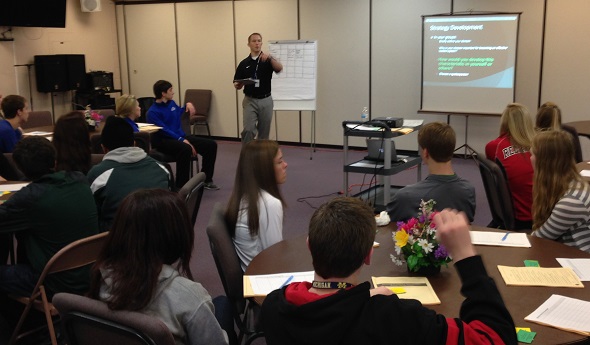
Frushour spearheads the student-based programs at the MHSAA with assistance from Andi Osters and Paige Winne. Among the first ISYS students to work with the MHSAA were Dana Voelker and Jed Blanton, who helped conceptualize the Captains Clinics curriculum. Today at the clinics, ISYS graduate students lead one-day seminars that provide student-athletes with insight on how to understand themselves as leaders, build key leadership skills and handle tough situations on their teams.
Currently, Westfall and Scott Pierce are the ISYS members providing their time and expertise with the MHSAA Student Advisory Council, Captains Clinics, and a new Online Captains Course set to debut this school year.
The Course is student-driven, with two SAC members serving as the faces of the program. Such peer delivery is vital to delivering the messages.
“Students often view leadership from teachers, coaches and administrators as regular, everyday activity. While adults are highly respected figures, students often see adults as outsiders who do not fully understand what it is like to walk a mile in their shoes,” Westfall said.
“The power is rooted in the peer-to-peer relationships and mutual empathy, as student-athletes are very close in age. Student-based leadership is often held with higher validity because the student leader is likely experiencing many of the same adversities and temptations as the peers on his or her team.”
Adding value and credence to the opinions of the ISYS staff is the fact they are steeped in research. The ISYS can gear its efforts to surveys and field studies that the MHSAA, due to staff constraints, cannot. It’s what the ISYS does; it’s the forte of its staff, and the findings help to shape CAP, the SAC and Captains Clinics.
“Research tells us that when kids get to middle school and high school, peer comparison has a really strong influence on how students and student-athletes act and behave,” said Pierce. “Based on this, we believe that student leaders can, and do, act as important role models on the field and in the classroom.
“It is not always easy for students to stand up as leaders because often times this means standing up and being different. So while student-based leadership is vitally important, it doesn't happen automatically. It needs to be talked about and developed over time.”
The MHSAA Captains Clinics and upcoming online course, it is believed, are examples of programs which can develop leaders.
“One of the leadership quotes we used in Tier 1 of the online student leadership course is from Vince Lombardi. It states: ‘Leaders are made, they are not born. They are made by hard effort, which is the price which all of us must pay to achieve any goal that is worthwhile,’” said Westfall. “This type of sentiment, combined with the joint belief between the ISYS and the MHSAA that leadership skills can be taught and cultivated, leads us to believe that leadership can be developed in an individual.”
Through such development, real inroads can be made to promote sportsmanship, teamwork and citizenship in school sports. It’s a worthwhile endeavor for participants, both attendee and instructor.
“Our staff finds the MHSAA Captains Clinics to be some of the most enjoyable and rewarding work that we do,” Pierce said. “The events focus on building leadership in the student-athletes, and give us (ISYS) an ideal opportunity to put our research and scientific knowledge into practice with the students and have a lot of fun doing so.”
Throughout the year, Frushour works with schools and conferences to schedule dates and locations for the clinics. For each day-long clinic, three to five ISYS staff lead a series of workshops for high school student-athletes. The workshops focus on building the four key pillars of leadership – motivation, communication, positive peer-modeling and team cohesion – and have the students involved in discussions, group activities, journaling and role plays.
“We are always trying to find new ways to integrate the new knowledge that we acquire about leadership and trying to reach as many students as possible,” said Pierce, alluding to the forthcoming Online Captains Course. “The online course aims to build off the great things the MHSAA and the ISYS have done with the Captains Clinics.”
A tremendous amount of enthusiasm surrounds the project, and for good reason. The track record of the MHSAA-ISYS partnership reflects a successful venture that might just be hitting stride.
“Over the past 15 years, the relationship between the ISYS and the MHSAA has blossomed. It is to the credit of the forward-thinking MHSAA staff members along with the ISYS faculty and graduate students that this relationship is stronger than ever,” Westfall said. “With the arrival of Dr. Karl Erickson to the ISYS this fall, the upcoming MHSAA coaching requirements for CAP courses, and the launch of the Online Captains Course, the future looks bright for the ISYS-MHSAA team.”
PHOTO: Scott Westfall from the Institute for the Study of Youth Sports conducts a Captains Clinic session as part of his work with the MHSAA.
5 Ways Frankenmuth is Flying High
February 7, 2017
By Geoff Kimmerly
Second Half editor
FRANKENMUTH – In a section of stands nearest the door to welcome all who enter Frankenmuth’s gym, the first Battle of the Fans champion was born five years ago.
The seventh graders that winter of 2012 are seniors now. And the Eagles on Friday were seeking to add the title of first two-time champion to that original BOTF banner as we finished up this year’s finalists tour with our fifth and last stop.
The breakdown: This was our third visit to Frankenmuth in six years of Battle of the Fans. The student section hasn’t come up with a catchy name for itself, but it certainly has a reputation across the Saginaw and Thumb areas for the raucous atmosphere it creates during games, along with plenty of singing, dancing and general silliness. The Eagles always had decent student support for their successful football and girls and boys basketball teams, but amped up the organization, excitement and following five years ago – just in time to win that first BOTF title.
This trip, we met with seniors Megan Watkins, Shafer Webb, Kris Roche, Dalton Enequist and Jackie Weess, and juniors Kyle Robinson and Sam Tagget for the Eagles’ boys basketball game against Millington. Below is our video and takeaways after another visit with our first BOTF champion.
1. They’re carrying on a legacy.
That 2012 championship is a point of pride, at least for this year’s leaders, and perhaps especially to Webb and Robinson – their older brothers led Frankenmuth's section when it won the inaugural contest. The Eagles were a BOTF finalist in 2013 as well, but not again until this season. Students still turned out to support their classmates at games, but it took a driven leadership group to help the section step back into contention. Roche said the effort was kicked off with a hype video played during the “Friday Feed,” a weekly video show played school-wide. Leaders have worked closely clearing everything – themes, cheers, wild halftime shows (see below) – with athletic director Kevin Schwedler. Excitement started building during football season, and the turning point was the team’s trip and caravan that followed to Marquette for a Division 5 Semifinal at the Superior Dome. “Being on the sideline looking up at that crowd, it was easy to realize that we had a student body that was excited about being in the student section,” said Roche, a standout fullback and linebacker. “You don’t travel six and a half hours for a high school game if you don’t have pride in your school and want to be a part of it.”
2. They don’t care about being cool.
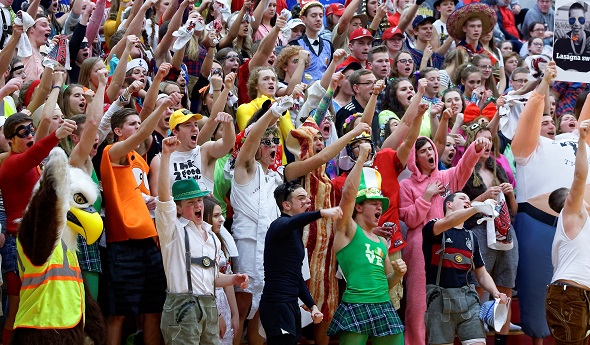
If you show up in normal clothes, you’re going to be the one looking ridiculous. That’s a direct quote from one of the leaders, and it remains true as much as it was evident during our first visit five years ago. The Eagles take their themes seriously, and the weirder the better. “That’s the biggest thing, trying to get the underclassmen out of their shells, realizing you don’t have to be all self-conscious and what not coming into high school,” Tagget said. “The whole point of the student section is to look as ridiculous as possible when you walk out into that set of bleachers.”
-Costume Party
*Look ridiculous
*No rules (other than keep it appropriate)
-Show MHSAA what the hype is about#GoEagles ??????????— FHS Student Section (@muthstudents) February 3, 2017
3. United, they stand.
Frankenmuth has 530 students, and at least half of them loaded the stands for Friday’s game. Granted, it was against rival Millington, but leaders boast that they bring a higher percentage of the student body to most games than other schools and rally as well to support a girls basketball team that has won 105 straight league games although often those contests are played midweek instead of Fridays. Even some of the parents got in the game for “costume night” with jerseys on top and lederhosen below. Coaches for both basketball teams have thanked the section for its support this season, and the solidarity with those teams is obvious from section leaders’ involvement in pregame introductions to their near-constant support throughout the game. It's common for student sections to have dances/stunts/skits planned for breaks. But what sets the elite sections apart is how they engage in cheering for their teams during play. Frankenmuth was all in on every possession from start to finish, chanting names of their classmates after they scored, celebrating baskets even when the final result had long been decided, and mixing in a little German chant for made free throws.
4. Eagles treat student section like another sport.
All seven leaders who met with us play at least one sport. They see the student section as another, which explains their competitive pursuit of the BOTF title. Watkins has spent more time editing videos over the last month than working on her golf game – although she’s playing that sport next year when she moves on to Western Michigan University. And like with our other finalists this year, getting the section ready from week to week and especially for the BOTF visit was a group effort fueled by high expectations. “We hold ourselves to a standard of excellence, and for every sport the goal is a championship,” Roche said. “This is our Super Bowl. We’re here to win.”
 5. They’re always on their game.
In this case, that means a couple of things. Frankenmuth brings plenty of originality to the table, with theme nights like “Lit-mas” (think Lit + Christmas) and Friday's “Costume Night,” which saw a mix of German garb highlighting the town’s heritage but also a variety of costumes and signs that defined random. What they did do together was cheer from before tipoff through the end of a 36-point win – and as was the case during our visits in 2012 and 2013, every break in the action at a Frankenmuth game is an opportunity to sing and dance, this time featuring everything from Miley Cyrus to “Santa Claus is Coming to Town.” We’re hesitant to explain halftime, even if leaders assured us they were “professionals” before rolling out mats and taking part in a WWE-style wrestling match complete with body slams and metal chairs. Kids, don’t try this at home – or at your schools without prior administrative approval.
In their words
Teachable moments: “I think with high school and everything in general nowadays, there’s a stereotype of how you should act, how you should dress,” Watkins said. “The freshman girls look at the senior girls, and I remember when I was a freshman and I saw the seniors, and they didn’t care – they wanted to express themselves and be who they are. And I think that’s why with our themes we dress crazy and we’re all different. … You grow into yourself and you have that confidence about you. We’re all athletes and we all understand that you have to live life with a little bit of confidence with our sports, with our grades, everything. (The section) kinda taught us that over the years; it’s just a student section, but it means a lot more than what people think it would.”
This was the goal: “Growing up, I always had my eyes on the student section,” Tagget said. “To be honest I never had any idea what it was. I just thought it was people going crazy in the stands. But I grew up with Kyle (Robinson), and being around his brother, he was the laughing-stock. And watching him lead the student section, I said that’s what I want to do when I get to high school.”
Tradition will live on: “We’ve got these (juniors), and they know the standard they have to hold, not only for themselves and the other leaders, but every student,” Roche said. “My little brother is going to be a freshman next year, and all his friends are beyond excited about their opportunity. And I think the excitement around here in the community, it’s real again. I don’t think we’re going be going away for a long time.”
Next up on BOTF: With all five visits complete, public voting for this year’s champion will begin Feb. 13 on the MHSAA’s Facebook, Twitter and Instagram feeds and continue through Feb. 16. To vote, like, retweet and/or share the photo of your favorite student section. The winner will be announced Feb. 17 on Second Half, and representatives from all five finalists will be invited March 24 to the Class B Boys Basketball Semifinals at the Breslin Center, where the winner will receive this year’s championship banner. Click for coverage of our visits to Boyne City on Jan. 13, Traverse City West on Jan. 20, Charlotte on Jan. 28 and Petoskey on Feb. 1.
The Battle of the Fans is sponsored in part by the United Dairy Industry of Michigan.
PHOTOS: (Top) Frankenmuth students fill their section of bleachers for Friday's Battle of the Fans visit. (Middle) Students decked out for "Costume Night" cheer on the Eagles to a win over Millington. (Photos by Chip DeGrace.)