

MHSAA Teams Up for Leadership Training

October 2, 2014

By Rob Kaminski
MHSAA benchmarks editor

Nothing strengthens a community like neighbors working together. The same can be said for organizations whose missions and goals are closely aligned.

Welcome to East Lansing, where the MHSAA and the Michigan State University Institute for the Study of Youth Sports share geographical boundaries and the same philosophies for educational athletics.

The ISYS mission, as stated on its website, is as follows: “The mission of the Institute for the Study of Youth Sports is to provide leadership, scholarship and outreach that ‘transforms’ the face of youth sports in ways that maximize the beneficial physical, psychological, and social effects of participation for children and youth while minimizing detrimental effects.”

That should sound familiar to athletic leaders within the MHSAA.

Key to the relationship between the MHSAA and the ISYS was the hiring of Dan Gould to the MSU faculty in 2004. Director of the ISYS, he helped to facilitate one of the first major initiatives between the ISYS and the MHSAA, which was to revamp the coaches education program, replacing the PACE program with the Coaches Advancement Program (CAP). Dr. Larry Lauer of the ISYS was heavily involved in creation of the CAP under the direction of MHSAA Assistant Director Kathy Vruggink Westdorp.

At the same time, Dr. Gould also led a study with athletic directors and coaches throughout the state to understand the greatest issues in high school sports. Additionally, to continue the ISYS mission to disseminate research findings, Dr. Marty Ewing, Dr. Gould, and a number of the ISYS graduate students have been presenters at the MHSAA Women in Sport Leadership Conference.

Such services have now become a natural fit into the development of the MHSAA’s student leadership programs, providing huge dividends to those in the ISYS program and the MHSAA.

“The mutually beneficial relationship led to a joint project to enhance student-athlete development with a specific focus on leadership development,” said Scott Westfall, one of two ISYS graduate students who work closely with MHSAA Director of Brand Management Andy Frushour.

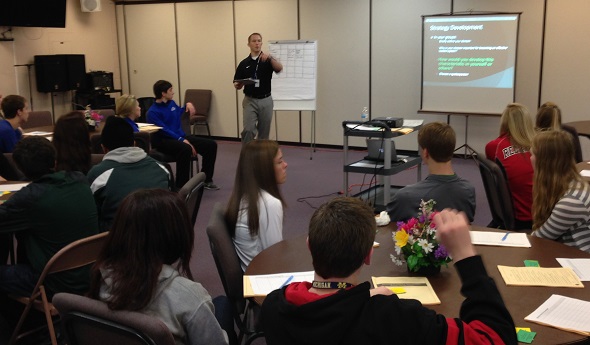
Frushour spearheads the student-based programs at the MHSAA with assistance from Andi Osters and Paige Winne. Among the first ISYS students to work with the MHSAA were Dana Voelker and Jed Blanton, who helped conceptualize the Captains Clinics curriculum. Today at the clinics, ISYS graduate students lead one-day seminars that provide student-athletes with insight on how to understand themselves as leaders, build key leadership skills and handle tough situations on their teams.

Currently, Westfall and Scott Pierce are the ISYS members providing their time and expertise with the MHSAA Student Advisory Council, Captains Clinics, and a new Online Captains Course set to debut this school year.

The Course is student-driven, with two SAC members serving as the faces of the program. Such peer delivery is vital to delivering the messages.

“Students often view leadership from teachers, coaches and administrators as regular, everyday activity. While adults are highly respected figures, students often see adults as outsiders who do not fully understand what it is like to walk a mile in their shoes,” Westfall said.

“The power is rooted in the peer-to-peer relationships and mutual empathy, as student-athletes are very close in age. Student-based leadership is often held with higher validity because the student leader is likely experiencing many of the same adversities and temptations as the peers on his or her team.”

Adding value and credence to the opinions of the ISYS staff is the fact they are steeped in research. The ISYS can gear its efforts to surveys and field studies that the MHSAA, due to staff constraints, cannot. It’s what the ISYS does; it’s the forte of its staff, and the findings help to shape CAP, the SAC and Captains Clinics.

“Research tells us that when kids get to middle school and high school, peer comparison has a really strong influence on how students and student-athletes act and behave,” said Pierce. “Based on this, we believe that student leaders can, and do, act as important role models on the field and in the classroom.

“It is not always easy for students to stand up as leaders because often times this means standing up and being different. So while student-based leadership is vitally important, it doesn't happen automatically. It needs to be talked about and developed over time.”

The MHSAA Captains Clinics and upcoming online course, it is believed, are examples of programs which can develop leaders.

“One of the leadership quotes we used in Tier 1 of the online student leadership course is from Vince Lombardi. It states: ‘Leaders are made, they are not born. They are made by hard effort, which is the price which all of us must pay to achieve any goal that is worthwhile,’” said Westfall. “This type of sentiment, combined with the joint belief between the ISYS and the MHSAA that leadership skills can be taught and cultivated, leads us to believe that leadership can be developed in an individual.”

Through such development, real inroads can be made to promote sportsmanship, teamwork and citizenship in school sports. It’s a worthwhile endeavor for participants, both attendee and instructor.

“Our staff finds the MHSAA Captains Clinics to be some of the most enjoyable and rewarding work that we do,” Pierce said. “The events focus on building leadership in the student-athletes, and give us (ISYS) an ideal opportunity to put our research and scientific knowledge into practice with the students and have a lot of fun doing so.”

Throughout the year, Frushour works with schools and conferences to schedule dates and locations for the clinics. For each day-long clinic, three to five ISYS staff lead a series of workshops for high school student-athletes. The workshops focus on building the four key pillars of leadership  – motivation, communication, positive peer-modeling and team cohesion – and have the students involved in discussions, group activities, journaling and role plays.

“We are always trying to find new ways to integrate the new knowledge that we acquire about leadership and trying to reach as many students as possible,” said Pierce, alluding to the forthcoming Online Captains Course. “The online course aims to build off the great things the MHSAA and the ISYS have done with the Captains Clinics.”

A tremendous amount of enthusiasm surrounds the project, and for good reason. The track record of the MHSAA-ISYS partnership reflects a successful venture that might just be hitting stride.

“Over the past 15 years, the relationship between the ISYS and the MHSAA has blossomed. It is to the credit of the forward-thinking MHSAA staff members along with the ISYS faculty and graduate students that this relationship is stronger than ever,” Westfall said. “With the arrival of Dr. Karl Erickson to the ISYS this fall, the upcoming MHSAA coaching requirements for CAP courses, and the launch of the Online Captains Course, the future looks bright for the ISYS-MHSAA team.”

PHOTO: Scott Westfall from the Institute for the Study of Youth Sports conducts a Captains Clinic session as part of his work with the MHSAA. 

Classy Competitor

December 20, 2013

By Scott Westfall
MSU Institute for the Study of Youth Sports
 

It goes without saying that coaches and many of their student-athletes are highly competitive individuals.

I know from my time as a student-athlete, along with 11 years as a coach, that on game days I was a little bit edgy, tunnel-visioned, and ready to compete.

Competition, after all, is what makes sports exciting; it keeps the games fun for the players & coaches and exhilarating for the fans. However, there is a balancing act that all coaches and athletes face between having a ferocious will to win, while also displaying appropriate body language, speaking the right words, and being a part of a positive team culture.

There can be a dark underside to competition when coaches, athletes, and even fans let the heat of the moment hijack their emotions, thereby turning their competitive spirit into brashness or poor sportsmanship altogether. In today’s magnified world of camera phones, voice recorders, and social media, what may not have been intended for public consumption might now end up on Twitter, YouTube, or even the front page of the newspaper.

One moment of stupidity can often mean a lifetime of regret. Thus, today’s coaches and athletes need to take extra steps to ensure that only their absolute best self is what’s seen and known to be the true representation of them and their schools.

Coaches must remember that most athletes do not arrive in their program knowing how to be good sports. Therefore, coaches must lay the groundwork, well in advance, before their team’s first competition.

While players may have been given simple instructions in the lower levels to shake hands after the game, it is unlikely that they have been completely mentored on how to travel respectfully, properly execute pregame routines, compete with grace, keep their emotions under control in the face of adversity, and walk off the playing surface with composure regardless of the outcome. While we would like to assume these things are innate, the reality is that most kids have never been instructed in these areas.

Today, what kids see from professional, and sadly, even college athletics, is often a poor example of sportsmanship. If a young person watches sports on TV, she or he frequently sees taunting, touchdown dances, unsportsmanlike penalties, and bench-clearing brawls. Heck, even if they missed it live, it will be replayed on Sports Center the next morning and viewed over one million times on the Internet.

Kids today have grown up being led to believe that this type of negative behavior is the norm in the upper levels of sports; therefore, it is only a matter of time before this negativity begins seeping into the lower ranks – if it hasn’t already. 

High school coaches must be the gatekeepers! Coaches, whether you like it or not, your words, actions, and tolerance for bad sportsmanship will be the key as to whether your athletes and your school are viewed as classy competitors or an epicenter for sportsmanship implosion.

High school athletics are the last bastion of clean, uninfected competition, and we must keep it this way. Below are some coaching recommendations on how to send the right message and keep your team classy and competitive:

• On game days, have your players dress-up for school, the bus ride, entrance into the hosting school’s building, and trip home. If the players on your team do not own or cannot afford dress clothes, start a donation box. Many times players will grow out of dress shirts, shoes, and other clothes. This donation box can be a way for some of the older players and their families to leave something behind to help the younger players whose families struggle to make ends meet.

• When hosting an athletic contest, ask your athletic director to greet the visiting team at the front door. An appropriate greeting should sound something like, “Hello coach. Welcome to ________ High School. We are glad you and your players are here today. Let me show you your locker room. Is there anything (water, cups, tape, etc.) that I can get for you?” If your athletic director is busy handling other administrative duties, take on this duty yourself. These small gestures send a clear message that your school and athletic program are classy and that people at your school care. 

• When traveling, make sure that your team behaves appropriately on the bus. The best coach I ever played for always insisted that we focus and visualize, rather than talk and socialize on trips. In addition, establish a team norm that every player thanks the bus driver. “Thank you sir,” or “Thank you ma’am.” These small gestures instill manners in your players and give them the message that wherever they go they are to carry themselves with class.

• When entering a building, have your players remove their hats and headphones and put them in their backpacks. They can put them back on after entering the locker room or while warming up (if it’s allowed as part of your team policies). By doing this, your athletes send the message that they are polite, attentive, and acknowledge their hosts with respect. Also, before entering, double-check to make sure all of your players have their outfits properly equipped (shirts tucked in, ties tied, pants at waist level, dresses at the proper length, shoes tied, etc.). Finally, make sure that you get off the bus as a team, enter the building as a team, and enter the locker room as a team.

• Always inspect the locker room before your enter. Take inventory and make sure there is no damage. If there is damage such as graffiti, broken equipment, spills, or trash strewn about, let the host school know about it before your players start getting ready. 

• Let it be known during warm-ups that players are never to taunt, showboat, or attempt to intimidate the opposing team. If the other team’s fans are trying to get into your players' heads, instruct them to smile confidently and continue warming up as they always do.

• During the National Anthem all players are to remove anything from their heads, face the American flag, and place their hands on their hearts.

• Instruct your players to play passionately at all times. They represent you, their school, the players who came before them, and their community. Let your players know that it’s okay to play hard as long as it’s always within the rules. As a football coach I used to always tell my players, “Knock them down, and after the whistle, help them back up.”

• The referees are not your enemies! While communicating with officials (if it’s allowed in your particular sport), players should always address them with reverence & respect (“Yes sir – Yes ma’am”), and NEVER question their calls – Coaches this goes for you too!

• Teach your players there is a right way and a wrong way to handle adversity! 
Always model the appropriate way to act; if something unfair happens to your team, you must remember that your players are looking to you for how to respond. There will be times when calls do not go your way, players from the other teams commit hard fouls, or something occurs that you, your team, or your fans believe is completely unjust. However, it is important to remember that when adversity strikes, your reactions are what matter the most as they have a trickle-down effect on your team. You and your players are always under the microscope – and how you respond, with your words and body language, in the seconds after something negative occurs can be the identity of the program and school for years to come.

• Always keep your opponent’s dignity intact. If you are winning by a comfortable margin, let your second and third-string players receive playing time. Don’t ever run up the score – running up the score by playing only your first string is a surefire way to be labeled a classless coach. 

• Be humble in victory and gracious in defeat. When you and your players are shaking hands, take the time to truly let your competitors know the amount of respect you have for them, their commitment and sacrifices. Just like you, your opponents are spending every day after school working to become their best and improve as players, students and people. Regardless of rivalries or close games, the mentality in the handshake line should always be respect for your opponents’ hard work, preparation, and will to compete. 

• Instruct your players to always leave the field with their heads held high! No matter the score – win or lose, if they have played with passion – went all out every play, and displayed honor and integrity in their conduct on the field, they should always be proud of their performance.

• Make it part of your program’s culture that your parents and fans applaud both teams at the end of the contest. This salute to the opposition is an ultimate sign of sportsmanship and class, and will become the culture and reputation of your program.

• Always leave the locker room in better condition than you found it. Regardless of whether the locker room was pristine or a pigsty when you entered, make sure that you leave the place immaculate. Changing areas, rest rooms, training rooms, etc. should all be spotless. Also, your players will have a better attitude about cleaning if they see their coaches setting the example and cleaning alongside them!

• Upon returning home, make sure your athletes pick up the bus and thank the bus driver once more, “Thank you sir,” or “Thank you ma’am.” Have your captains stay behind to make sure the bus looks better than how your team found it (windows are all up, no spills, floor swept, etc.). Bus drivers transport a lot of kids and when they find a group as polite and respectful as yours, not only will they appreciate it, but also they will begin telling other community members how classy of a program you run!

“What you tolerate is what you teach.” When I was coaching, if I saw something that I disagreed with but perhaps didn’t think I had the time or the energy to deal with it, I would often start negotiating with my conscience (Do I really want to spend the extra time just to cover this minor detail?). I found that every time my conscience lost the negotiation, I ended up regretting it later in the season. Coaches, you are teaching every minute of every day! If a norm, policy, rule, or law is being broken and you choose the easy path of letting it go or ‘sweeping it under the rug’ you will send a message that the rules don’t always apply. Thus, keep in mind that if you tolerate rule breaking in your program then that is exactly what you will get.

Coaches, at the end of your career, you will undoubtedly reflect on your seasons, and ask yourself the questions: “What did my program stand for?” “What sort of impact did I have on my players?” and “What was my legacy?" If you have read the checklist above and many of these suggestions seem foreign, then perhaps you should reassess your program’s mission statement.

However, if you have looked at the list and have said, “Check…check…. check,” then you are probably known as one of the class programs of your area. What your players see on TV from pro and college sports is NOT the new norm of high school athletics – nor should it be. High school coaches stand on an incredibly influential platform and their expectations, teachings, along with what they tolerate, will establish the athletic culture at their school for years to come.

Scott Westfall has spent the last 10 years as a teacher, coach, and athletic director in Fort Collins, Colo. He currently is working on his Doctorate at Michigan State University, with an emphasis in Sport Psychology and Athletic Administration, and assisting the MHSAA with its student leadership programs. Westfall is a former athlete who participated in football, wrestling, tennis and cross country at the high school level, and rugby at the collegiate level. He can be reached at [email protected].