

MHSAA Teams Up for Leadership Training
October 2, 2014
By Rob Kaminski
MHSAA benchmarks editor
Nothing strengthens a community like neighbors working together. The same can be said for organizations whose missions and goals are closely aligned.
Welcome to East Lansing, where the MHSAA and the Michigan State University Institute for the Study of Youth Sports share geographical boundaries and the same philosophies for educational athletics.
The ISYS mission, as stated on its website, is as follows: “The mission of the Institute for the Study of Youth Sports is to provide leadership, scholarship and outreach that ‘transforms’ the face of youth sports in ways that maximize the beneficial physical, psychological, and social effects of participation for children and youth while minimizing detrimental effects.”
That should sound familiar to athletic leaders within the MHSAA.
Key to the relationship between the MHSAA and the ISYS was the hiring of Dan Gould to the MSU faculty in 2004. Director of the ISYS, he helped to facilitate one of the first major initiatives between the ISYS and the MHSAA, which was to revamp the coaches education program, replacing the PACE program with the Coaches Advancement Program (CAP). Dr. Larry Lauer of the ISYS was heavily involved in creation of the CAP under the direction of MHSAA Assistant Director Kathy Vruggink Westdorp.
At the same time, Dr. Gould also led a study with athletic directors and coaches throughout the state to understand the greatest issues in high school sports. Additionally, to continue the ISYS mission to disseminate research findings, Dr. Marty Ewing, Dr. Gould, and a number of the ISYS graduate students have been presenters at the MHSAA Women in Sport Leadership Conference.
Such services have now become a natural fit into the development of the MHSAA’s student leadership programs, providing huge dividends to those in the ISYS program and the MHSAA.
“The mutually beneficial relationship led to a joint project to enhance student-athlete development with a specific focus on leadership development,” said Scott Westfall, one of two ISYS graduate students who work closely with MHSAA Director of Brand Management Andy Frushour.
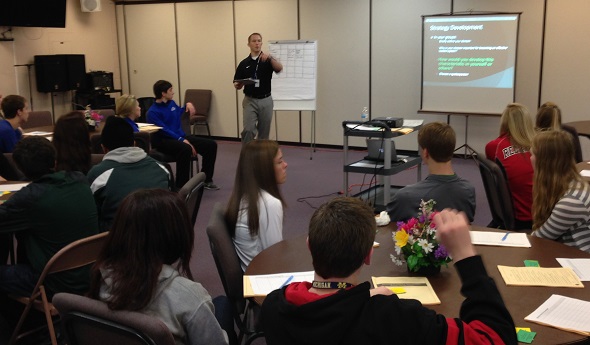
Frushour spearheads the student-based programs at the MHSAA with assistance from Andi Osters and Paige Winne. Among the first ISYS students to work with the MHSAA were Dana Voelker and Jed Blanton, who helped conceptualize the Captains Clinics curriculum. Today at the clinics, ISYS graduate students lead one-day seminars that provide student-athletes with insight on how to understand themselves as leaders, build key leadership skills and handle tough situations on their teams.
Currently, Westfall and Scott Pierce are the ISYS members providing their time and expertise with the MHSAA Student Advisory Council, Captains Clinics, and a new Online Captains Course set to debut this school year.
The Course is student-driven, with two SAC members serving as the faces of the program. Such peer delivery is vital to delivering the messages.
“Students often view leadership from teachers, coaches and administrators as regular, everyday activity. While adults are highly respected figures, students often see adults as outsiders who do not fully understand what it is like to walk a mile in their shoes,” Westfall said.
“The power is rooted in the peer-to-peer relationships and mutual empathy, as student-athletes are very close in age. Student-based leadership is often held with higher validity because the student leader is likely experiencing many of the same adversities and temptations as the peers on his or her team.”
Adding value and credence to the opinions of the ISYS staff is the fact they are steeped in research. The ISYS can gear its efforts to surveys and field studies that the MHSAA, due to staff constraints, cannot. It’s what the ISYS does; it’s the forte of its staff, and the findings help to shape CAP, the SAC and Captains Clinics.
“Research tells us that when kids get to middle school and high school, peer comparison has a really strong influence on how students and student-athletes act and behave,” said Pierce. “Based on this, we believe that student leaders can, and do, act as important role models on the field and in the classroom.
“It is not always easy for students to stand up as leaders because often times this means standing up and being different. So while student-based leadership is vitally important, it doesn't happen automatically. It needs to be talked about and developed over time.”
The MHSAA Captains Clinics and upcoming online course, it is believed, are examples of programs which can develop leaders.
“One of the leadership quotes we used in Tier 1 of the online student leadership course is from Vince Lombardi. It states: ‘Leaders are made, they are not born. They are made by hard effort, which is the price which all of us must pay to achieve any goal that is worthwhile,’” said Westfall. “This type of sentiment, combined with the joint belief between the ISYS and the MHSAA that leadership skills can be taught and cultivated, leads us to believe that leadership can be developed in an individual.”
Through such development, real inroads can be made to promote sportsmanship, teamwork and citizenship in school sports. It’s a worthwhile endeavor for participants, both attendee and instructor.
“Our staff finds the MHSAA Captains Clinics to be some of the most enjoyable and rewarding work that we do,” Pierce said. “The events focus on building leadership in the student-athletes, and give us (ISYS) an ideal opportunity to put our research and scientific knowledge into practice with the students and have a lot of fun doing so.”
Throughout the year, Frushour works with schools and conferences to schedule dates and locations for the clinics. For each day-long clinic, three to five ISYS staff lead a series of workshops for high school student-athletes. The workshops focus on building the four key pillars of leadership – motivation, communication, positive peer-modeling and team cohesion – and have the students involved in discussions, group activities, journaling and role plays.
“We are always trying to find new ways to integrate the new knowledge that we acquire about leadership and trying to reach as many students as possible,” said Pierce, alluding to the forthcoming Online Captains Course. “The online course aims to build off the great things the MHSAA and the ISYS have done with the Captains Clinics.”
A tremendous amount of enthusiasm surrounds the project, and for good reason. The track record of the MHSAA-ISYS partnership reflects a successful venture that might just be hitting stride.
“Over the past 15 years, the relationship between the ISYS and the MHSAA has blossomed. It is to the credit of the forward-thinking MHSAA staff members along with the ISYS faculty and graduate students that this relationship is stronger than ever,” Westfall said. “With the arrival of Dr. Karl Erickson to the ISYS this fall, the upcoming MHSAA coaching requirements for CAP courses, and the launch of the Online Captains Course, the future looks bright for the ISYS-MHSAA team.”
PHOTO: Scott Westfall from the Institute for the Study of Youth Sports conducts a Captains Clinic session as part of his work with the MHSAA.
Scholars and Athletes 2013: Class A
By
Geoff Kimmerly
MHSAA.com senior editor
February 19, 2013
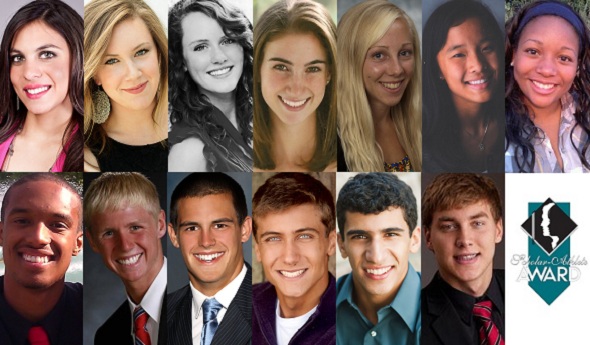
The Michigan High School Athletic Association has selected 13 student-athletes from Class A member schools to receive scholarships through its Scholar-Athlete Award program.
Farm Bureau Insurance, in its 24th year of sponsoring the award, will give a $1,000 college scholarship to 32 individuals who represent their member school in at least one sport in which the Association sponsors a postseason tournament. The first 30 scholarships are awarded proportionately by school classification and the number of student-athletes involved in those classes; also, there are two at-large honorees which can come from any classification. Of Class A honorees, seven are girls and six are boys – with the seventh girl an at-large selection.
Each scholarship recipient will be honored during a halftime ceremony at the Class C Boys Basketball Final game March 23 at the Breslin Student Events Center in East Lansing. Commemorative medallions will be given to other finalists in recognition of their accomplishments.
The Class A Scholar-Athlete Award honorees are: Lara Fawaz, Dearborn; Kayla Giese, Macomb Dakota; Kristin Nicole Green, Saline; Kelly Hall, Saline; Brooke Kovacic, Oxford; Teresa LaForest, St. Joseph; Reinie Thomas, Portage Central; Marcus Barnett, St. Clair Shores Lake Shore; Connor James Bos, Holland; Bryan Condra, Hartland; Kalvis Hornburg, Traverse City Central; Jeremy Simon, Richland Gull Lake; and Adam Whitener, Saline.
Overviews of the scholarship recipients of the Class A Scholar-Athlete Award follow. A quote from each recipient's essay also is included:
Lara Fawaz, Dearborn. Four-year letterwinner in Basketball and Tennis, served at team captain and captured all-league and academic all-league honors in both sports. Has played doubles on Dearborn tennis team which has qualified for MHSAA Finals the past three years. Four-year participant in Key Club, Arabic Club and Sadr Foundation USA. Has served as student government vice president for two years, and as an officer for National Honor Society and Arabic Club. Helped launch a book drive for Oakwood Center for Exception Families, which garnered over 500 books. Has also been a tutor. Plans neuroscience studies at the University of Michigan.
Essay Quote – “Those who lose and start to cause trouble with their opponents, do not only lose, but also undermine the respectable system of the game. Sometimes you lose and others you win, but how you react to a certain loss or win is what will define you as an athlete.”
Kayla Giese, Macomb Dakota. In four years on swimming team, was team captain, most valuable, all-county and league all-academic. Helped lead squad to back-to-back conference championships. Also lettered twice in track, earning all-county and league all-academic on teams which won league and county championships. Served as vice president of student government and National Honor Society, and was class secretary. Delegate to Michigan Association of Student Councils & Honor Societies. Active in Key Club and Be The Change at Dakota High School, and has performed numerous hours of community service. Will attend Michigan State University, studying cellular and molecular biology.
Essay Quote – “I have evolved as a sportsman, as well as a leader. I have flourished and succeeded through this development of sportsmanship. It has allowed me to expand my leadership skills as my teammates admire the encouragement and support I provide for them.”
Kristin Nicole Green, Saline. Will letter for four seasons in both cross country in track. Earned all-conference, academic all-conference and league sportsmanship awards. Captain of both cross country and track teams as a senior. Medaled at MHSAA Lower Peninsula Track & Field Finals twice as part of relay teams. Also earned all-conference and academic all-conference honors in track. Organized effort by cross country team to provide Christmas for local family. Youth soccer referee and a certified swimming lifeguard. Part of Link Crew at Saline, which helps freshmen transition into high school. Plans to major in marketing and psychology at the University of Michigan.
Essay Quote – “When there is no sportsmanship in an athletic event, whether it is a recreational soccer match or the football state championships there is a gaping hole for bitterness, frustration, and even hatred to fill.”
Kelly Hall, Saline. A four-time letterwinner in cross country, and also earned three letters in track. Received hardest worker award as a senior. Received league all-academic award each year in cross country and track. Recipient of school’s Coach Mike Smith Scholarship for sportsmanship, leadership and character. Has been an officer with National Honor Society, Saline Youth Council and Interact Club. Has played violin in school symphony orchestra. Selected Homecoming Queen in 2012. Received INTERACT Award three times. Volunteer work ranges from food bank to youth membership. Will attend either the University of Michigan or Yale University to study informatics and epidemiology and eventually pursue an MBA degree.
Essay Quote – “It may sound like a cliché, but I truly believe that the lessons learned every day in practice are as important as those learned in the classroom. One of the most important of these lessons is sportsmanship, and I’m blessed to have a coach who recognizes this. He has instilled in us values and respect and modesty, reminding us often ‘Humble when you win, gracious when you lose.’”
Brooke Kovacic, Oxford. Served as team captain of cross country squad for the past three seasons, as well as the past two seasons in track. Will win four varsity letters in each sport. Medaled at MHSAA Division 1 Lower Peninsula Cross Country Finals all four years, finishing fourth as a junior, sixth as a senior. Team most valuable and all-league four times. Academic all-state honoree. On the track, also earned all-state, all league and all-country awards. Played clarinet in concert band four years. Helps mentor and tutor younger students through Captain’s Club and Link Crew. Member of National Honor Society, and captain of Adventure Club. Plans to study Kinesiology at Michigan State University.
Essay Quote – “These acts and manners that we learn through sports effortlessly carry into our everyday behaviors and transform us into well rounded, caring citizens. Sportsmanship is contagious, and the leadership, discipline, and determination that we learn from competing against others who share these qualities make the experiences all the more beneficial and applicable to life.”
Teresa LaForest, St. Joseph. Performs in cross country in the fall and tennis in the spring, winning seven varsity letters to date. A team captain in cross country, and a Regional Singles champion and all-conference honoree in tennis. Has participated in student government all four years, and served as class treasurer and vice president. Also a member of Key Club, Latin Club and Math Club, and is as an officer in all three groups. Has been a youth tennis instructor and a volunteer with a local soup kitchen and Habitat for Humanity. Engineering will be her course of study at the University of Michigan.
Essay Quote – “The strength of the human spirit will always be tested by challenges, but making choices based on the values of respect, integrity and fairness – the essentials of sportsmanship – brings out the best in all people, athletes and non-athletes alike.”
Reinie Thomas, Portage Central. Will finish high school playing days with 10 varsity letters – four each in basketball and track; and two in volleyball. A team captain in hoops and on the track. Most valuable and most improved in basketball; and also won all-conference honors. Helped organize Pink Out games for American Cancer Society. All-conference performer in the 200-meter dash in track. Elected to leadership positions with National Honor Society and youth councils for Portage and Kalamazoo. Plays the saxophone and piano. Also attends Kalamazoo Area Math & Science Center and competes on computer science team. Active in numerous community volunteer roles. Will continue education at the University of Chicago and study pre-med.
Essay Quote – “Though many times good sportsmanship is overlooked, it is a very valuable piece to every game. The fact that someone is still able to care about someone other than themselves during a contest almost means more than the game itself. After all, it is only a game. I love to win, but what’s a win with a bad attitude and reputation?”
Marcus Barnett, St. Clair Shores Lake Shore. Three-sport athlete, winning four letters in soccer and track and field, and three in basketball. All-state and academic all-state in soccer, and was team captain as a senior. Won all-academic awards three straight years in basketball and track and field. Was team captain in track and field, and a qualifier for the MHSAA Lower Peninsula Finals first three years in school. Involved for four years in Principals & Leadership. Treasurer in National Honor Society. Took part in Chinese Foreign Cultural Exchange Program and Lake Shore Chinese/American Student Summit. Member of Goodfellows of Madison Heights, and active in church activities. Plans to study engineering at Lawrence Technological University or the University of Michigan.
Essay Quote - “My mother always taught me to treat people the way you would like to be treated. This life lesson is the very same principle I use on the soccer field, basketball court, and the track. I know that in other areas of my life, such as college or my career, I will encounter people who will try to advance themselves by putting others down. In these situations I can fall back on the sportsmanship lessons that I have practices through high school athletics.”
Connor James Bos, Holland. Four-year standout in swimming, qualifying for MHSAA Lower Peninsula Finals each year. Finished sixth in 100-yard backstroke as a junior, and also was part of two relay teams that medaled. Also earned all-conference honors, and was part of winning 400-yard relay team. Spent four years on Student Council, and was class president three times. Member of choir and Fellowship of Christian Athletes throughout high school. Worked for three years on Holland Youth Advisory Council and West Michigan Airport Authority Board. Took part in Boy’s State and Boy’s Nation. Member of church praise band. Will study business and political science in college; considering Hope College, the University of Kentucky, Auburn University and Gardner-Webb University.
Essay Quote – “Too often, our eyes are only on the prize of winning and not the process it takes to really be a ‘winning’ team in all aspects. When I interview for a job, is a first place medal going to define who I am, or will it be my character? You be the judge.”
Bryan Condra, Hartland. Eleven varsity letters – four each in swimming and diving, and track and field; and three in soccer – were earned in prep career. A team captain in swimming and soccer. Three-time academic all-state in the pool, and qualified for MHSAA Lower Peninsula Finals first three years in school. Led soccer team in scoring as junior and garnered most valuable and most improved honors that year. Holds school record in 3,200-meter run in track. Four-year involvement in student government, three as class president. Helped create Be The Change program in school, and anti-bullying campaign. Participated in Bible Club and teaches youngsters at a local church. Has served for two years in program that mentors freshmen students. Plans to attend Grand Valley State University and study business management/finance.
Essay Quote – “I led my team to the understanding that there is more to what we do on the field any given day. The way in which we present ourselves reflects directly on our community and how people from other districts view Hartland. I led them to believe that sportsmanship was the single most important aspect of the game.”
Kalvis Hornburg, Traverse City Central. Skiing, soccer and track and field are his sports. Captured all-state honors in skiing as a junior, finishing second in the slalom. Will earn fourth varsity letter this season. Helped ski team to MHSAA titles as a freshman and sophomore. Team most valuable as a junior and team captain this year. Won all-conference honors three times. Was also a team captain in soccer, and won all-academic honors on three occasions. Chapter officer in National Honor Society. Participated for four years in school choir and advanced Science, Math and Technology Program. Played lead role in two school musicals. Active in local church choir. Plans neuroscience/pre-med studies in college.
Essay Quote – “True sportsmanship lies in building mutual respect, in the cooperative aspects of competition, in finding friendship and camaraderie in shared dedication to something you love. Consequently, sportsmanship transcends the athletic boundary, and has a resounding influence on the way we deal with others in school and the workplace.”
Jeremy Simon, Richland Gull Lake. A standout in cross country and track and field; will finish with four letters in each sport. Two-time team captain in both sports. Won academic all-state in all –conference honors in each. Was team most valuable in cross country as a junior. Won all-state honors as part of medaling relay team at MHSAA Lower Peninsula Track & Field Finals as a sophomore. Four-year member of Student Senate and served as class president three years. Participant in National Honor Society, Spanish Honor Society and Volunteens. Also serves on Superintendents Advisory Committee, as a tutor to other students and as a youth Deacon at his church. Plans to pursue studies in finance or pre-medicine at either Hope College or the University of Michigan.
Essay Quote – “After my experience with Scottie, I grew immensely as a sportsman because I realized the kind of impact my leadership and moral discipline could have on people, and I recognized the evident significance of sportsmanship. I learned to stand firmly for what I believe and for what is right.”
Adam Whitener, Saline. Captained Saline’s swimming and diving team, and will win four letter in the sport this winter. MHSAA Lower Peninsula Division 1 champion in the 100 and 200-Yard Freestyle as sophomore and junior, and swam on winning 400 Free Relay teams both years. Part of winning 200 Freestyle Relay quintet as a freshman and junior. All-conference performer on multiple occasions. Member of Boys Scouts throughout high school, attaining rank of Eagle Scout. Participated in band each year, playing the saxophone, and winning top competition ratings three times. Community service includes Special Olympics, food drives and work with local historical society. Plays with church praise band. Will attend the University of Virginia and study computer science.
Essay Quote – “Jake Englemeier, the captain of the high school team my freshman year is the embodiment of what sportsmanship should be in educational athletics. Jake was most admired by the team for his patience and positive approach as a captain. He never resorted to belittling us lower classmen in practice. Instead, he would use humor and wit to motivate and encourage us.”
Other Class A girls finalists for the Scholar-Athlete Award were: Kristy Allen, East Grand Rapids; Casie Ammerman, Ann Arbor Huron; Jacqueline Burke, Troy; Francesca Ciaramitaro, Grosse Pointe North; Morgan Alexandria Gilliam, North Farmington; Sarah Gutknecht, Farmington; Hailey Hrynewich, Muskegon Mona Shores; Jessica Kalbfleisch, Traverse City West; Jillian Klein, Muskegon Mona Shores; Elizabeth Michno, Macomb L'Anse Creuse North; Kelly Raterink, Zeeland East; Roxanne Raven, Okemos; Kerigan Riley, Livonia Churchill; Haley Schaafsma, Riverview; Carley Serowoky, Waterford Kettering; Kendall Tamler, Birmingham Seaholm; and Lindsay Walter, Saline.
Other Class A boys finalists for the Scholar-Athlete Award were: Andrew Camp, Midland Dow; Jarrod Eaton, St. Johns; Tristan Eggenberger, Okemos; Alex Fauer, Macomb Dakota; Thomas Greidanus, Grand Rapids Christian; Reed Hrynewich, Muskegon Mona Shores; Austin Jones, Bay City Central; Tyler Scott Kemerer, Saginaw Heritage; Anthony Lamus, Saline; Jacob J. Presto, Orchard Lake St. Mary's; Charles Robert Proctor, Bay City Western; David Read, Midland Dow; Harrison Schurr, Jenison; Jonathan Sollish, Berkley; Thomas Spicuzza, Oxford; Jason Vander Horst, Milford; Kevin W. Walsh, Detroit Catholic Central; and Pierce Watson, Lowell.
Previously announced were the scholarship award recipients in Classes B, C and D. The Class B Scholar-Athlete Award honorees are: Ashley M. Carney, Jackson Northwest; Amanda Ciancio, Comstock Park; Mary Emington, Cadillac; Nicole L. Green, Portland; Alec Robert Fisher, Battle Creek Harper Creek; Patrick Gifford, Haslett; Scott Parkinson, Grayling; and Keeton Thayer Ross, Grosse Ile. The Class C Scholar-Athlete Award honorees are: Kylei Ratkowski, Bronson; Grace Smith, Kalamazoo Hackett; Nicole Winter, Watervliet; Jesse Anderson, Union City; Ashwin Fujii, Ann Arbor Greenhills; and Connor Lockman, Royal Oak Shrine. The Class D Scholar-Athlete Award scholarship recipients are: Elyse Kathleen Lisznyai, Hillsdale Academy; Elena Victoria Luce, Mason County Eastern; Charles Barchett, Watervliet Grace Christian; Chip A. Blood, Hillsdale Academy; and Francisco Jay Noyola, Lansing Christian
Farm Bureau Insurance, one of Michigan's major insurers, has a statewide force of more than 400 agents serving more than 380,000 Michigan policyholders. Besides providing life, home, auto, farm, business and retirement insurance, the company also sponsors life-saving, real-time Doppler weather tracking systems in several Michigan communities.