

MHSAA Teams Up for Leadership Training
October 2, 2014
By Rob Kaminski
MHSAA benchmarks editor
Nothing strengthens a community like neighbors working together. The same can be said for organizations whose missions and goals are closely aligned.
Welcome to East Lansing, where the MHSAA and the Michigan State University Institute for the Study of Youth Sports share geographical boundaries and the same philosophies for educational athletics.
The ISYS mission, as stated on its website, is as follows: “The mission of the Institute for the Study of Youth Sports is to provide leadership, scholarship and outreach that ‘transforms’ the face of youth sports in ways that maximize the beneficial physical, psychological, and social effects of participation for children and youth while minimizing detrimental effects.”
That should sound familiar to athletic leaders within the MHSAA.
Key to the relationship between the MHSAA and the ISYS was the hiring of Dan Gould to the MSU faculty in 2004. Director of the ISYS, he helped to facilitate one of the first major initiatives between the ISYS and the MHSAA, which was to revamp the coaches education program, replacing the PACE program with the Coaches Advancement Program (CAP). Dr. Larry Lauer of the ISYS was heavily involved in creation of the CAP under the direction of MHSAA Assistant Director Kathy Vruggink Westdorp.
At the same time, Dr. Gould also led a study with athletic directors and coaches throughout the state to understand the greatest issues in high school sports. Additionally, to continue the ISYS mission to disseminate research findings, Dr. Marty Ewing, Dr. Gould, and a number of the ISYS graduate students have been presenters at the MHSAA Women in Sport Leadership Conference.
Such services have now become a natural fit into the development of the MHSAA’s student leadership programs, providing huge dividends to those in the ISYS program and the MHSAA.
“The mutually beneficial relationship led to a joint project to enhance student-athlete development with a specific focus on leadership development,” said Scott Westfall, one of two ISYS graduate students who work closely with MHSAA Director of Brand Management Andy Frushour.
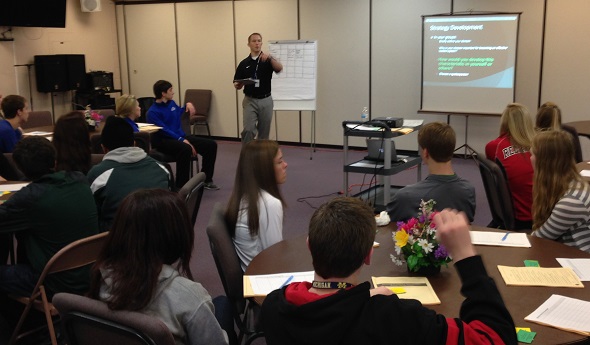
Frushour spearheads the student-based programs at the MHSAA with assistance from Andi Osters and Paige Winne. Among the first ISYS students to work with the MHSAA were Dana Voelker and Jed Blanton, who helped conceptualize the Captains Clinics curriculum. Today at the clinics, ISYS graduate students lead one-day seminars that provide student-athletes with insight on how to understand themselves as leaders, build key leadership skills and handle tough situations on their teams.
Currently, Westfall and Scott Pierce are the ISYS members providing their time and expertise with the MHSAA Student Advisory Council, Captains Clinics, and a new Online Captains Course set to debut this school year.
The Course is student-driven, with two SAC members serving as the faces of the program. Such peer delivery is vital to delivering the messages.
“Students often view leadership from teachers, coaches and administrators as regular, everyday activity. While adults are highly respected figures, students often see adults as outsiders who do not fully understand what it is like to walk a mile in their shoes,” Westfall said.
“The power is rooted in the peer-to-peer relationships and mutual empathy, as student-athletes are very close in age. Student-based leadership is often held with higher validity because the student leader is likely experiencing many of the same adversities and temptations as the peers on his or her team.”
Adding value and credence to the opinions of the ISYS staff is the fact they are steeped in research. The ISYS can gear its efforts to surveys and field studies that the MHSAA, due to staff constraints, cannot. It’s what the ISYS does; it’s the forte of its staff, and the findings help to shape CAP, the SAC and Captains Clinics.
“Research tells us that when kids get to middle school and high school, peer comparison has a really strong influence on how students and student-athletes act and behave,” said Pierce. “Based on this, we believe that student leaders can, and do, act as important role models on the field and in the classroom.
“It is not always easy for students to stand up as leaders because often times this means standing up and being different. So while student-based leadership is vitally important, it doesn't happen automatically. It needs to be talked about and developed over time.”
The MHSAA Captains Clinics and upcoming online course, it is believed, are examples of programs which can develop leaders.
“One of the leadership quotes we used in Tier 1 of the online student leadership course is from Vince Lombardi. It states: ‘Leaders are made, they are not born. They are made by hard effort, which is the price which all of us must pay to achieve any goal that is worthwhile,’” said Westfall. “This type of sentiment, combined with the joint belief between the ISYS and the MHSAA that leadership skills can be taught and cultivated, leads us to believe that leadership can be developed in an individual.”
Through such development, real inroads can be made to promote sportsmanship, teamwork and citizenship in school sports. It’s a worthwhile endeavor for participants, both attendee and instructor.
“Our staff finds the MHSAA Captains Clinics to be some of the most enjoyable and rewarding work that we do,” Pierce said. “The events focus on building leadership in the student-athletes, and give us (ISYS) an ideal opportunity to put our research and scientific knowledge into practice with the students and have a lot of fun doing so.”
Throughout the year, Frushour works with schools and conferences to schedule dates and locations for the clinics. For each day-long clinic, three to five ISYS staff lead a series of workshops for high school student-athletes. The workshops focus on building the four key pillars of leadership – motivation, communication, positive peer-modeling and team cohesion – and have the students involved in discussions, group activities, journaling and role plays.
“We are always trying to find new ways to integrate the new knowledge that we acquire about leadership and trying to reach as many students as possible,” said Pierce, alluding to the forthcoming Online Captains Course. “The online course aims to build off the great things the MHSAA and the ISYS have done with the Captains Clinics.”
A tremendous amount of enthusiasm surrounds the project, and for good reason. The track record of the MHSAA-ISYS partnership reflects a successful venture that might just be hitting stride.
“Over the past 15 years, the relationship between the ISYS and the MHSAA has blossomed. It is to the credit of the forward-thinking MHSAA staff members along with the ISYS faculty and graduate students that this relationship is stronger than ever,” Westfall said. “With the arrival of Dr. Karl Erickson to the ISYS this fall, the upcoming MHSAA coaching requirements for CAP courses, and the launch of the Online Captains Course, the future looks bright for the ISYS-MHSAA team.”
PHOTO: Scott Westfall from the Institute for the Study of Youth Sports conducts a Captains Clinic session as part of his work with the MHSAA.
Flashback 100: One Last Look Back as We Turn Focus Toward Future
July 10, 2025
We hope you’ve enjoyed this school year's retrospective on some of the most iconic athletes and personalities who began their journeys in MHSAA sports. While we’ve done our best to highlight a diverse range of individuals across various sports and professions, a single year simply isn’t enough to capture every standout story.
Michigan high schools have produced an incredible array of talent — and the following, in addition to those we've wrote about over the last 10 monrths, are just another glimpse of that legacy:
- Kirk Gibson (Waterford Kettering) – The 1988 National League MVP also played a pivotal role in the Detroit Tigers’ 1984 World Series championship and starred in football as well at Michigan State.
- Jake Long (Lapeer East) – Selected as the NFL’s No. 1 overall draft pick in 2008, he's among a distinguished list of Michigan high school alums to go early in the draft, including Braylon Edwards (Harper Woods Bishop Gallagher, No. 3 in 2005), Carl Banks (Flint Beecher, No. 3 in 1984), Jerome Bettis (Detroit Mackenzie, No. 10 in 1993), and Tyrone Wheatley (Dearborn Heights Robichaud, No. 17 in 1995).
- Jeff Daniels (Chelsea) – Before becoming a renowned actor with credits like The Newsroom, Escanaba in da Moonlight, and Dumb and Dumber, Daniels was a high school baseball player.
- Lisa Byington (Portage Northern) – A trailblazing broadcaster, she serves as the play-by-play voice for the Milwaukee Bucks and regularly appears on CBS during NCAA Basketball Tournaments.
- Kristin Haynie (Mason) – She was first athlete to play in both the NCAA Women’s Division I Basketball Championship and the WNBA Finals in the same calendar year.
- Jalen Rose, Voshon Lenard, and Howard Eisley – This trio of NBA professionals once shared the court at Detroit Southwestern, making it one of the most talent-rich high school teams in state history.
- Jim Abbott (Flint Central) – Born without a right hand, Abbott defied the odds to pitch for 10 seasons in Major League Baseball.
- Earl Morrall (Muskegon) – He was named NFL MVP in 1968 and enjoyed a long and successful pro football career.
- Charlie Gehringer (Fowlerville) and Hal Newhouser (Detroit Wilbur Wright) – Both legends of Major League Baseball, each captured MVP honors during their Hall of Fame careers.
- Kate Markgraf (Detroit Country Day) – A champion at every level of soccer, she earned titles in high school and college, an Olympic Gold Medal, and a FIFA World Cup victory.
- Allison Schmitt (Canton) – One of the most decorated American swimmers of all time, Schmitt has earned 10 Olympic medals.
- Jason Richardson (Saginaw Arthur Hill) and Charles Rogers (Saginaw) – Both were drafted among the top five in their respective college sports (Richardson to the NBA in 2001, Rogers to the NFL in 2003) and faced off against each other as part of one of the state's most historic basketball rivalries.
- Staying with the city of Saginaw, Draymond Green (Saginaw) won a basketball championship in high school (2007) and then four in the NBA (2015, 2017, 2018, 2022) after being drafted in the second round of the 2012 draft by the Golden State Warriors.
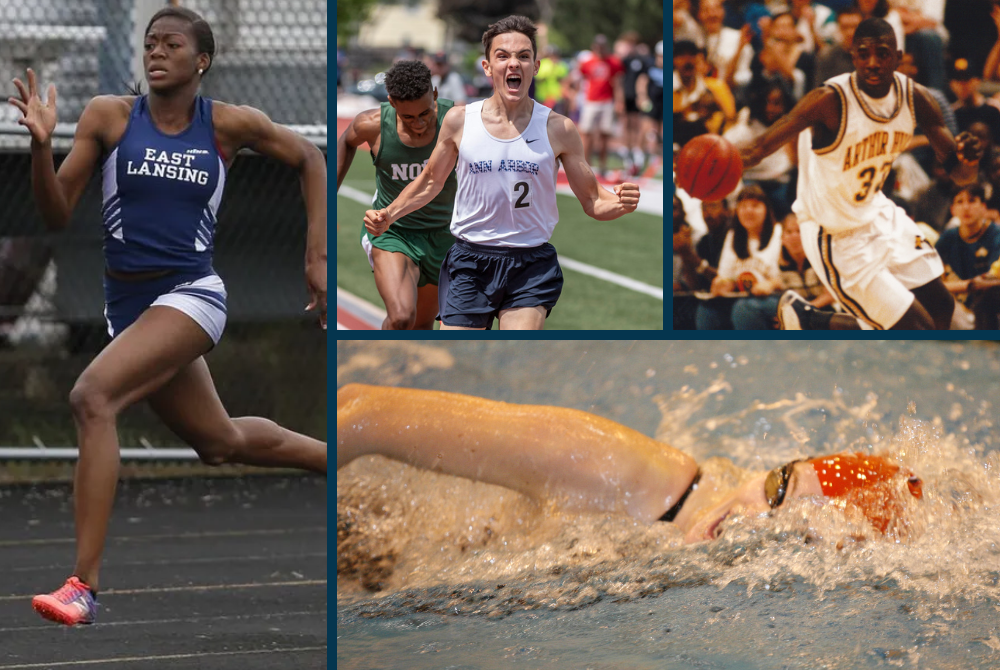
And the legacy continues. Olympic gold medal dreams are alive in track & field standouts like Taylor Manson (East Lansing), Hobbs Kessler (Ann Arbor Skyline), and Grant Fisher (Grand Blanc), who are already well-accomplished on the worldwide stage.
So, who’s next?
Who will be the next MHSAA athlete selected on draft night? Hoisting an MVP trophy? Standing atop the podium as a champion?
We don’t know yet — but as we close the book on the first 100 years of MHSAA history, we can’t wait to see what the next century will bring.
Previous "Flashback 100" Features
June 23: Hutchinson's Dominance Starts as Multi-Sport Divine Child Standout - Read
June 10: Wagner's Dream of Going on Tour Realized - with Greta Van Fleet - Read
May 23: Tarpley's Legendary Run Began as Portage Central's Miss Soccer - Read
May 16: Scane’s Record-Setting Lacrosse Run Began at Cranbrook Kingswood - Read
May 8: Duckett's High School Domination Extended to Shot Put Circle - Read
May 6: MHSAA Titles Just Start for NCAA Champion, Olympian Stark - Read
May 1: Legendary Actor Played Multiple Sports Roles at Country Day - Read
April 23: Legacy Program Provided Start for Pioneering NBA Official Schroeder - Read
April 11: Rice's Championship-Winning Ways Started at Flint Northwestern - Read
March 28: Youngquist's Times Still Among MHSAA's Fastest - Read
March 18: After 40 Years, Coles' Shot Remains Among Century's Most Famous - Read
March 7: Walled Lake Northern's Hellebuyck Reigns as NHL's Elite Netminder - Read
Feb. 27: Zeerip's Mat Stats Remain Rarely-Challenged Chart Toppers - Read
Feb. 21: Before TV Stardom, Kerwin Excelled as All-State Skier - Read
Feb. 14: Detroit Central Star Voted into Pro Football Hall of Fame - Read
Feb. 6: Multi-Sport Star Look Becomes Super Bowl Officiating Legend - Read
Jan. 31: Johnson Family Put Magical Stamp on Michigan High School Hoops - Read
Jan. 24: Future Hall of Famers Face Off First in MHSAA Class A Final - Read
Jan. 17: First-Ever WNBA Draft Pick Rocked at Salem, Won Titles at Tennessee - Read
Jan. 10: Despite Launching Before 3-Point Line, Smith Still Tops Scoring List - Read
Jan. 3: Edison's Jackson Earns Place Among State's All-Time Elite - Read
Dec. 20: Future Olympian Piper Leads Grosse Pointe North to Historic Heights - Read
Dec. 13: The Other Mr. Forsythe in Michigan School Sports - Read
Dec. 6: Coleman's Legendary Heroics Carry Harrison Through Repeat - Read
Nov. 29: Harbaugh Brothers' Football Roots Planted in Part at Pioneer - Read
Nov. 22: 8-Player Football Finals Right at Home at Superior Dome - Read
Nov. 15: Leland Career Helps Set Stage for Glass' International Stardom - Read
Nov. 8: Future Baseball Pro Led Escanaba's Legendary Football Title Run - Read
Nov. 1: Michigan High School Baseball Trio Provide World Series Voices - Read
Oct. 25: Before Leading Free World, Ford Starred for Champion GR South - Read
Oct. 18: Mercy Links Legend Becomes World Golf Hall of Famer - Read
Oct. 11: Fisher Races to Finals Stardom on Way to U.S. Olympic First - Read
Oct. 4: Lalas Leaves High School Legacies on Ice & Pitch - Read
Sept. 27: Tamer's History-Making Run Starts in Dexter, Continues to Paris - Read
Sept. 20: Todd Martin’s Road to Greatness Starts at East Lansing - Read
Sept. 13: James Earl Jones, Dickson High Hoops to Hollywood Legend - Read
Sept. 6: Pioneers' Unstoppable Streak Stretches 9 Seasons - Read
Aug. 30: Detroit dePorres Rushes to 1995 Class CC Football Championship - Read
PHOTOS Clockwise from left: Taylor Manson sprints for East Lansing, Hobbs Kessler wins a race for Ann Arbor Pioneer, Jason Richardson plays in a Class A Basketball Final for Saginaw Arthur Hill and Allison Schmitt swims a championship race for Canton. (Manson photo courtesy of the Lansing State Journal; Kessler photo by RunMichigan.com. Others are MHSAA file photos.)