


Online Course Trains Leaders Nationwide
By
Geoff Kimmerly
MHSAA.com senior editor
August 11, 2015
By Geoff Kimmerly
Second Half editor
The valuable lessons student leaders have received over the last decade during Captains Clinics presented statewide by Michigan High School Athletic Association staff are now available to students nationwide and beyond as part of an online Captains Course produced by the MHSAA and available from the National Federation of State High School Associations on its Learning Center website.
The Captains Course, created over two years with assistance from Michigan State University’s Institute for the Study of Youth Sports (ISYS), is broken into 10 segments providing instruction on leadership styles and skills to how to handle situations faced by leaders of teams in any sport. A total of 20 past members of the MHSAA Student Advisory Council speak during the program, providing peer-to-peer guidance that has proven effective in student leadership campaigns.
The online Captains Course has been started 2,881 times since its release in July, including 802 times during the first 10 days of this month. The first MHSAA Captains Clinic was conducted in March 2005, and clinics are presented in person on a league-by-league basis to approximately 1,000 students each school year.
The online Captains Course is free and can be downloaded after an account is created on the NFHS Learning Center website at http://www.nfhslearn.com.
“Many student-athletes have characteristics that allow them to become leaders, but rarely do they receive lessons in how to be an effective team captain; this has been the goal of our Captains Clinics and is the aim of this Captains Course,” said MHSAA assistant director Andy Frushour, who coordinates the association’s student services programs and advises the Student Advisory Council. “Our in-person Captains Clinics are still a great way to deliver leadership lessons and to get students from rival schools to interact with each other in a fun and worthwhile way. But we can only do so many in-person clinics per year.
“With the online version, we can deliver the same message, albeit through a different format. And we can do it 24 hours a day, at the user’s convenience, using a medium that kids use like the rest of us use oxygen, and potentially delivering our captains message to exponentially more students than the in-person version; even to students outside of Michigan.”
The online Captains Course is an introductory program, with plans for two more advanced leadership courses that will be facilitated online but with activities and discussions to take place offline in local communities. The goal for the “hands-on” portion of later training courses will be for leaders to conduct interviews with coaches and administrators, write short answers and interact with teammates for a more transformational learning experience.
The first course is made up of 10, 10-minute segments, and takes about two hours to complete – but is meant to be completed over multiple days. The short “bite-sized” segments make it easier for students to digest all of the information being given to them, and are based on research by the Institute for the Study of Youth Sports. Doctoral students working with the institute serve as instructors during Captains Clinics.
The Captains Course is hosted by recent high school graduates Caycee Turczyn of Lapeer High School and Connor Thomas of Marlette. Both were two-year members of the Student Advisory Council; Turczyn will begin studies this fall at the University of Michigan, while Thomas will start at Oakland University.
“All of the lessons are based on research conducted by MSU’s Institute for the Study of Youth Sports,” Frushour said. “Dr. Dan Gould and his doctoral students are rock stars in the field of youth and leadership development, and we are lucky to have them as partners on this project “
The Institute for the Study of Youth Sports was launched in 1978 to establish a world-class institute that would scientifically study the beneficial and detrimental effects of sports participation on children and youth and then work to maximize the beneficial effects. The mission of the Institute for the Study of Youth Sports is to provide leadership, scholarship and outreach that transforms the face of youth sports in ways that maximize the beneficial physical, psychological, and social effects of participation for children and youth while minimizing detrimental effects.
The Student Advisory Council is a 16-member group which provides feedback on issues impacting educational athletics from a student’s perspective, and also is involved in the operation of MHSAA championship events and other programming. Members of the Student Advisory Council serve for two years, beginning as juniors. Eight new members are selected annually to serve on the SAC, with nominations made by MHSAA member schools.
The MHSAA is a private, not-for-profit corporation of voluntary membership by more than 1,400 public and private senior high schools and junior high/middle schools which exists to develop common rules for athletic eligibility and competition. No government funds or tax dollars support the MHSAA, which was the first such association nationally to not accept membership dues or tournament entry fees from schools. Member schools which enforce these rules are permitted to participate in MHSAA tournaments, which attract more than 1.4 million spectators each year.
PHOTO: Lapeer's Caycee Turczyn and Marlette's Connor Thomas host the online Captains Course, with this segment shot at DeWitt High School.
Yale Kohler's Krazies Rise to Roar
January 27, 2015
By Geoff Kimmerly
Second Half editor
YALE – The magnitude of last season’s Boys Basketball District Final gave Yale’s “Kohler's Krazies” a glimpse of their potential as a booming student cheering section.
But a 90-minute delay during that eventual overtime loss to Imlay City showed junior Karli Klocke how a collection of her classmates watching a basketball game could impact their entire school.
 The game was forced into an unexpected break after humidity in the gym made the floor too slippery. The teams went to their locker rooms during clean-up, and many of the 1,000 fans in the sold-out stands took their seats.
And despite the wait, all of more than 100 Krazies stayed through the final buzzer.
“I just like how it brought everybody, all grades, together,” Klocke said. “And during that hour and a half, we were all sitting there together. We’ve never been a group that’s usually been all together.”
Ten months later, the Krazies have ridden the momentum of that March evening – and grown into a top-five contender for this season’s Battle of the Fans IV championship.
Yale hosted the latest MHSAA finalists visit Friday for its boys basketball game against Almont. Reigning champion Beaverton was the first tour stop, Jan. 16, with Buchanan scheduled for this Friday and then St. Johns and Dowagiac over the next three weeks leading up to the naming of this year’s champion Feb. 20. The public may vote for its favorite on the MHSAA’s Facebook, Twitter and Instagram sites beginning Feb. 17, with the MHSAA Student Advisory Council taking results into consideration when selecting the champion after the vote has concluded.
The Krazies were first-time BOTF applicants this winter, following the transformation of a section that existed on a much smaller and informal scale over the last half-decade.
The former Kohler’s Kids, then Kohler’s Krew and Krew 2.0 before becoming the Krazies for 2013-14 – all in recognition of boys hoops coach Garnett Kohler – previously was a group of 20-40 upperclassmen who gathered to cheer on the team.
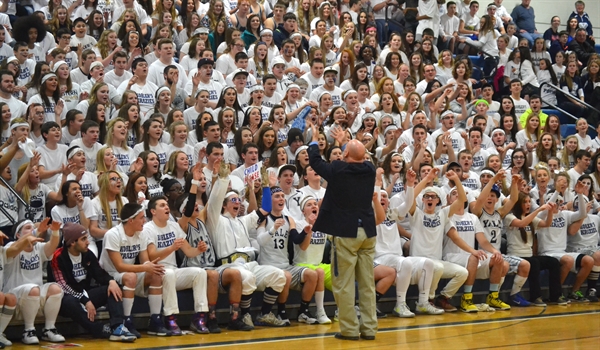
With last season’s District turnout helping fuel the effort, new section leaders this fall began organizing a section that would be more inclusive – encouraging the entire student body to take part – and have enjoyed immediate results. The Krazies swelled to an estimated 450 and filled a quarter of Yale’s gym to the rafters for Friday's girls and boys hoops doubleheader.
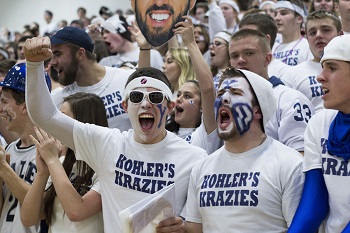 There hasn’t been anything complicated about Yale’s campaign; it’s as simple as trying to get more students to watch games together. And the Krazies have a rather straightforward goal for each game night; they don't stop cheering, aside from halftime, from the opening tip until the final buzzer – even when Yale's lead tops 20 points.
“This is such a new thing, everybody’s so excited about it and they just want to be a part of it,” junior Kaylee Schiffelbine said.
The Krazies took steps toward formalizing last season, when a group of four seniors sold T-shirts and created some of the favorite cheers. But their vision for the section was “small,” senior Spencer French said, and he and a few others began talking over the summer about how to expand it.
For starters, the section would no longer be about juniors and seniors only. Over two weeks this fall, the Krazies sold 210 section T-shirts – three times more than the year before. They started Facebook and Twitter feeds to get the word out, and parents joined in the social media loop; the Krazies’ BOTF application video enjoyed more than 1,000 views in just a few days after it was posted and now has been watched more than 5,000 times.
“Even with the video, (we thought) it would be cool to get top five (of BOTF),” senior Robert Vinckier said, “but getting the video shared around, it gets more people in the game, and they see how fun it is.
“We’re such good friends with the players on the team, so we’d go to the game whether we had a student section or not. But we might as well have more fun while we’re watching them play.”
The section’s rallying cry for 2013-14 could’ve been summed up as “wear your shirt and show up.”
“Wear your shirt and show up” should now include the word “early.” Although the girls varsity game Friday didn’t begin until 6 p.m., the first Krazies showed at 4:30 to secure seats closest to midcourt and the floor.
And the Krazies are a basketball cheering section in the literal sense. They cheered, nearly non-stop, through the end of a mostly one-sided 68-46 win by their boys team. Of course, they mixed some creative frills – bowling using the Bulldog mascot to knock down a group of fans, and the first superintendent-led roller coaster in BOTF tour history – but those merely kept the mood amped during breaks in play.
The objective is simple as well – be loud. Loud enough that an opposing player tweets that the section is “crazy.” Loud enough to encourage a rumor the Krazies won’t be allowed to cheer at a rival’s gym later this season. Loud enough to force an opponent’s point guard to motion to his bench because he can’t hear his coach yelling in the plays. Loud enough that Yale’s coach and players also had to come up with hand signals so they could communicate over the blare.
“Loud” would’ve been an understatement Friday. The Krazies’ roar, heard standing on the opposite side of Yale’s gym, registered noticeable decibels above the norm for a high school game.
French admits he didn’t know what they were taking on when he and a group of about 10 began meeting twice a week in late October armed only with ideas and what senior Steven Jordan calls “unwritten rules of sportsmanship.” But they forged strong relationships with principal Paul Flynn and athletic director Maureen Klocke (no relation to Karli), who have provided plenty of input while trusting the leaders to police the group when it’s rarely necessary. Leaders run ideas past administrators first, and that has allowed for what leaders feel is a bit more leniency.
Their classmates, meanwhile, have followed the lead and made good on last year’s potential.
“In high school, there are groups. Some groups aren’t going to be there (at games),” French said. “But it’s those kids who are coming out and saying, ‘Hey, what can we do? Can we do this? Are we wearing this? Can we do a costume night?’ That’s been the coolest thing for me. There’s people that I would never think would go to a basketball game, and they come up to me and say, ‘Hey, what can I do to help?’”
Spencer admits he was a bit anxious before the first boys basketball game this winter – until 115 students showed. The school’s athletic booster club has since donated $100 for gift cards to give out as prizes, and the student council supplied a sling shot Friday to send free shirts into the crowd.
“When we started off this year, a lot of people didn’t think it would be that big of a deal; it would just be another student section,” he said. “But as we’ve progressed throughout the season, people realized this is a big deal.
“We weren’t that tight-knit beforehand. Slowly but surely as the season has progressed, the parents, student organizations and administration all have been brought closer together. And we’re not even halfway through the season yet.”
PHOTOS: (Top) Yale superintendent Ken Nicholl leads the roller coaster during Yale's boys basketball game Friday against Almont. (Middle) Kohler's Krazies cheer numbered 450 for the MHSAA visit. (Top photo by Lisa Depelsmaeker, middle by Katie Priehs.)