


SAC Sound-Off: Don't Forget Those Underdogs
October 1, 2012
 By Madeleine Martindale
Lake Orion junior
At any sporting event, the superstars are the ones who draw us in. In track and field, the winning athletes keep the crowd roaring with pride as they pull ahead and cross the finish line first.
Meanwhile, the runners behind them receive only the periodic courtesy clap.
But, just like in the story of the rabbit and the hare, it’s the underdog athlete with the will to improve who can sneak up from behind and unexpectedly become a winning force – and can benefit most from your encouragement as you cheer from the stands above.
This is a story about my friend Corey, who was just that underdog. She is a solid athlete, but she was not the favorite to win her sprint events. Her ambition and positive attitude clearly stood out, though.
As a freshman, she had several spills caused by clipping the hurdles, and lived through her fair share of other embarrassing finishes too. Having a great family support system as well as teammates who believed success is small accomplishments strung together, Corey was unwilling to give up. She set her mind to improve her performance one day at a time.
Corey knew performing at a higher level was going to take commitment beyond the time limits of track season. She set goals, developed a plan and began working on it. Every day Corey would work extremely hard at practice. During the summer, she could be found at the track almost daily. She spoke her goals out loud and shifted her thoughts from “I might” to “I can” and “I will.” She continually clocked her times and pushed herself to reduce her best by one millisecond each time she ran.
The coach stepped in to monitor her progress too. He was willing to devote extra time to her since she had taken such initiative to improve. Anyone who paid attention to her work ethic knew Corey was going to achieve her goals. Also, it seemed certain the whole team would improve through Corey. If we wanted a chance at winning, we would have to increase our own training to keep ahead of her.
When track season arrived, Corey was ready. Her competitors were a little rusty from the winter, but they were still expected to finish ahead of her. I stood on the sideline and cheered for my team, but I was especially loud for Corey – who nervously anticipated her first race.
From the start, it was clear Corey’s efforts were paying off, and she was moving to the front of the pack. I ran down the sideline screaming for her to push a little harder and prove to herself she could do it. You could see the determination on her face and complete focus on getting to the finish line first. She had prepared for this, and it was clear she was not going to be defeated without giving her best fight.
She was winning … She won!
Her perseverance paid off and the cheers were all hers. Except for one.
The voice of one bad attitude came from the stands and made its way to the field. It angered those of us who heard it. It was from a parent who was less than happy that her daughter lost the race to “her” (Corey). As unkind as we felt it was to her daughter, who is a talented, hard-working athlete, it was equally unfair to Corey. We interpreted the inflection as the loss was a measure of poor performance rather than appreciation of Corey’s increased ability. Corey worked hard to produce such a notable performance, and deserved respect for this honorable win.
It doesn’t matter what sport you’re supporting; don’t limit your cheers to the superstar. Cheer louder for those underdogs. They dismiss their fears of failure and publicly face the challenge, falling often – which is harder to deal with the older we get. It’s this courageous attitude that should be encouraged, because it is the lesson that develops leaders in life. I feel it’s all of our responsibilities to foster their ambitions through positive encouragement and behaving respectfully when they finally reach their goals.
We cannot all be the superstar athletes you come to watch; but your support might keep us from giving up. After all, the moment you choose to sit in the stands is the moment you are an extension of our team. As such, we expect you to cheer on all of us like we do each other – not just the winners. Not just your daughters, sons or friends. Cheer for all of us as if we’re almost in first, with the finish line before us.
Madeleine Martindale, Lake Orion junior
- Sports: Track and Field (pole vault/sprints), competitive and sideline cheer
- Non-sports activities: Martindale created Our Hope Project, a service club she manages with other students from her school; also: bicycling, gymnastics, snowboarding.
- Favorite classes: Chemistry and Team Sports
- What's next: Martindale would like to continue her track and field at a university with a strong pole vault coach. She plans to study education in hopes of becoming a teacher and track and field coach while also continuing to work and mentor in her community.
- Shining sports moments: Setting Lake Orion's pole vault record, being named team Most Valuable Player as a freshman and qualifying for the MHSAA Final despite a taped ankle and while wearing tennis shoes; Winning the summer Grand Haven Beach Vault with a personal record of 10 feet; Placing fifth with her teammates at last season's Division 1 Cheer Finals.
- Pump-up jam: "It's a Beautiful Day" (U2)
Herd dat? Buchanan Back for BOTF III
January 21, 2014
By Geoff Kimmerly
Second Half editor
BUCHANAN – Andi Frost might be walking the hall between classes with some of her senior friends when a freshman will approach and ask about the next theme night.
Or a quick trip to the gas station could turn into a conversation with locals about what she and her classmates have planned for Friday’s basketball game.
Once, during a trip to a few miles south to Steak & Shake in South Bend, a patron from across the border noticed her “Herd” shirt and asked if she was from Buchanan.
 Plenty of notice has come this small town’s way since “The Herd” student cheering section won last year’s MHSAA Battle of the Fans II. No question, the championship helped some find the small southwestern school on the map – including one Twitter follower who made contact from Nebraska.
The recognition has been fun and the friendly comments from all over the state much appreciated. But the best to come from last year’s formation of The Herd, without doubt, is the sense of togetherness that was cultivated in the bleachers but has infused the entire community.
“The best thing that happened from this whole experience is that it’s even higher than a title now,” Frost said. “It’s our way of life in Buchanan. It’s the whole school, all the teachers, everyone in the community. Grandparents, moms, dads and little brothers; it’s the whole town.
“You sense it in the building; we’re not just a school with different grades. We know everybody now. Everybody has become a big family.”
Buchanan on Friday was the first stop on this season’s Battle of the Fans III finalists tour. MHSAA staff and Student Advisory Council members will visit Beaverton, Bridgman, Frankfort and Traverse City West for home games later this month and during the first two weeks of February. The winner will be determined by an Advisory Council vote weighted by a public vote on the MHSAA’s Facebook, Twitter and Instagram sites from Feb. 18-20. The champion will be announced Feb. 21 and recognized March 21 during the Boys Basketball Semifinals at Michigan State’s Breslin Center.
Buchanan’s Herd got its start during an MHSAA Sportsmanship Summit during fall 2012 after a presentation on the benefits of a positive, fun student cheering section and the Battle of the Fans contest in particular.
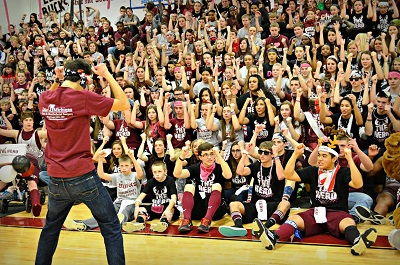 Section leaders and teacher “shepherds” did some quick work to make The Herd formidable – and start the ball rolling toward a culture change in the school and a new unity felt throughout the town of roughly 4,500 residents.
This school year, The Herd came back – and this time much more organized.
Nearly 40 students showed up for the section’s first meeting last spring as it looked ahead to 2013-14. A group of roughly 60 – or 13 percent of the student body – came to another planning meeting over the summer.
Leaders of the section realized early that with so much interest, organization would be key. They split their classmates into small groups and gave each a task – coming up with theme night ideas, new cheers or planning pep rallies or “traveling pep rallies” to the middle and elementary schools.
What emerged was a fall schedule that included plans for attending not only home football games, but also Herd gatherings at volleyball and soccer games and a cross country race. The section has a full line-up for its home basketball games, both boys and girls, including individual cheers for every player and 22 cheers/chants/dances to break out during time-outs.
“We’ve made such a big deal out of all of this, there’s such good positivity everywhere, and everyone just loves it. So we definitely want to keep it as a tradition,” said junior Ellie Hurd, also a section leader last year as a sophomore.
One of the reigning champ’s biggest challenges this fall was coming up with fresh material to blend in with some that leaders wanted to carry over from the section’s inaugural season.
Last year’s favorites are mixed with versions of more recently popular “Timber” and “Wrecking Ball.” Pregame introductions are still lights-out with Herd members providing cell phone spotlights. And the Herd continues to sing the national anthem before games, on this night with Frost on the microphone leading the crowd.
Perhaps the most compelling part of Buchanan’s victory story in 2013 centered on one of the section’s main motivations – the untimely death the summer before of classmate Dilan Shearer. Another challenge this past summer was deciding how best to continue on while keeping intact the togetherness that sad event helped create.
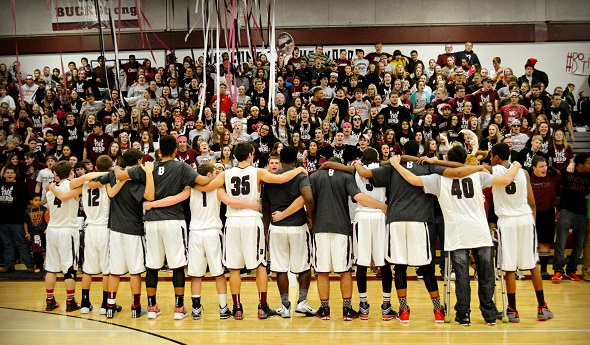
Similar to last season – when the section finished game nights by singing Shearer’s favorite song, “Springsteen” – every home night this winter ends with another community song – Jason Aldean’s “Tattoos On This Town.”
“Last year we had all of that positive energy taking something bad, some sadness, and we turned it into something better,” Martinez said. “This year, we turned what we did last year, all of the good things that happened, and made it into something more.”
The Herd isn’t just about showing up strong at games. They’re frequently called to show up at events in the community and have used their powers of influence to help their neighbors – raising roughly $1,300 plus clothing donations after a local apartment fire and a few thousand dollars to assist community supporter Don Ross, who died Thursday after suffering from Lou Gehrig’s Disease.
“‘It’s left our mark on us, and we’ve left our mark on it,’ and that’s what we’ve done,” Frost said, referring to a favorite lyric from Aldean’s song.
“We’ve built everlasting memories,” Martinez added, “just by all of the stuff we’ve done with The Herd.”
Filling the stands for every home varsity hoops game meant five nights of basketball last week. But the Herd showed en masse, and it’s fair to believe made a difference – the boys team in particular hasn’t lost a home game since the first of 2012-13 and came back from 20 points down to beat a rival earlier this season.
When senior A.J. Reed’s seventh grade brother told A.J. he was considering leading The Herd in high school instead of playing basketball, A.J. was stunned (and told his brother to stick with his sport). But in just over a year, the section has established that level of presence within the school.
“Traditional high schools, you think about if they have a good football team or a good basketball team every year,” said Reed, who like other section leaders plays at least one sport. “I think when a lot of people think of us, now recently, they’ve thought of the student section. It’s almost like a sport to us. We are a team.”
Battle of the Fans III is sponsored in part by the United Dairy Industry of Michigan.
PHOTOS: (Top) Buchanan's "Herd" and its boys basketball team gather for "Tattoos On This Town" after Friday's win over Niles Brandywine. (Middle) Members of the student section lock in for a rollercoaster ride during halftime Friday. (Photos courtesy of Jessica Cornelius.)