


SAC Sound-off: It’s not about Perfection
April 25, 2012
 “Practice makes perfect” is just one of the many phrases that inspire one to work harder toward the goal of obtaining perfection.
Though these words may be used to inspire perfection, that is not their true purpose. Perfection doesn’t exist, but the inspiration to reach for higher goals does.
My senior year opened my eyes up to the actualization that trying to be perfect was not what sports had been teaching me all along. What I was meant to take from them were the valuable lessons of dedication, drive, teamwork, and communicating skills.
High school sports are more than a tool for athletic development. They are a medium for creating mentally-strong people who can execute in difficult situations faced later in life. Not that one may perform perfectly in these hypothetical situations, but that one may be able to handle situations that require thinking outside of the box.
How great it would be for all student-athletes to know and realize these secrets – because for the ones that feel the pressure to be perfect, it may be a much-needed relief.
I have strived to be the best I can be, and I have achieved success by doing so. However, with that success came pressure to be perfect in an athletic sense.
My junior year I was named all-state in basketball and I won the MHSAA Division 4 discus championship. Negative comments from others during my senior year about my basketball games or field events in track used to make me feel insignificant and insecure. That was before I realized I have achieved great heights and I will continue to raise my pinnacle as long as I stay positive.
I will never be absolutely perfect; I’m only human, and the best anyone can do is try his or her hardest to never back down from a task at hand.
High school athletics have molded me from a perfection-seeking mess to a confident, realistic, and optimistic person that finally realizes nothing I do in life is about perfection – it is about the climb of simply becoming a stronger person.
What I can strive for in the realm of perfection is a perfect attitude. The contagiousness of a good attitude will not only keep me optimistic, but it can influence others around me to pursue that positive mental toughness that is so often tested in sports.
Lena Madison, New Buffalo, senior
- Sports: Volleyball, basketball, track and field
- Non-sports activities: Student Government, Spanish Honors Society, National Honors Society, Special Olympics and Senior Olympics volunteer
- Must-see TV: "Lost"
- One shining moment: Winning the MHSAA Division 4 championship in discus last spring.
- What's next: My plan for next year is to attend Notre Dame. I will major in pre-medicine and be on the track team.
- My favorite part of game day is: ... right before every game, my team has a dance party. We get our nerves out of our systems by dancing them away!
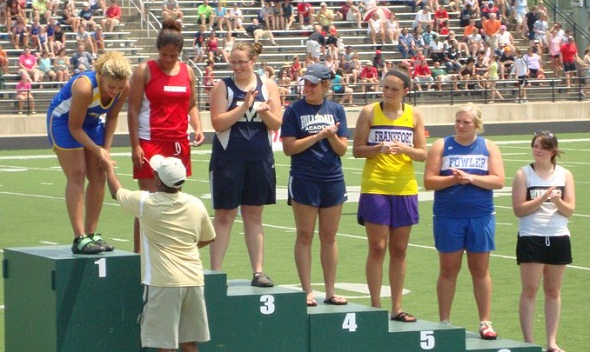
PHOTO: Madison accepts her first-place medal at last season's Division 4 Track and Field Final. (Photo courtesy of Lena Madison.)
SAC Leaders Represent at NFHS Summit
By
Geoff Kimmerly
MHSAA.com senior editor
August 10, 2015
By Geoff Kimmerly
Second Half editor
New members of the MHSAA Student Advisory Council quickly find themselves among new friends from different schools who are similarly motivated to provide valuable leadership to their classmates.
Four SAC seniors were among 100 students at the inaugural National Student Leadership Summit on July 20 in Indianapolis – and again found plenty of common ground with leaders from all over the country also driven to provide strong student voices in their schools and communities.
The event was hosted over three days by the National Federation of State High School Associations. Students were split into discussion groups tackling a variety of topics and also spent time working with Indiana Special Olympians.
Now home, the MHSAA's four representatives – Ben Kowalske of Livonia Stevenson, Bekah Myler of Gaylord St. Mary, Trevor Trierweiler of Portland and Greta Wilker of Belding – reflected briefly on the experience and what they’ll take into this year to pass on both at their schools and to leaders all over Michigan.
What was your first impression of being surrounded by student leaders from all over the country?
Trevor: When I first arrived at the camp I didn't know want to expect; I did not know whether to be nervous, excited or happy. Then when I started being around other leaders with similar personalities, and mindsets, it was easy to be around them and interact with them.
Bekah: My first impression of being surrounded by leaders was that I felt comfortable and secure because I knew everyone around me had the same goal of becoming a better leader.
Ben: At first I was wondering how well all the leaders would mix in during the activities. My first impression was how nice and respectful everyone was.
Greta: I thought it was really cool to see all the leaders from different states and know that we got to be a part of something pretty selective.
What was the most fun part of the trip?
Trevor: I had the most fun during activities with other student leaders, and in the leadership lounge. In the lounge all the student leaders spent time together playing games and enjoying fun activities.
Bekah: Walking to Steak 'n Shake after the dance with my new friends; also hanging out in my room with my roommate who I became good friends with. All in all, I enjoyed meeting new people!
Greta: The most fun part was getting to make friends with kids from across the country and getting to hang out with them for the three days. The late night Steak 'n Shake runs were a lot of fun and just hanging out in the rooms afterwards, just getting to know everyone.
What was the most eye-opening part?
Ben: Not to sound stuck up, but the most eye-opening was how well the MHSAA SAC is doing. Most states don't even have a council, so seeing how much we do and that we have a council unlike most states was eye opening
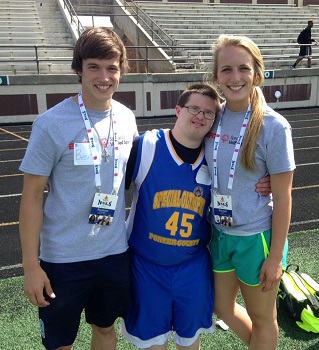 Bekah: The Special Olympics event opened my eyes. I was able to experience something that I never have before. When I play any given game whether it be checkers or basketball, I have a desire to win. But that day, it wasn't about winning or losing. It was about giving and sharing the joy of accomplishments that so many of us take for granted.
Greta: It was amazing how hard the athletes work and how skilled they are at the sports they play. I got to work with Nick and he was beating me badly in corn hole, but we did make a pretty good team in bocce ball.
Trevor: Seeing the smiles on the Olympians faces really made me feel special and realize how lucky I am.
What did you learn that will be most useful during your senior season, either on the field or off?
Trevor: Two really important things the counselors preached was that everyone has different perspectives. That just because it’s not your way does not mean it’s wrong; it just means someone else may have seen it differently or solved it differently.
Greta: The most useful thing I learned was about relationships with one another and how you can create a positive environment through them – and also how to be a respected leader while still being able to confront others on your team to push them.
Bekah: To be a leader, you don't have to be liked by everyone, but you must gain respect from your teammates and give them a reason to respect you through your actions on and off the field.
Ben: Being a great leader doesn't always mean you have to be the boss or be in charge. You can lead by example by doing the little things, and people will follow you.
Trevor: Another thing that I want to bring back to my school, and teams, is that all players, and people, should be treated equally no matter what age or grade. For example, all players should be delegated (to carry) supplies, not just the freshman or underclassmen.
What from the conference would be best to pass on to student leaders throughout the MHSAA?
Greta: I think the thing to pass on is that you can make an impact; you just have to have the confidence in yourself to do so. Leading is all about the influence you can have on people by setting a good example and believing in yourself.
Ben: Stand up for what is right and always do the right thing, because you never know who is watching.
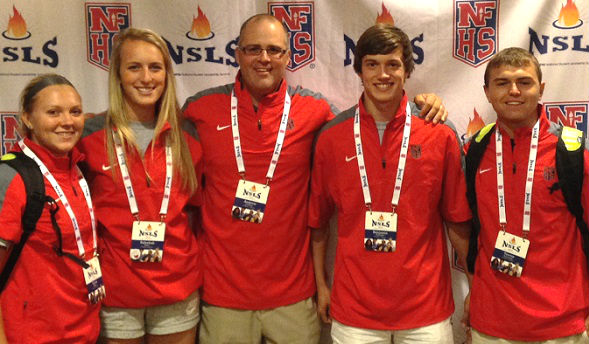
PHOTOS: (Top) From left, Belding's Greta Wilker, Gaylord St. Mary's Bekah Myler, the MHSAA's Andy Frushour, Livonia Stevenson's Ben Kowalske and Portland's Trevor Trierweiler attend the first-ever National Student Leadership Summit. (Middle) Kowalske and Myler pose with a Special Olympian during their activities as part of the NFHS experience.