


Battle of the Fans: Blue Crew Legacy
February 18, 2012
PETOSKEY -- Directly across the gym from the Petoskey student cheering section Friday, a toddler played on the first row of bleachers.
He wasn’t paying much attention to the Northmen’s boys basketball game against West Branch Ogemaw Heights. But he was wearing a blue T-shirt that read “Future Blue Crew” -- guaranteeing he will be soon enough.
At Petoskey High, a Class A school in a town where families have lived for generations, kids grow up aspiring not just to be the athletes playing for championships -- but also the Blue Crew members cheering them on.
While the other cheering section finalists in this season’s MHSAA “Battle of the Fans” contest were officially organized, for the most part, over the last year or two, Petoskey’s Blue Crew is nearing a decade as a constant at its school’s athletic events -- and a source of community pride.
“It’s such a legacy. Eighth grade, you’re looking forward to to being even involved in the Blue Crew, ... and now that we’re all seniors, everyone is listening to us, and we just want our teams to do well,” Petoskey senior Hayley Fettig said. “That’s a big part of it. We’re here to support our teams and cheer for our teams, and be a team ourselves.”
Petoskey was the fifth and final stop on the Battle of the Fans tour to find Michigan’s top student cheering section. Over the last five weeks, MHSAA staff and members of its Student Advisory Council also visited Frankenmuth, Reese, Grand Rapids Christian and Rockford. MHSAA-produced videos of all five finalists have been posted on the MHSAAsports YouTube page. Online voting will take place Monday-Thursday on the MHSAA Facebook page (you must “like” our page to vote). The winner will be announced Friday.
For most of its basketball history, Petoskey played in its old Central Gymnasium, an arena straight from the movie “Hoosiers” which seats about 1,500 fans and turned into a giant tunnel of cheers and shouts for every home game. But late in the fall of 2002, the newly-built high school opened a much larger gym that not only holds more fans, but also is more cavernous.
A bigger room meant a need for bigger spirit. And that sparked the Blue Crew, the brain child of members of the student council, some of whose names are still thrown around the halls to this day -- although the current seniors were in elementary school when it all began.
About 140 students piled into a “whited out” Blue Crew on Friday, plus 60 more in the jazz band that plays every home game and easily could be confused for one at the college level. To the left of the Crew sat about 50 more students not yet in high school. All sub-high school students are known as “Future Blue Crew,” while teachers are “Old-School Blue Crew.”
The Blue Crew often stands larger than it did Friday -- but on this night, the junior varsity and freshman basketball teams were playing simultaneously at other sites, and the hockey team was on the road. Petoskey’s Big North Conference foes are spread throughout the northern third of the Lower Peninsula, but the Blue Crew is known for making hours-long trips and constant support.
Members of the student council still play a big part. Those 12 students, plus 10 more take a one-hour leadership class taught by former girls varsity coach Matt Tamm. His classroom is a hall of memories itself, with photos of teams going back decades. Taking up center spot on a main wall is the original Blue Crew banner including its mission and three directives for generations to come.
“When I was younger, the older kids always told us, ‘You have to watch how we do this so when you’re older, you can do it how we did it,’ senior Brad Berkau said.
“You begin to learn when you’re younger what we do and how to go about cheering the right away. Not just boasting about our team, but not putting down the other ones too,” senior Nick Godfrey added.
That “right way” includes refusing to cheer negatively. Petoskey athletic director Gary Hice said it’s been four or five years since he’s had to tell the Crew that one of its cheers was crossing the line. Counselor Karen Starkey, who helps by coordinating parents to cheer with the students, said she hasn’t seen the Blue Crew respond to an opposing cheering section’s negative chant in at least two years.
Instead, the Crew pours its energy into more memorable ventures.
Starkey was diagnosed with breast cancer in January 2011, and her first chemotherapy treatment was on a game night.
She showed up in white, anticipating a white out. Instead, she found the entire Blue Crew in pink -- before receiving a group hug from the 200 or so students there supporting her as well.
“Those are the things these guys just jump out and do,” Starkey said. “It’s so not necessary, but it was just so cool.”
PHOTOS courtesy of Larry Tracy and CMA Action Photography.
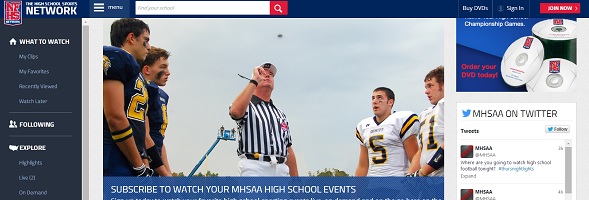
MHSAA.TV Makeover Goes LIVE
August 26, 2014
A new look awaits visitors to the MHSAA.tv website this season, a makeover which will allow fans to clip and share highlights and easily track their favorite school.
MHSAA.tv is one of more than 40 states on the NFHS Network, powered by PlayOn! Sports. The highlights clip and share features, among others, are available with free basic memberships. Viewers can subscribe to watch live and freshly-uploaded sporting events, with a portion of the subscription going back to their school. Contests being aired involving schools using Digital Scout for statistics may also include live stats. Games become available for free viewing after 72 hours.
The MHSAA.tv re-launch coincides with the first full week of competition for the 2014-15 school year and fresh school-created content, plus the season debut of MHSAA Football Friday Overtime on FOX Sports Detroit and MHSAA Perspective on a statewide radio network.
The School Broadcast Program gives members an opportunity to showcase excellence in their schools by creating video programming of athletic and non-athletic events, with students gaining skills in announcing, camera operation, directing/producing and graphics. The program also gives schools the opportunity to raise money through advertising and viewing subscriptions. As many as 60 MHSAA member schools annually participate in the program, which is in its sixth year.
Here’s the schedule of School Broadcast Program members planning to cover varsity competition this week for broadcast at MHSAA.tv (As of Aug. 25):
- Comstock Park Invitational – Volleyball – LIVE – Wednesday, 3 p.m. - Subscription
- Cedar Springs at Comstock Park – Football - LIVE – Thursday, 7 p.m. – Subscription
- Fenton at Davison – Football – Thursday, 7 p.m. – Video on Demand available following game
- Mio at Whittemore-Prescott – Football – Thursday, 7 p.m. – Video on Demand available following game
- Northland Pines (Wis.) at Calumet – Football – Thursday, 7 p.m. – Video on Demand available following game
- St. Johns at East Lansing – Football – Thursday, 7 p.m. - Video on Demand beginning week of Sept. 1
Schools interested in becoming a part of the School Broadcast Program should contact John Johnson at the MHSAA Office.
Beginning this Friday and running for 13 weeks at midnight is MHSAA Football Friday Overtime on FOX Sports Detroit. Mickey York and Rob Rubick return to host the weekly 30-minute highlights show. The show will re-air Saturdays at 11 a.m. and Sunday mornings – check your local listings. (This week at Noon)
The following games are scheduled to be highlighted this week on Football Friday Overtime:
- Saginaw Swan Valley at Saginaw Nouvel
- Saginaw Arthur Hill at Saginaw Heritage
- Macomb Dakota at Clarkston
- Orchard Lake St. Mary’s vs. Southfield at Prep Kickoff Classic, Detroit
- Detroit Cass Tech vs. Oak Park at Prep Kickoff Classic, Detroit
- Ypsilanti Community at Ann Arbor Pioneer
- Westland John Glenn at Ann Arbor Skyline
Beginning its 10th season this week is the radio commentary MHSAA Perspective – presented by the Michigan Army National Guard, which will air on over 60 radio stations across the state generally during the local broadcasts of high school games. The program runs for 30 weeks through the end of the winter sports season. MHSAA Perspective can also be accessed from the home page of the MHSAA Website.
In this week's edition, John Johnson talks about new rules for practice and games in football this season: Safety Trumps Everything