

SBP Brings Our Schools to You
August 25, 2014
By John Johnson
MHSAA communications director
Coaches used to come and go each weekend during the football season. Late at night they would drop their game films off at a local 24-hour gas station or diner; and a couple of nights later, they’d return to pick up the processed film to use in preparation for the next game.
That was life in the 1950s, 60s and 70s. It was difficult for students to get into a visual medium like film in general, and certainly in sports. The equipment was bulky and hard to operate, and the film went to some central location for processing which took at least a couple of days. Editing the stuff when it came back took a splicing machine, tape and glue to make even the simplest edit – and that’s assuming your school was lucky enough to have that gear.
Say the word “film” to a young person now, and they may recall seeing it in a history book or finding a box of old negatives or home movie reels in their grandparents’ attic.
Today’s high school students have endless possibilities because with a little creativity and vision, they can be hands on producing their schools’ athletic and non-athletic events and reach out to members of their schools’ global community to show them the homecoming parade, game, musical or graduation. Aunt Millie in Montana doesn’t have to wait for that phone call later that weekend to find out that Johnny scored three touchdowns. She watched all of them live, and texted him on the bus on the way home to congratulate him as he watched the game on demand on his handheld device.
More and more schools are keeping their communities connected by broadcasting their games over the Internet, and there are more schools in Michigan and nationwide providing that opportunity under the banner of the School Broadcast Program.
Powered by PlayOn! Sports and the NFHS Network, there are 860 schools in 38 states regularly producing events and giving the students producing those games some real-life hands-on broadcasting experience in the process.
“The PlayOn! Sports platform gives schools the opportunity to be successful at creating video broadcasts of their events regardless of their enrollment and resources,” said Mark Rothberg, Vice President of PlayOn! Sports, who handles the day-to-day administration of the School Broadcast Program. “You can produce a great-looking event with a simple crew of three kids handling the announcing, the camera and generating graphics on the computer; and if you’re fortunate to have the resources to create productions using multiple cameras and replays, you’ll look even better.
“Our partnership with the NFHS Network and most state associations creates a single portal, unlike anything a school can do on its own or by utilizing other streaming services, where fans of high school sports can keep up with the team in their backyard or other schools around the country where they have family or friends participating. It’s truly the destination for high school sports.”
More than half of Michigan schools participating in the NFHS Network School Broadcast Program have signed up through the Michigan Interscholastic Connection, and those schools have produced the majority of the SBP content on MHSAA.tv the past two years.
“What we try to do with our schools first is see if video production can be integrated into the curriculum, so that even though athletics is the driving force behind the School Broadcast Program, the athletic department doesn’t have to worry about adding this to an already long to-do list,” said Sparky Nitchman of the Michigan Interscholastic Connection. “Every school is unique, so our process is very individualized, aiming at providing the resources that each school needs in order to provide the best environment possible for a flourishing, long-term broadcasting class.
“We try to be very hands-on with our schools in giving them guidance in the classroom and at events, and with the marketing side of the program.”
Membership in the School Broadcast Program is free. PlayOn! Sports makes sure schools secure the proper equipment to run the software and has a dedicated support team to provide telephone and e-mail assistance should something occur during a production. Schools can live stream as many athletic events annually as they can on a customized school branded portal under the MHSAA.tv and NFHSNetwork.com websites. Live internet video broadcasts are permissible by MHSAA Handbook rules when they are produced by member schools and are available on a subscription or password-protected basis.
The subscription model provided by PlayOn! Sports provides a tool for schools to generate new revenue. Beginning this fall, schools can sell their fans annual subscription passes at a deeply discounted rate and receive a significant revenue share on each pass sold. Schools will continue to have the opportunity to sell advertising within their broadcasts in a way that they typically cannot if an event is being streamed on the school district’s website.
“We’ve already had schools on the subscription program happily surprised when, at the end of a season, we mailed them a four-figure check from subscription revenue,” Rothberg said. “The opportunity for financial success as a School Broadcast Program member is very real if a school works hard at marketing and then does a solid job of producing events.”
In addition to the educational experience students receive producing events, a number of students at SBP schools who graduated this spring chose to attend colleges with strong broadcasting curriculums or athletic broadcast departments, or trade schools like Specs-Howard. These kids have found an exciting activity to participate in and are getting real experience in the production field.
“Kids who may have felt they were on the outside edge of things at school have found something in the School Broadcast Program that does the same thing for them that athletics do for so many other kids,” said John Johnson, communications director for the MHSAA, who helps manage the day-to-day operation of the SBP with member schools. “It gives them a reason to get up in the morning to go to school, do well in school, and interact with kids they may never have dreamed that they’d be rubbing elbows with. All through the power of sports, and a medium that so many of them are naturally attracted to anyway in this digital age.”
The MHSAA always has had strong ties to the broadcasting community. While the days are gone of 40 to 50 local radio stations originating all four games of the Boys Basketball Finals – even if their community representative had been already knocked out of the tournament – those same stations now pick up an MHSAA Network originated feed of the Boys and Girls Basketball Finals.
For nearly a decade, the MHSAA has partnered with the Michigan Association of Broadcasters Foundation to support the latter’s Student Broadcasting Awards, with some of the Public Service Announcements created in those contests being broadcast statewide. Students winning the Sports Play-By-Play category even get an opportunity to sit courtside during a Finals event and call the action on the MHSAA Network website.
Also, a new alliance has been formed with the Student Broadcast Foundation to create field trip days to selected MHSAA tournament events, where students can meet with broadcasting industry professionals, watch the productions behind the scenes and even call or produce a mock audio broadcast of a game.
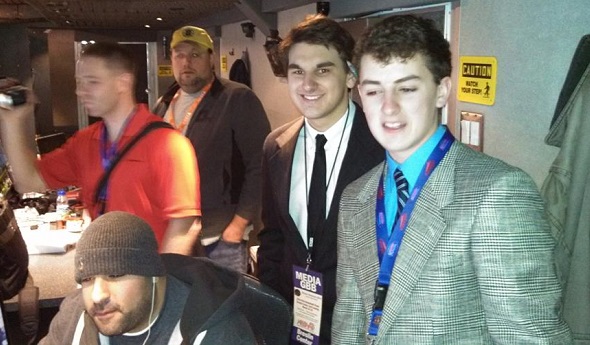
PHOTO: Davison students tour the Fox Sports Detroit broadcast truck during the 2013-14 school year.
Division 6 Final: Play it Again, Yellowjackets
November 29, 2011
DETROIT – So began the legacy of Ithaca quarterback Travis Smith.
And so continues an incredible run by one of Michigan’s newest football powerhouses.
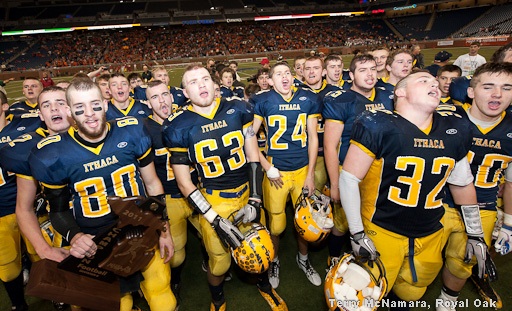
The Yellowjackets pushed their winning streak to 28 and claimed their second straight MHSAA championship by downing Constantine 42-14 in Friday's Division 6 Final.
They did so led by a number of last season’s top players, but minus their 2010 Final star. That’s where the sophomore Smith came in, joining the starting lineup in the season’s second week and bringing Ithaca back to Ford Field for another title.
“It’s more special just because this is the last time to suit up for most of us. We’re not going to be able to play another game next year, and we get to end on the biggest stage high school football has to offer in Michigan,” Ithaca senior linebacker/running back Garrett Miniard said.
“I think it was almost a little jealousy of the seniors last year of being able do that, being able to go out on top. I think that kept us going throughout the season, throughout the offseason. Being able to have that luxury of going out on top just like they did.
Ithaca (14-0) hasn’t lost since its 2009 Semifinal against Montague. With two more wins to start next fall, the Yellowjackets can become the 14th team on the MHSAA record book list with at least 30 straight victories.
And Smith should be there to lead the way. He connected on 18 of 25 passes for 299 yards and a touchdown Friday, and ran for 43 yards and a score. Miniard rushed for 43 yards and two touchdowns, and had 14 tackles. And senior David Brown caught six passes for 122 yards and also ran for a score.
Smith followed the path this fall of another former sophomore starter at his position – Alex Niznak, who graduated in the spring, plays at Central Michigan now, but didn’t leave before leading the Yellowjackets to both their first Semifinal berth and MHSAA championship over the last two seasons. Niznak’s title game performance last season included 251 yards passing, 138 rushing and an MHSAA Finals-record five touchdowns running the ball.
Brown originally took over at quarterback this fall. But he was injured on opening night – after running for three touchdowns against Williamston – and missed significant time, allowing Smith to take hold of the offense. Smith finished his first varsity season with a not-too-shabby 2,310 passing yards, 969 rushing yards, and a combined 48 touchdowns throwing or running.
“Coach (Terry) Hessbrook told me to just go in there and do what I can do, and just play football,” Smith said. “I’ve got so many good athletes around me. I just need to get my players the ball and let them do what they can do.”
Ithaca twice had catching up to do in the Final, with Constantine (11-3) scoring first and then taking a 14-7 lead midway through the first quarter – before the Yellowjackets rolled to 35 unanswered points.
“These kids had this goal since last year … of getting back here,” Hessbrook said. “We didn’t want Ithaca football to just be one and done, or a one-year wonder. And they’ve worked really hard.”
Constantine junior Ben Mallo did run 17 times for 189 yards and both scores. But the Falcons were without quarterback Tommy Reed, who was injured during last week’s Semifinal win over Ecorse. They played Ithaca to a 14-14 halftime tie before the Yellowjackets’ offense broke the game open.
“We’ve played offenses with that type of talent. Last week, for instance. And I’m sure Coach Hessbrook watched those films and saw some things he could do against us," Constantine coach Shawn Griffith said. "It’s a lot different than what we do, and you saw we caused them a little bit of problems early in the game as well. We do our thing, they do theirs. They do their thing very well. We did ours well. We just weren’t quite there on a couple drives that ended short.”