


7 Sleeping Tips for Student-Athletes
November 5, 2019

Henry Ford Health System
Many athletes seem to believe time spent not training is time wasted. But, on the contrary.
The time athletes spend resting and sleeping is actually just as important. Take the world’s best female skier, Mikaela Shiffrin, for example. Shiffrin reportedly not only sleeps nine hours each night, but naps at least an hour every day.
So, what does sleeping have to do with her success? When asleep, the body not only has time to recover, but the information that was taken in during the day goes from short-term memory and becomes long term.
“Being an elite athlete is a 24-hour profession, and sleep and recovery are integral to optimal performance,” says Meeta Singh, M.D., a sleep medicine specialist at Henry Ford Health System.
Here are seven tips to help your student athlete catch some Zzzs during the season:
1. Limit caffeine. Caffeine is a popular ingredient in many pre-workout drinks, and many athletes choose to use it for an energy boost. However, having caffeine late in the day may make falling asleep and staying asleep difficult. But, everyone reacts differently to caffeine, so athletes should try logging their intake to determine what time to stop consuming and how much is okay to consume.
2. Maintain a regular sleep schedule. The body has an internal clock that’s largely affected by environment. Going to bed and waking up at approximately the same time each day can add a natural rhythm to the body’s internal clock, which can cause people to feel more awake during the day and fall asleep easily at night.
3. Workout early. Often times, working out later in the day gives people a burst of energy that can keep them up late into the night. For example, exercising after 9 p.m. can boost body temperature, making sleep difficult. However, research shows morning workouts can help achieve deeper sleep, and working out in the afternoon can help reduce insomnia.
4. Unplug. Nothing can keep one up at night like a buzzing smartphone. Additionally, the blue light a phone emits may slow the production of melatonin, making sleep difficult. Advise your children to leave electronics out of reach while they’re sleeping. And as an added bonus: If their phone is their alarm, it will force them out of bed in the mornings.
5. Use essential oils. Essential oils have seen growing popularity in recent years, and this is in part because scent helps trigger memory. Oils can be diffused, rubbed on temples or drops can be spread on pillows. Popular oils for promoting sleep are lavender, valerian root and roman chamomile.
6. Focus on breathing. Focusing on breath can help steady heart rate and relax the body. A popular breathing technique is the 4-7-8 exercise, in which one inhales through the nose for four seconds, holds their breath for seven, and exhales for eight.
7. Keep it dark, cool and quiet. Having the right environment is an important part of falling asleep … and staying asleep.
Ultimately, when it comes to enhancing athletic performance, getting proper sleep, resting and recovering can be just as important as training or hitting the gym.
“Since sleep can modulate reaction time and accuracy, it’s important to ensure an athlete gets his or her Zzzs,” Dr. Singh says.
See also: Is Your Teen Sleep Deprived?
Want to learn more? Henry Ford Health System sports medicine experts are treating the whole athlete, in a whole new way. From nutrition to neurology, and from injury prevention to treatment of sports-related conditions, they can give your athlete a unique game plan.
Visit henryford.com/sports or call (313) 972-4216 for an appointment within 24 business hours.
Let's Learn What This Time Can Teach Us
April 8, 2020
By Kevin Wolma
Hudsonville Athletic Director
A simple service return that landed into the net last fall ended my son’s tennis career.
When you are a senior, there is an end date. Just like that it is over.
Seems like yesterday I was playing catch with him in the front yard. Seems like yesterday I was rebounding as he shot at our basketball hoop. Seems like yesterday I put a tennis racquet in his hands for the first time. The success and failures along with the laughter and frustration all came to an end.
Along the way people would warn me about how fast the time goes, but when you are living day to day, you don’t really believe them. Going into the final day of the season, I had those thoughts that this would be the last day I’d watch my son play a competitive tennis match, but it didn't really hit me until I watched that last ball go into the net.
However, I also realized that we were going to experience many final moments during his senior year and this was a natural part of the journey. What I didn't know on that day was that this was the very last time I would see him compete. The cancellation of spring sports season with the COVID-19 crisis took that opportunity away from him competing in track & field this spring.
We never know when things will be taken away from us.
Administrators, Athletes, Coaches, Officials, Trainers:
Do you have a message that will provide inspiration, motivation or comfort to Michigan’s high school sports community during this unprecedented time? We’d like to help share it. Submit your “viewpoint” – written or video – to [email protected] for consideration for publication on Second Half.
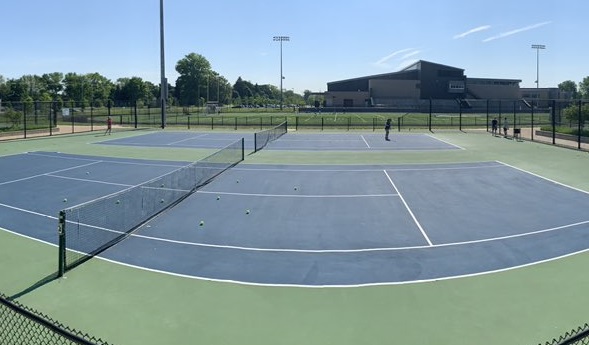
My daughter, also a senior, will also lose the opportunity to finish her tennis career at Hudsonville because of the COVID-19 shutdown. For the two of us, tennis was more than a sport – it was our connection. From the time she was 5 years old hitting foam balls in the gym to now, the tennis court became far more than a surface with a net and lines.
The tennis court was our place of solitude. We hit thousands and thousands of tennis balls over the years. But more importantly, the tennis court created a platform where lessons were shared, stories of success and failure were told, and a love for a sport was born. I dread the day the tennis court sits silent, because that means my daughter will move on to her next stage in life. That time could be now.
Sports is not the end-all, and it surely does not define a person. However, it is a mechanism to bring people together and to teach life lessons that are often taken for granted, until we realize it is over.
The purpose of this article is not to talk about the end as much as it is to emphasize the importance of those moments leading to the end. Don’t let those moments slip away. If your son or daughter asks you to go outside and play catch, please put down the computer or phone and do it. The email can wait. The phone call can wait. The game on TV can wait.
Admittedly, I have been occasionally guilty of this as well and now realize the importance of time and how unpredictable it can be. I have one more chance with my youngest daughter to make sure we don’t take those moments for granted. They are moments we will never get back, and again, we never know when those moments will be taken away.
As a high school athletic director, all I’ve wanted was more time. Sixty plus-hour work weeks while trying to navigate work and home schedules is often a challenge. Many of us live this life every day. We all would like more time.
However, over a 48-hour span during the month of March 2020, time was all I had. In those two days, after the Utah Jazz’ Rudy Gobert tested positive for COVID-19, both the NCAA and NBA shut down while schools and businesses began closing their doors indefinitely.
Now, time is all any of us have.
My hope is that we realize time is a gift and we must be willing to receive it when available. Take advantage of the time to regain a perspective of what is really important in our lives and act on that. This moment in time will end and for many of us, our lives will resume juggling personal, work, and sports schedules. Are we ready? Did we take this “time off” from the busyness of life and focus on how we can maximize every moment of every day?
For some of us, this gives us a chance to hit the restart button and maybe look at youth sports through a different lens. Maybe our interactions with our kids, coaches, and officials will be more positive. Maybe we worry less about the outcome and more about the process. Once we get back to the playing field, maybe we will look at participation in sports differently. Maybe we will understand that it is truly a gift, and every gift deserves a level of gratitude – gratitude toward the many people who allow this experience, and all its life lessons, to transpire.
Years from now, when we look back at the year of COVID-19, will we still value the essence of time and living in the moment? Will we still give gratitude to the gift of sports? Each one of us wants to look back at our kid’s experiences with athletics and have no regrets. No regrets with our actions. No regrets with our time. We have an opportunity as parents right now to pause, reflect, and make changes that could impact youth sports for generations to come.
We must seize this opportunity now because this part of life will be over before we know it. For some of us, maybe even more quickly than we expected.
Wolma has served as Hudsonville's athletic director since 2011 and previously coached boys varsity basketball and girls varsity golf among other teams. He also previously taught physical education and health. Photo courtesy of the Hudsonville High School tennis programs.