


7 Sleeping Tips for Student-Athletes
November 5, 2019

Henry Ford Health System
Many athletes seem to believe time spent not training is time wasted. But, on the contrary.
The time athletes spend resting and sleeping is actually just as important. Take the world’s best female skier, Mikaela Shiffrin, for example. Shiffrin reportedly not only sleeps nine hours each night, but naps at least an hour every day.
So, what does sleeping have to do with her success? When asleep, the body not only has time to recover, but the information that was taken in during the day goes from short-term memory and becomes long term.
“Being an elite athlete is a 24-hour profession, and sleep and recovery are integral to optimal performance,” says Meeta Singh, M.D., a sleep medicine specialist at Henry Ford Health System.
Here are seven tips to help your student athlete catch some Zzzs during the season:
1. Limit caffeine. Caffeine is a popular ingredient in many pre-workout drinks, and many athletes choose to use it for an energy boost. However, having caffeine late in the day may make falling asleep and staying asleep difficult. But, everyone reacts differently to caffeine, so athletes should try logging their intake to determine what time to stop consuming and how much is okay to consume.
2. Maintain a regular sleep schedule. The body has an internal clock that’s largely affected by environment. Going to bed and waking up at approximately the same time each day can add a natural rhythm to the body’s internal clock, which can cause people to feel more awake during the day and fall asleep easily at night.
3. Workout early. Often times, working out later in the day gives people a burst of energy that can keep them up late into the night. For example, exercising after 9 p.m. can boost body temperature, making sleep difficult. However, research shows morning workouts can help achieve deeper sleep, and working out in the afternoon can help reduce insomnia.
4. Unplug. Nothing can keep one up at night like a buzzing smartphone. Additionally, the blue light a phone emits may slow the production of melatonin, making sleep difficult. Advise your children to leave electronics out of reach while they’re sleeping. And as an added bonus: If their phone is their alarm, it will force them out of bed in the mornings.
5. Use essential oils. Essential oils have seen growing popularity in recent years, and this is in part because scent helps trigger memory. Oils can be diffused, rubbed on temples or drops can be spread on pillows. Popular oils for promoting sleep are lavender, valerian root and roman chamomile.
6. Focus on breathing. Focusing on breath can help steady heart rate and relax the body. A popular breathing technique is the 4-7-8 exercise, in which one inhales through the nose for four seconds, holds their breath for seven, and exhales for eight.
7. Keep it dark, cool and quiet. Having the right environment is an important part of falling asleep … and staying asleep.
Ultimately, when it comes to enhancing athletic performance, getting proper sleep, resting and recovering can be just as important as training or hitting the gym.
“Since sleep can modulate reaction time and accuracy, it’s important to ensure an athlete gets his or her Zzzs,” Dr. Singh says.
See also: Is Your Teen Sleep Deprived?
Want to learn more? Henry Ford Health System sports medicine experts are treating the whole athlete, in a whole new way. From nutrition to neurology, and from injury prevention to treatment of sports-related conditions, they can give your athlete a unique game plan.
Visit henryford.com/sports or call (313) 972-4216 for an appointment within 24 business hours.
Timeout to Appreciate Officials
September 23, 2013
By Kevin Wolma
Hudsonville athletic director
Wolma is in his third school year as athletic director at Hudsonville and previously coached basketball and golf. Below is a recent “30-second timeout” he wrote for the Hudsonville district newsletter.
We were five seconds away from one of the greatest upsets in the history of Caledonia basketball.
During the regular season, South Christian had beaten us by more than 30 points on two different occasions. The District Finals became the site for the third contest between the two schools on a warm March day.
We were able to slow them down just enough to stay within striking distance until late in the fourth quarter, when we finally took the lead for the first time. South Christian had one last chance with seven seconds left on the clock. After a timeout, they in-bounded the ball from the sideline and their player forced up a shot. I could see it was going to be short from my viewpoint, and my heart began to race with adrenaline as I could sense the impossible was going to become possible.
What happened next has stuck with me for the rest of my life, as one of the South Christian players pushed one of our players in the back, grabbed the rebound, and put the ball in the basket with one second left.
Game over. South Christian wins the District championship.
For the next eight years as a varsity basketball coach, I held a grudge against officials for that one call. Twelve years later, after I was done coaching, I went back and watched the game over again for the first time. I almost turned the video off when they in-bounded the ball in those last seven seconds because I did not want to relive that moment and the ensuing emotions that took place.
While watching I discovered something.
The South Christian player did not shove my player as much as I thought, and our players did not box out like I had thought, which made it easier for them to get the rebound and score. Looking back, did I even tell my players to box out during that last timeout before the ball was in-bounded?
At that moment it became very clear to me that what we see during a game may be clouded because we want our team to gain every advantage and every call in order for them to be successful. Perception is not reality. Officials are human. They will make mistakes just like the coaches and players do during a game.
There still has never been a game that has been decided by an official. Some people will say that the Class B Semifinal boys basketball game (in 2010) was decided on an official’s call when they ruled one of Forest Hills Northern’s player's foot was on the line on his last-second shot when in reality his foot clearly was behind the line. That call cost them a chance to play in the (MHSAA) Finals.
Coach Steve Harvey was quoted in the paper as saying, "We had opportunities to take care of the game before it even came down to that shot.” In the moment it seemed like that one play cost Forest Hills Northern the game, but there were over 50 possessions on offense and defense that preceded the play and potential outcome.
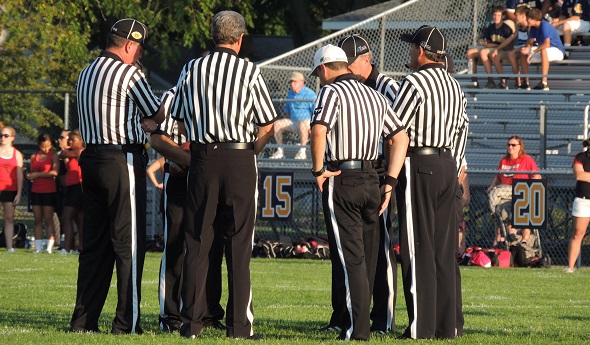
Having the opportunity to spend time with officials inside the locker room has made it very evident they are serious about their jobs and calling the best game they can. I have had requests from officials to have a monitor available to break down film an hour and a half before their contest begins to see strengths and weaknesses in their placement and mechanics from prior contests. I have had officials upset at halftime or after a game because they realized they made a mistake. I have had officials contact me personally after a game to apologize for a call made during the contest.
In the business world and also in education we use the word collaboration a lot. Officials collaborate before, during, and after every contest to garner more knowledge so they can continue to improve.
This is not even their full time job. Officials do what they do because they love the game and want to give back to the sport that made an impact on them.
The next time we are at a game and we think the officials missed a call, let’s take a 30-second timeout to gather our emotions so we do not say anything we will regret later. Instead let’s spend our energy cheering on our teams to be the best they can be.