

Add Rest Days to Your Workout Routine
June 2, 2020

Henry Ford Health System
Whether you're new to exercise or a seasoned enthusiast, it's tempting to adopt an all-go, no-quit attitude. This is especially common when you're are trying to achieve a fitness goal. Maybe you want to run a 5K, or maybe you have 10 pounds you want to shed before going on vacation.
"Whatever the driver, it's important to remember that scheduling time for rest and rejuvenation is a critical component of any workout regimen," says James Moeller, M.D., a sports medicine specialist at Henry Ford Health System.
Building in Rest Days
From high-intensity interval training (HIIT) and spin to barre and Zumba, popular workouts increasingly push exercisers to go faster, longer, stronger. This prolonged physical stress can lead to overuse injuries, such as stress fractures, muscle strains and joint pain. Excessive exercise can also lead to hormonal changes, disrupted sleep patterns, decreased immunity and mood swings.
“Working out, especially resistance training, breaks tissues down, causing microscopic damage,” Dr. Moeller says. "Rest days allow your muscles time to rebuild."
So how much rest do you really need? There isn't a one-size-fits-all prescription. Factors like your age, fitness level, the intensity of your workout and the amount of training you do weekly will impact the amount of recovery time you need. But there are some basic guidelines for rest days:
1. Go easy: Rest is a relative term. "It's not just sitting on the couch with an iced tea," says Dr. Moeller. "You may still be exercising on 'rest' days, but at a lower intensity." Maybe you go for a brisk walk or ride your bike to work. Take a yoga class or do some dynamic stretching. The key is to make sure you're not overworking the same body parts.
2. Get sufficient sleep: Sleep is a key component of muscle repair and rebuilding. During sleep, your body’s production of growth hormone increases. Not getting quality shuteye thwarts your body's production of growth hormone and can impact your performance.
3. Give overtaxed muscles a break: You don't need to skip the gym on specific days each week, but you do need to rotate which body parts you're working. The general rule is to give muscles 48 hours to recover after a workout. So it's a good idea to take two to three days off before working the same muscle groups again.
4. Stay hydrated: Make sure to restore lost fluids before, during and after a workout. Dehydration can lead to overheating, headaches and muscle fatigue, among other ailments. You don’t need a sports drink; water is best. "Sports drinks aren't required unless you're getting into very high intensity activity, or exercising for more than one hour at a time," Dr. Moeller says.
5. Pay attention to your body: A lot of people try to work out through pain and fatigue. If there's a heaviness to your movements, or if you feel like your muscles are not responding appropriately to the stress you're providing, take a time out. "It's really about learning to read your body's signals," says Dr. Moeller.
Health authorities and news headlines widely publicize the health benefits of exercise — and the consequences of inactivity. The American Heart Association recommends that adults get at least 150 minutes of moderate-intensity exercise per week, plus strength training two or three days per week. Less discussed are the negative effects of not allowing your body sufficient time to rest.
Getting sufficient rest between workouts is just as important as participating in regular exercise. "Both are part of the total process required to build strength, endurance and muscle mass," Dr. Moeller says.
Want to learn more? Henry Ford Health System sports medicine experts are treating the whole athlete, in a whole new way. From nutrition to neurology, and from injury prevention to treatment of sports-related conditions, they can give your athlete a unique game plan.
Visit henryford.com/sports or call (313) 972-4216 for an appointment within 24 business hours.
Flashback 100: One Last Look Back as We Turn Focus Toward Future
July 10, 2025
We hope you’ve enjoyed this school year's retrospective on some of the most iconic athletes and personalities who began their journeys in MHSAA sports. While we’ve done our best to highlight a diverse range of individuals across various sports and professions, a single year simply isn’t enough to capture every standout story.
Michigan high schools have produced an incredible array of talent — and the following, in addition to those we've wrote about over the last 10 monrths, are just another glimpse of that legacy:
- Kirk Gibson (Waterford Kettering) – The 1988 National League MVP also played a pivotal role in the Detroit Tigers’ 1984 World Series championship and starred in football as well at Michigan State.
- Jake Long (Lapeer East) – Selected as the NFL’s No. 1 overall draft pick in 2008, he's among a distinguished list of Michigan high school alums to go early in the draft, including Braylon Edwards (Harper Woods Bishop Gallagher, No. 3 in 2005), Carl Banks (Flint Beecher, No. 3 in 1984), Jerome Bettis (Detroit Mackenzie, No. 10 in 1993), and Tyrone Wheatley (Dearborn Heights Robichaud, No. 17 in 1995).
- Jeff Daniels (Chelsea) – Before becoming a renowned actor with credits like The Newsroom, Escanaba in da Moonlight, and Dumb and Dumber, Daniels was a high school baseball player.
- Lisa Byington (Portage Northern) – A trailblazing broadcaster, she serves as the play-by-play voice for the Milwaukee Bucks and regularly appears on CBS during NCAA Basketball Tournaments.
- Kristin Haynie (Mason) – She was first athlete to play in both the NCAA Women’s Division I Basketball Championship and the WNBA Finals in the same calendar year.
- Jalen Rose, Voshon Lenard, and Howard Eisley – This trio of NBA professionals once shared the court at Detroit Southwestern, making it one of the most talent-rich high school teams in state history.
- Jim Abbott (Flint Central) – Born without a right hand, Abbott defied the odds to pitch for 10 seasons in Major League Baseball.
- Earl Morrall (Muskegon) – He was named NFL MVP in 1968 and enjoyed a long and successful pro football career.
- Charlie Gehringer (Fowlerville) and Hal Newhouser (Detroit Wilbur Wright) – Both legends of Major League Baseball, each captured MVP honors during their Hall of Fame careers.
- Kate Markgraf (Detroit Country Day) – A champion at every level of soccer, she earned titles in high school and college, an Olympic Gold Medal, and a FIFA World Cup victory.
- Allison Schmitt (Canton) – One of the most decorated American swimmers of all time, Schmitt has earned 10 Olympic medals.
- Jason Richardson (Saginaw Arthur Hill) and Charles Rogers (Saginaw) – Both were drafted among the top five in their respective college sports (Richardson to the NBA in 2001, Rogers to the NFL in 2003) and faced off against each other as part of one of the state's most historic basketball rivalries.
- Staying with the city of Saginaw, Draymond Green (Saginaw) won a basketball championship in high school (2007) and then four in the NBA (2015, 2017, 2018, 2022) after being drafted in the second round of the 2012 draft by the Golden State Warriors.
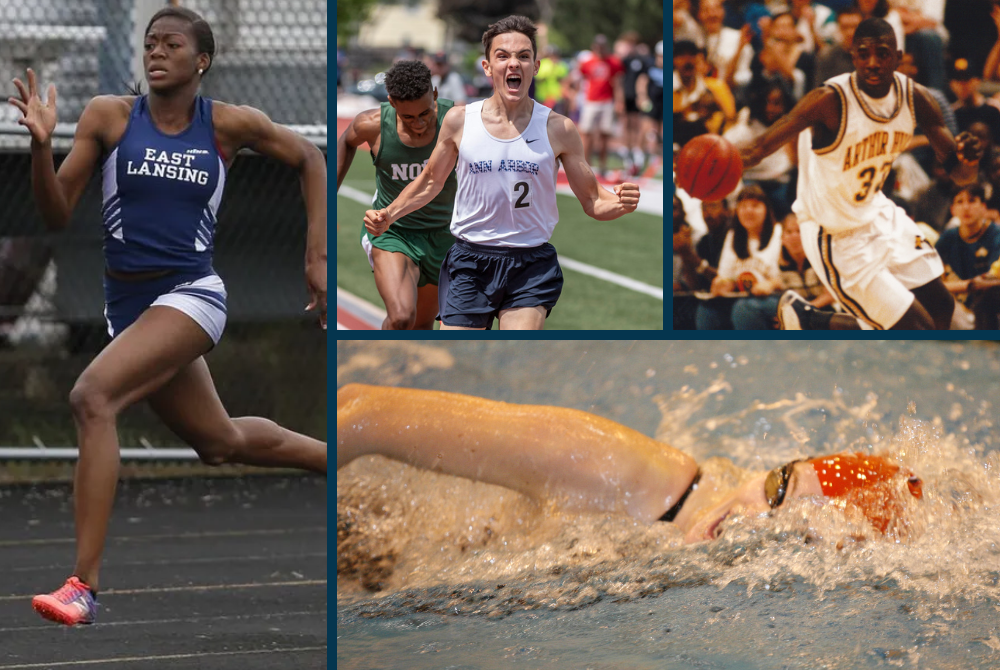
And the legacy continues. Olympic gold medal dreams are alive in track & field standouts like Taylor Manson (East Lansing), Hobbs Kessler (Ann Arbor Skyline), and Grant Fisher (Grand Blanc), who are already well-accomplished on the worldwide stage.
So, who’s next?
Who will be the next MHSAA athlete selected on draft night? Hoisting an MVP trophy? Standing atop the podium as a champion?
We don’t know yet — but as we close the book on the first 100 years of MHSAA history, we can’t wait to see what the next century will bring.
Previous "Flashback 100" Features
June 23: Hutchinson's Dominance Starts as Multi-Sport Divine Child Standout - Read
June 10: Wagner's Dream of Going on Tour Realized - with Greta Van Fleet - Read
May 23: Tarpley's Legendary Run Began as Portage Central's Miss Soccer - Read
May 16: Scane’s Record-Setting Lacrosse Run Began at Cranbrook Kingswood - Read
May 8: Duckett's High School Domination Extended to Shot Put Circle - Read
May 6: MHSAA Titles Just Start for NCAA Champion, Olympian Stark - Read
May 1: Legendary Actor Played Multiple Sports Roles at Country Day - Read
April 23: Legacy Program Provided Start for Pioneering NBA Official Schroeder - Read
April 11: Rice's Championship-Winning Ways Started at Flint Northwestern - Read
March 28: Youngquist's Times Still Among MHSAA's Fastest - Read
March 18: After 40 Years, Coles' Shot Remains Among Century's Most Famous - Read
March 7: Walled Lake Northern's Hellebuyck Reigns as NHL's Elite Netminder - Read
Feb. 27: Zeerip's Mat Stats Remain Rarely-Challenged Chart Toppers - Read
Feb. 21: Before TV Stardom, Kerwin Excelled as All-State Skier - Read
Feb. 14: Detroit Central Star Voted into Pro Football Hall of Fame - Read
Feb. 6: Multi-Sport Star Look Becomes Super Bowl Officiating Legend - Read
Jan. 31: Johnson Family Put Magical Stamp on Michigan High School Hoops - Read
Jan. 24: Future Hall of Famers Face Off First in MHSAA Class A Final - Read
Jan. 17: First-Ever WNBA Draft Pick Rocked at Salem, Won Titles at Tennessee - Read
Jan. 10: Despite Launching Before 3-Point Line, Smith Still Tops Scoring List - Read
Jan. 3: Edison's Jackson Earns Place Among State's All-Time Elite - Read
Dec. 20: Future Olympian Piper Leads Grosse Pointe North to Historic Heights - Read
Dec. 13: The Other Mr. Forsythe in Michigan School Sports - Read
Dec. 6: Coleman's Legendary Heroics Carry Harrison Through Repeat - Read
Nov. 29: Harbaugh Brothers' Football Roots Planted in Part at Pioneer - Read
Nov. 22: 8-Player Football Finals Right at Home at Superior Dome - Read
Nov. 15: Leland Career Helps Set Stage for Glass' International Stardom - Read
Nov. 8: Future Baseball Pro Led Escanaba's Legendary Football Title Run - Read
Nov. 1: Michigan High School Baseball Trio Provide World Series Voices - Read
Oct. 25: Before Leading Free World, Ford Starred for Champion GR South - Read
Oct. 18: Mercy Links Legend Becomes World Golf Hall of Famer - Read
Oct. 11: Fisher Races to Finals Stardom on Way to U.S. Olympic First - Read
Oct. 4: Lalas Leaves High School Legacies on Ice & Pitch - Read
Sept. 27: Tamer's History-Making Run Starts in Dexter, Continues to Paris - Read
Sept. 20: Todd Martin’s Road to Greatness Starts at East Lansing - Read
Sept. 13: James Earl Jones, Dickson High Hoops to Hollywood Legend - Read
Sept. 6: Pioneers' Unstoppable Streak Stretches 9 Seasons - Read
Aug. 30: Detroit dePorres Rushes to 1995 Class CC Football Championship - Read
PHOTOS Clockwise from left: Taylor Manson sprints for East Lansing, Hobbs Kessler wins a race for Ann Arbor Pioneer, Jason Richardson plays in a Class A Basketball Final for Saginaw Arthur Hill and Allison Schmitt swims a championship race for Canton. (Manson photo courtesy of the Lansing State Journal; Kessler photo by RunMichigan.com. Others are MHSAA file photos.)