


Coaches Must Set the Example
October 15, 2012
By Scott Westfall
MSU Institute for the Study of Youth Sports
NOTE: This is part one of a two-part viewpoint explaining the importance of coaches and parents setting proper examples for young athletes in their treatment of game officials.
 In light of the recent uproar over NFL replacement officials, it seems that never before has it been so common and socially accepted to yell disgust at referees.
While this trend is prevalent in both professional and college football, it has unfortunately trickled down into the high school ranks. What is actually accomplished when a coach or fan yells at an official? Do people really believe that if they become irate, a ‘bad call’ will be erased? In all of my years watching, playing, and coaching athletics, not once have I seen a referee change his or her ruling because a coach or a fan yelled at him or her.
When adults lose control and scream at referees, who does this bad behavior really affect? Since youth learn their emotional control from adult leaders, I believe the true damage is done to the young minds that are witnessing their mentors lose their cool. After their display of anger, how can these same adults hope for kids to stay calm when things do not go their way in life? It is pure hypocrisy to expect otherwise.
Whether we like it or not, referees are the absolute authority in athletic contests; they control the game from start to finish, make the tough calls on the playing surface, and even decide who gets to stay and who is sent to the locker room. Yet, it is baffling how often their authority is disrespected.
It is the coach’s responsibility to establish his or her program as one that respects authority. Since players watch all of the moves their coaches make, it is imperative that coaches respect the officials – especially when the calls do not go their way. If a player sees his or her coach going berserk due to a ‘bad call,’ the same player will think it is OK to act like this down the road when upset or faced with adversity. Even more detrimental to these kids is hearing their coach preach a message but contradict it by not backing it up with actions.
Great high school coaches will use the playing surface as an extension of their classroom. In my years as a head coach, I tried my hardest to set a good example for my players and told them to never question, back-talk, or disrespect an official. However, I made the mistake of breaking my own rule on one occasion by questioning the referee’s judgment.
When I was a younger coach, I may have attributed my actions to the heat of the moment, or defended myself on the criteria that I was trying to stick up for my team. However, being a veteran leader who wanted to practice what I preached, I saw my mistake as a teaching moment.
The next practice, when we conducted team discipline conditioning, “Reminders” (usually reserved for players with unacceptable school behavior or poor grades), I asked my players what I had taught them about respecting authority and if I had broken my own rule. The players agreed that I had broken my rule and had not respected the referee.
I let them know that this rule applied to me as much as them. I then lined-up on the goal line and ran my own set of wind sprints as the players, assistant coaches, and managers watched in disbelief. Afterward, to even my surprise, several players thanked me for holding myself accountable.
One kid even had tears in his eyes, and said that after watching my self-imposed discipline, he wanted more than ever to be a man of his word and do the right thing.
Scott Westfall has spent the last 10 years as a teacher, coach, and athletic director in Fort Collins, Colo. He currently is working on his Doctorate at Michigan State University, with an emphasis in Sport Psychology and Athletic Administration, and assisting the MHSAA with its student leadership programs. Westfall is a former athlete who participated in football, wrestling, tennis and cross country at the high school level, and rugby at the collegiate level. He can be reached at [email protected].
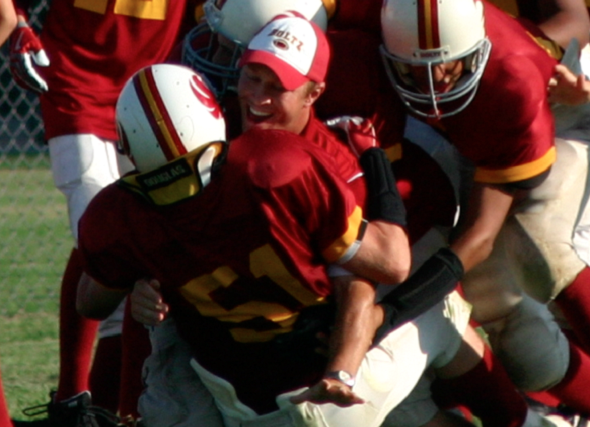
PHOTO: Scott Westfall celebrates with his football team while serving as a coach at Boltz Middle School in Fort Collins, Colo.

NFHS Voice: Punish Bad Fan Behavior
October 2, 2019
By Karissa Niehoff
NFHS Executive Director
About four weeks ago, we distributed an op-ed suggesting that inappropriate behavior by parents and other adult fans at high school sporting events was causing many officials to quit before they even reached two years on the job.
Although we received mostly positive support from this article, some people thought we went too far in telling parents to “act your age” and “stay in your own lane.” On the contrary, perhaps we should have been more direct.
Last week, one of our member state associations shared a resignation letter it had received from a 20-year veteran soccer official who had taken all the abuse he could handle. A portion of that letter follows:
“Soccer parents: you are absolutely 100% the reason we have a critical refereeing shortage and games are being cancelled left and right. And you are at least a part of the reason I’m done here. The most entitled among you are the ones that scream the loudest. And every time you do this, you tell your son or daughter the following:
‘I do not believe in you, I do not believe in your team, I do not believe in your collective ability to overcome your own adversity and you absolutely will not win and cannot do this without me tilting the table in your favor.’
“On behalf of myself and so many other referees – and I say this with every ounce of my heart and soul – shut up about the referees, and let your kids rise or fall as a team, as a FAMILY. Because the vast majority of you truly have no idea what you’re talking about, and even if you have a legitimate gripe about one play or one decision, you’re not fixing anything.”
And if that wasn’t enough, last week the Eastern Panhandle Youth Football League in West Virginia released the following statement:
“Unfortunately, it has come to the point that because of the abuse, negativity and utter disrespect shown to our officials from parents, coaches and most recently from our players, the Eastern Panhandle Officials Association president stated today that the association will no longer schedule officials for our league games at any field. This means effective immediately all remaining games are cancelled.”
This statement is from a youth league, which means the coaches are likely also parents of players, and the players are sons and daughters who are emulating their parents’ behavior.
So, no, our previous message was not too direct or emphatic. The kind of boorish parental behavior that compels a 20-year soccer official to quit cannot be allowed to continue. While we would hope that parents and other fans would embrace the concepts of education-based athletics by respecting the efforts of those men and women who officiate high school sports, that unfortunately is not occurring in some cases.
As a result, schools must adopt and enforce a strict, fan behavior policy. In soccer, a player receives a “yellow card” as a first warning for unsportsmanlike conduct. If the action occurs again, the player is hit with a “red card” and is ejected from the contest. Some schools have implemented a similar penalty structure for parents and other fans – not just at soccer games but all high school events. If the inappropriate behavior and verbal abuse of officials continues after one warning, the person is removed from the venue. There must be consequences for these offenders before we lose any more officials.
Most of the 7.9 million participants in high school sports are on the fields and courts every day to have fun and compete as a team with their classmates, and the 300,000-plus officials assist in that process. Now, if parents would let the players play and the officials officiate!
Dr. Karissa L. Niehoff is in her second year as executive director of the National Federation of State High School Associations (NFHS) in Indianapolis, Indiana. She is the first female to head the national leadership organization for high school athletics and performing arts activities and the sixth full-time executive director of the NFHS, which celebrated its 100th year of service during the 2018-19 school year. She previously was executive director of the Connecticut Association of Schools-Connecticut Interscholastic Athletic Conference for seven years.