


Coaches Must Set the Example
October 15, 2012
By Scott Westfall
MSU Institute for the Study of Youth Sports
NOTE: This is part one of a two-part viewpoint explaining the importance of coaches and parents setting proper examples for young athletes in their treatment of game officials.
 In light of the recent uproar over NFL replacement officials, it seems that never before has it been so common and socially accepted to yell disgust at referees.
While this trend is prevalent in both professional and college football, it has unfortunately trickled down into the high school ranks. What is actually accomplished when a coach or fan yells at an official? Do people really believe that if they become irate, a ‘bad call’ will be erased? In all of my years watching, playing, and coaching athletics, not once have I seen a referee change his or her ruling because a coach or a fan yelled at him or her.
When adults lose control and scream at referees, who does this bad behavior really affect? Since youth learn their emotional control from adult leaders, I believe the true damage is done to the young minds that are witnessing their mentors lose their cool. After their display of anger, how can these same adults hope for kids to stay calm when things do not go their way in life? It is pure hypocrisy to expect otherwise.
Whether we like it or not, referees are the absolute authority in athletic contests; they control the game from start to finish, make the tough calls on the playing surface, and even decide who gets to stay and who is sent to the locker room. Yet, it is baffling how often their authority is disrespected.
It is the coach’s responsibility to establish his or her program as one that respects authority. Since players watch all of the moves their coaches make, it is imperative that coaches respect the officials – especially when the calls do not go their way. If a player sees his or her coach going berserk due to a ‘bad call,’ the same player will think it is OK to act like this down the road when upset or faced with adversity. Even more detrimental to these kids is hearing their coach preach a message but contradict it by not backing it up with actions.
Great high school coaches will use the playing surface as an extension of their classroom. In my years as a head coach, I tried my hardest to set a good example for my players and told them to never question, back-talk, or disrespect an official. However, I made the mistake of breaking my own rule on one occasion by questioning the referee’s judgment.
When I was a younger coach, I may have attributed my actions to the heat of the moment, or defended myself on the criteria that I was trying to stick up for my team. However, being a veteran leader who wanted to practice what I preached, I saw my mistake as a teaching moment.
The next practice, when we conducted team discipline conditioning, “Reminders” (usually reserved for players with unacceptable school behavior or poor grades), I asked my players what I had taught them about respecting authority and if I had broken my own rule. The players agreed that I had broken my rule and had not respected the referee.
I let them know that this rule applied to me as much as them. I then lined-up on the goal line and ran my own set of wind sprints as the players, assistant coaches, and managers watched in disbelief. Afterward, to even my surprise, several players thanked me for holding myself accountable.
One kid even had tears in his eyes, and said that after watching my self-imposed discipline, he wanted more than ever to be a man of his word and do the right thing.
Scott Westfall has spent the last 10 years as a teacher, coach, and athletic director in Fort Collins, Colo. He currently is working on his Doctorate at Michigan State University, with an emphasis in Sport Psychology and Athletic Administration, and assisting the MHSAA with its student leadership programs. Westfall is a former athlete who participated in football, wrestling, tennis and cross country at the high school level, and rugby at the collegiate level. He can be reached at [email protected].
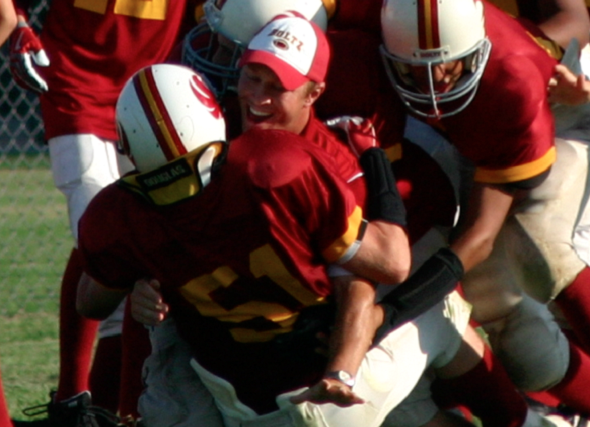
PHOTO: Scott Westfall celebrates with his football team while serving as a coach at Boltz Middle School in Fort Collins, Colo.
Century of School Sports: On This Day, December 13, We Will Celebrate
By
Geoff Kimmerly
MHSAA.com senior editor
December 10, 2024
This Friday, December 13, 2024, the Michigan High School Athletic Association will commemorate its 100th anniversary, a special day selected from a milestone school year as the MHSAA continues to celebrate a “Century of School Sports.”
But why December 13?
Short answer: On that day, the first Representative Council of the newly-formed MHSAA met for the first time.
Longer explanation: The MHSAA’s predecessor – the Michigan Interscholastic Athletic Association – had provided oversight of school athletics from 1909-24, and adjourned its final annual meeting Dec. 5, 1924. The reasons for the end of the MIAA and formation of the MHSAA are fascinating on their own, and we’ll cover that at a later date.
But as for this important date we are discussing this week:
- At the end of the MIAA, all that remained was a committee elected to represent various sections of the state and various sizes and types of schools during the transition – a 12-member Representative Council.
- Prior to the MIAA’s conclusion, a basketball rules interpretation meeting had been scheduled and publicized for Saturday, Dec. 13, 1924, in Ann Arbor. Several athletic directors, basketball coaches and officials were expected to attend, and it was decided to also conduct the first meeting of the Representative Council that day as well.
- The Council meeting was held at the Michigan Union. Ten of 12 Council members were present, with the board including representatives from multiple regions and both peninsulas, schools large and small, public and nonpublic; junior high schools and the state department of education, and with expertise in physical education, administration and coaching – in essence, the same mix that makes up much of the Council a century later.
- Officers were elected, funds were transferred from the former MIAAA to the new MHSAA, a committee was appointed to begin discussing policies for junior high sports as they had begun to emerge, and the first Executive Committee – then known as the “Committee on Appeals” was formed to consider appeals of eligibility decisions made by the state director. The 1925 MHSAA Basketball Tournament was discussed and a committee formed to work toward those arrangements. Finally, a football eligibility situation was considered and a member school suspended, to be reinstated two months later after satisfying a series of conditions to make restitution for the use of ineligible players.
And the rest is history, with more made every year.
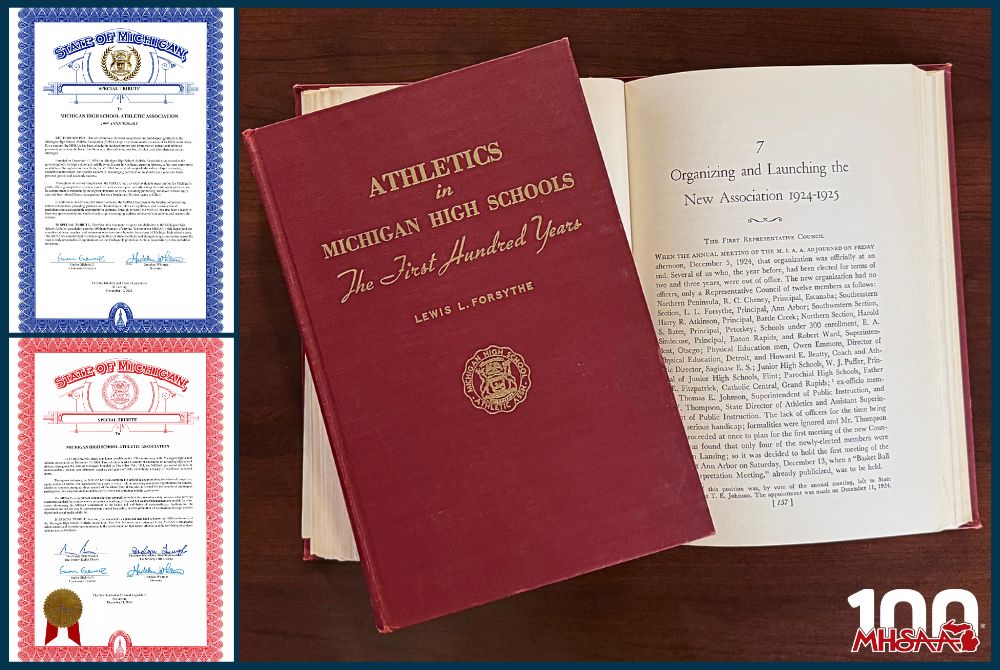
To commemorate this 100th anniversary, the MHSAA has received tributes from Gov. Gretchen Whitmer and Lt. Gov. Garlin Gilchrist II, and the Michigan Legislature signed as well by Sen. Sam Singh and Rep. Penelope Tsernoglou from the MHSAA office’s legislative districts.
The gubernatorial declaration states in part, “We honor the MHSAA’s rich legacy and the countless athletes, coaches, and volunteers who have contributed to the success of Michigan high school sports. The MHSAA’s commitment to enhancing the lives of student-athletes and strengthening communities across the state is truly remarkable.”
The legislature’s proclamation adds, “May this day serve as a testament to the MHSAA’s remarkable achievements and its enduring commitment to the advancement of high school athletics and the well-being of student-athletes across Michigan.”
Previous "Century of School Sports" Spotlights
Dec. 3: MHSAA Work Guided by Representative Council - Read
Nov. 26: Finals Provide Future Pros Early Ford Field Glory - Read
Nov. 19: Connection at Heart of Coaches Advancement Program - Read
Nov. 12: Good Sports are Winners Then, Now & Always - Read
Nov. 5: MHSAA's Home Sweet Home - Read
Oct. 29: MHSAA Summits Draw Thousands to Promote Sportsmanship - Read
Oct. 23: Cross Country Finals Among MHSAA's Longest Running - Read
Oct. 15: State's Storytellers Share Fall Memories - Read
Oct. 8: Guided by 4 S's of Educational Athletics - Read
Oct. 1: Michigan Sends 10 to National Hall of Fame - Read
Sept. 25: MHSAA Record Books Filled with 1000s of Achievements - Read
Sept. 18: Why Does the MHSAA Have These Rules? - Read
Sept. 10: Special Medals, Patches to Commemorate Special Year - Read
Sept. 4: Fall to Finish with 50th Football Championships - Read
Aug. 28: Let the Celebration Begin - Read
PHOTOS At left, gubernatorial and legislative commemorations recognize the MHSAA's 100th anniversary. At middle, the book "Athletics in Michigan High Schools - The First Hundred Years" is opened to the chapter introducing the early days of the MHSAA.