

Commentary: Flag Football First
October 29, 2014
By Chris Ervin
St. Johns Athletic Director
Throughout my career I have always argued that most schools/youth programs start tackle football too early. Most are putting young children in full pads and letting them have full contact as early as third or fourth grade. At this stage in life I don’t believe that children are physically prepared for that type of contact. At this age many of these kids are too big to touch the ball on offense. What fun is that?
But I understand why it is, what it is. Every football program feels the need to do the same, if not more, than our competition. Every program feels it must do what our neighbors are doing to remain competitive. In today’s society everyone believes that our programs must start early, practice often and hit hard, to win championships.
In today’s society we have more science than ever before. We know more about concussions, knee injuries, heat stress, etc. If the NFL, college football, and high school football are making changes as a result of these concerns, why should we not look at current practices of youth football?
I believe that if there was a study conducted with high school football coaches, most would prefer more flag than tackle football for younger children. I believe that most coaches would buy into starting tackle football later in life. But I also believe that coaches will not change unless change occurs across the board, in every community, in every program, to ensure an equal playing field.
Legendary Fowler Football Coach Steve Spicer won championships. He experienced great success even though Fowler started tackle football in the ninth grade for many years. Coach Spicer was able to coach athletes his way. He taught them proper tackling techniques and all of the necessary football skills in merely four years. And for that his teams won championships and were feared as one of the greatest small school football programs in Michigan.
So why flag football instead of tackle football? My take on this is that we start tackle football too early in life. Kids figure out quickly that hitting or getting hit hurts. They do this for six or seven years and then arrive in our high schools. Many of these kids have had enough of getting hit at this point and then hang up their cleats for another activity, work, girlfriend, etc. Some stay with football and enjoy the next four years, but too many go in a different direction due to burn out.
I keep hearing a common theme in Michigan and I suspect this is the case throughout the entire country. Football participation numbers are plummeting! Is this a result of kids having so many opportunities these days, starting school after Labor Day (football practice takes away their August vacation time), or the almost daily coverage by the media about the impact of concussions? All of these are factors.
So what is the solution to saving tackle football? I view this as an easy answer; Flag Football! We need to rally the troops (ADs, Football Coaches Associations, youth football programs, legislatures, parents, children) to take a philosophical stance that supports flag football across the board until at least middle school, and then transition into tackle football for the following years. We all talk about this, but we need action! Maybe a social media campaign is how we get the ball rolling.
Flag football is fun for kids! Flag football provides an opportunity for kids to learn the necessary skills so that later in life they are physically able to handle tackle football. And maybe they will enjoy the football experience so much that they will stick around and be part of our high school program!
Ervin is in his 21st school year as an athletic director, with nine at St. Johns, eight at Carson City-Crystal and four at Webberville. He also coached boys basketball at Webberville for six seasons.
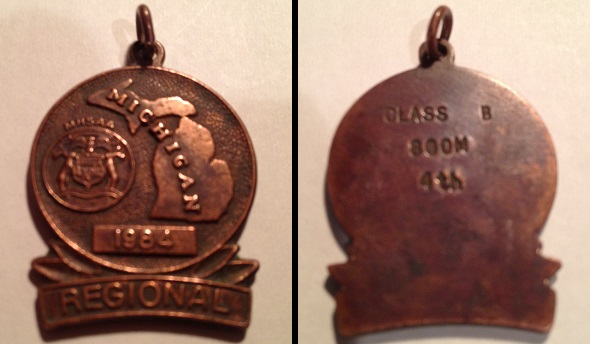
Did you lose this medal?
By
Geoff Kimmerly
MHSAA.com senior editor
August 19, 2013
It’s not quite a needle in a haystack. But it could turn into a great story.
This 1984 MHSAA Regional medal, pictured above, was found recently in Massachusetts with a metal detector. The finder, coincidentally a former collegiate track and field coach, hopes to return the medal to its rightful owner.
 Doing so might not be as difficult as it sounds, but we’ll need help from our friends in the track and field community.
Here’s what we know:
- The medal was received for finishing fourth in the 800 meters at a Class B Regional in 1984.
- The Regional had to be in the Lower Peninsula, because Class A and Class B were and continue to be combined in the Upper Peninsula.
- There were 10 Class B Regionals during the 1984 season, hosted by Sturgis, Parma Jackson County Western, Chelsea, Warren Fitzgerald, Linden, Corunna, Ovid-Elsie, Fremont, Greenville and Gaylord.
- So that means the medal could have only 20 possible owners.
Unfortunately, we do not have Regional results from the 1980s on file in our office. That’s where our helpers come in.
If you have results, or any idea who won this medal, please contact me at [email protected]. If we can connect medal with owner, we’ll tell much more of this story – including that of the coach who found it and made the call to start its return trip home.