

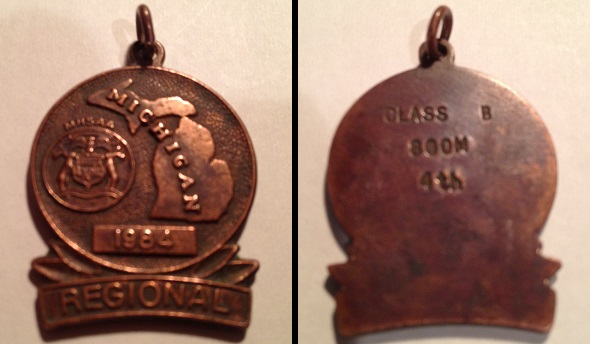
Did you lose this medal?
By
Geoff Kimmerly
MHSAA.com senior editor
August 19, 2013
It’s not quite a needle in a haystack. But it could turn into a great story.
This 1984 MHSAA Regional medal, pictured above, was found recently in Massachusetts with a metal detector. The finder, coincidentally a former collegiate track and field coach, hopes to return the medal to its rightful owner.
 Doing so might not be as difficult as it sounds, but we’ll need help from our friends in the track and field community.
Here’s what we know:
- The medal was received for finishing fourth in the 800 meters at a Class B Regional in 1984.
- The Regional had to be in the Lower Peninsula, because Class A and Class B were and continue to be combined in the Upper Peninsula.
- There were 10 Class B Regionals during the 1984 season, hosted by Sturgis, Parma Jackson County Western, Chelsea, Warren Fitzgerald, Linden, Corunna, Ovid-Elsie, Fremont, Greenville and Gaylord.
- So that means the medal could have only 20 possible owners.
Unfortunately, we do not have Regional results from the 1980s on file in our office. That’s where our helpers come in.
If you have results, or any idea who won this medal, please contact me at [email protected]. If we can connect medal with owner, we’ll tell much more of this story – including that of the coach who found it and made the call to start its return trip home.
This Week In High School Sports: 2/14/20
February 14, 2020
This week’s show highlights Farmington United gymnast Elena Vargo, presents Game Balls to Mount Clemens basketball's Javaughn Hannah and Houghton basketball's Brad Simonsen, explains hoops' held ball rule and discusses the multi-sport background of a Super Bowl star.
The 5-minute program, powered by MI Student Aid, leads off each week with feature stories from around the state from the MHSAA’s Second Half or network affiliates. "Be The Referee," a 60-second look at the fine art of officiating, comes in the middle of the show and is followed by a closing MHSAA "Perspective."
Listen to this week's show by Clicking Here.
Past editions
Feb. 7: Trenton swimmer Michael Wolsek, need for women in leadership positions in athletics - Listen
Jan. 31: Utica Ford bowling's Kensington Holland, winter lessons on civility - Listen
Jan. 24 White Pigeon multi-sport standout Claycee West, 2020 Youth Football Forum - Listen
Jan. 17: Promoting and protecting youth football, amateurism in educational athletics - Listen
Jan. 10: Livonia Stevenson hockey's Seth Lause, multi-media and social media impacts - Listen
Dec. 27: Mona Shores "Sailor Nation" life-saving success - Listen
Dec. 20: Battle of the Fans IX, details on purchasing Finals broadcasts - Listen
Dec. 13: Port Huron United hockey, what matters most in high school sports - Listen
Dec. 6: Highlights from 2019 11-Player Football Finals, instant replay in review - Listen
Nov. 29: Highlights from 2019 8-Player Football, Girls Volleyball and Girls Swimming & Diving Finals - Listen
Nov. 22: Ida volleyball record-setter Taylor Wegener, new Football Finals video review - Listen
Nov. 15: Reading lineman Nick Affholter, coaches as leaders in sportsmanship - Listen
Nov. 8: Lower Peninsula Cross Country and Boys Soccer Finals highlights - Listen
Nov. 1: Muskegon Orchard View football, bolstered MHSAA broadcast schedule - Listen
Oct. 25: Grand Rapids NorthPointe Christian girls golf, MHSAA Football Playoff selection - Listen
Oct. 18: Mendon volleyball's title drive, recognition for longtime announcer Erik O. Furseth - Listen
Oct. 11: Negaunee cross country's Emily Paupore, MHSAA mental health awareness efforts - Listen
Oct. 4: South Lyon soccer's Josh Mason, improving youth football - Listen
Sept: 27: Utica Eisenhower golfer Ariel Chang, adult fan behavior - Listen
Sept: 20: Pinckney football inspiration, decisions made at the local level - Listen
Sept. 13: Muskegon's offensive line, soccer substitution rule change - Listen
Sept. 6: Jenison girls golf's inspiration, new football practice contact restrictions - Listen
Aug. 30: St. Johns quarterback-now-coach Andy Schmitt, benefits of a multi-sport experience - Listen