

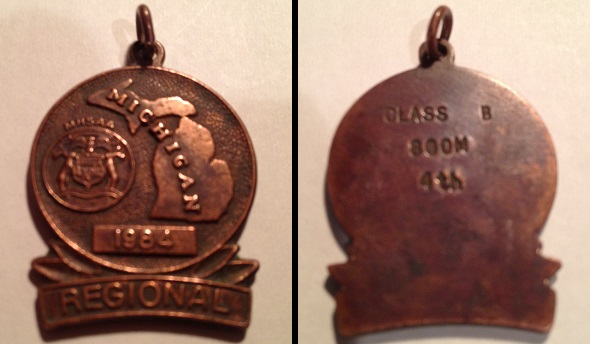
Did you lose this medal?
By
Geoff Kimmerly
MHSAA.com senior editor
August 19, 2013
It’s not quite a needle in a haystack. But it could turn into a great story.
This 1984 MHSAA Regional medal, pictured above, was found recently in Massachusetts with a metal detector. The finder, coincidentally a former collegiate track and field coach, hopes to return the medal to its rightful owner.
 Doing so might not be as difficult as it sounds, but we’ll need help from our friends in the track and field community.
Here’s what we know:
- The medal was received for finishing fourth in the 800 meters at a Class B Regional in 1984.
- The Regional had to be in the Lower Peninsula, because Class A and Class B were and continue to be combined in the Upper Peninsula.
- There were 10 Class B Regionals during the 1984 season, hosted by Sturgis, Parma Jackson County Western, Chelsea, Warren Fitzgerald, Linden, Corunna, Ovid-Elsie, Fremont, Greenville and Gaylord.
- So that means the medal could have only 20 possible owners.
Unfortunately, we do not have Regional results from the 1980s on file in our office. That’s where our helpers come in.
If you have results, or any idea who won this medal, please contact me at [email protected]. If we can connect medal with owner, we’ll tell much more of this story – including that of the coach who found it and made the call to start its return trip home.
Youth Sports: 'Focus on the End User'
August 24, 2018
By Geoff Kimmerly
Second Half editor
As we at the MHSAA work toward promoting the benefits of a multi-sport experience at the high school level, we – with our Multi-Sport Task Force – realize these messages will be most valuable when they reach parents of children at the youth levels.
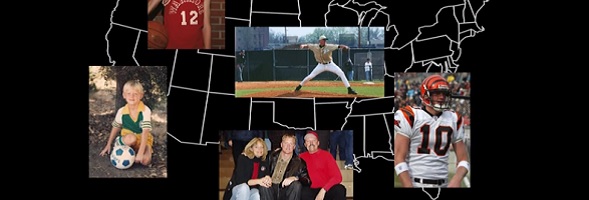
Below is an 18-minute TEDx talk by Travis Dorsch, a former kicker and punter at Purdue University and with multiple NFL teams who went on to receive his doctorate from Purdue and currently serves as an assistant professor at Utah State. He has conducted significant study on children’s youth sport participation and its impacts particularly on family relationships.
In this talk, he speaks on proper expectations for young athletes and how financial costs of youth sports have twisted those expectations.
Dorsch will speak at the 6th Annual Kristen Marie Gould Endowed Lecture on Sport for Children and Youth on Sept. 6 at Michigan State University. He will be lecturing on “From Sandlot to Stadium: What We Know, What We Don't, and Best Practices for Parent Involvement in Youth Sport.”