

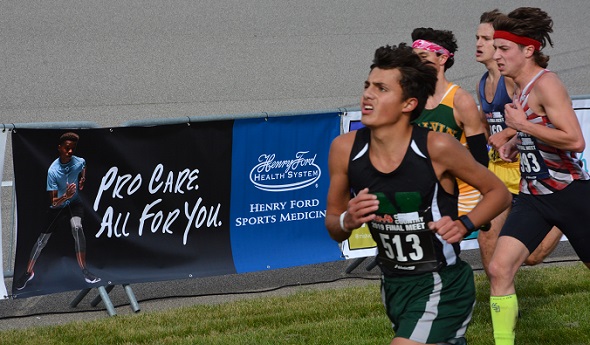
Enhancing Your Running Performance
August 4, 2020

Henry Ford Health System
With summer now in full swing and many people still avoiding gyms, lots of us are hitting the track, the streets and the trails to get and stay fit.
Whether you run marathons or prefer a quick lap around the block, there are many ways to adjust your running routine to get the most out of your workout.
"It's not uncommon for runners to get into a regular running routine," says Jamie Schwab, an athletic trainer at Henry Ford Health System. "They'll find a comfortable pace and stick with it, often even doing the same route." Unfortunately, doing the same run day after day not only leads to boredom, but it can also prevent you from reaching your full potential.
5 Tips to Run Smarter
It’s no secret that running is tough on the body. In fact, runners frequently develop muscle imbalances that make the body work harder. But you can take steps that can help you improve your run, maximize efficiency and get the most out of your running workout. Here's how:
1. Listen to your body: Whether you're a seasoned runner or just starting out, pay close attention to what your body is telling you. If your hips and knees are sore, back off. Feeling strong? Run another mile. The key to improving your run is to gradually increase distance and intensity over time. At first, you may only be able to handle a 10- or 15-minute jog. But if you keep at it, you'll be running for 30 minutes straight in no time.
2. Get the right footwear: If you're not a competitive runner, you might think any pair of running shoes will do. In reality, properly fitted running shoes not only enhance your performance but also reduce your risk of injury. Find a running store that can analyze your form and recommend shoes based on your unique gait and foot strike.
3. Pay attention to your target heart rate: Your target heart rate is 220 minus your age. Once you hit that rate during your run, you're working at maximum capacity. Don't want to invest in a heart rate monitor or be bothered with another tracking device? You're probably hitting the zone if you can still carry on a conversation during your run.
4. Focus on strength: If you're an avid runner but you aren’t strength training, you're setting yourself up for injury. "You're asking your body to do a lot during a run," Schwab says. "Weak glutes or hips add stress to your knees and ankles." Want to stabilize your run? Pay special attention to your core muscles. Solid strength training exercises include lunges, planks, squats and pushups.
5. Keep it interesting: Doing the same running routine day after day can be exhausting. Break out of your comfort zone by trying a different route, playing with your pacing, or running stairs or hills. You might even incorporate plyometric activities into your run. These explosive motions — hopping, skipping and jumping — help build power, strength and performance.
Running Safe
Eating well and getting regular exercise are key to enhancing overall health. Plus, a fit body is better equipped to avoid and battle infection. Running can also protect your sanity.
"Running is a great escape for many exercise enthusiasts," Schwab says. "Many people find they not only feel physically healthier, but their mental and emotional health also gets a boost."
The caveat: When you're running, you're placing double or triple your body weight on one side of your body at a time. So it's critical to pay attention to what shape your body is in before you take to the track. A few questions to ask yourself:
• Am I in good cardiovascular shape?
• Am I recovering from shin splints, knee injuries or hip problems?
• Am I at risk of falls?
• Am I suffering from osteoporosis?
It’s always important to check with your doctor before making changes in your exercise regimen. If running isn't appropriate for you, plenty of other activities, such as swimming, hiking and biking, can get your heart pumping.
Jamie Schwab, AT, ATC, SCAT, CSCS, is an athletic trainer with Henry Ford Sports Medicine and works with student athletes at Edsel Ford High School. She is a National Strength and Conditioning Association certified strength and conditioning specialist.
Want to learn more? Henry Ford Health System sports medicine experts are treating the whole athlete, in a whole new way. From nutrition to neurology, and from injury prevention to treatment of sports-related conditions, they can give your athlete a unique game plan.
Visit henryford.com/sports or call (313) 972-4216 for an appointment within 24 business hours.

NFHS Voice: Nationally, Lost Spring Ends
May 8, 2020
By Karissa Niehoff
NFHS Executive Director
On Monday, the New Jersey State Interscholastic Athletic Association became the 51st and final NFHS member state high school association to cancel its spring sports championships due to the Coronavirus pandemic.
The cancellation announcements began in late March and stretched to early May as states made every attempt possible to conduct spring sports and other activity programs.
Driven by a desire to offer perhaps a few weeks of competition – particularly for graduating seniors – many states waited as long as possible to move from postponed to cancelled, ultimately forced to make decisions when schools were closed to in-person learning for the remainder of the academic year.
While the leaders of our state associations knew that spring activities could not occur if schools did not re-open, and that the health and safety of the millions of participants ultimately drove these decisions, having to make these announcements was perhaps the most difficult task they had experienced as state leaders.
“We are disappointed for the thousands of New Jersey student-athletes who will be unable to compete this spring,” said Larry White, executive director of the New Jersey State Interscholastic Athletic Association. “While we remained hopeful to the end, and left open every possibility, competition simply is not feasible given the circumstances. It has been a harrowing time for everyone, and we know our student-athletes are extremely disappointed. That said, these unfortunate circumstances may have put an intriguing challenge in the path of our young people. As New Jersey’s own Vince Lombardi once said, ‘It's not whether you get knocked down, it's whether you get up.’ We’re confident all our kids will get back up and stand tall.”
Rhonda Blanford-Green, commissioner of the Colorado High School Activities Association, showed her emotions in making the difficult decision in her state:
“This decision, unlike the many decisions our office makes over the course of a year, has been extremely difficult because we are personally connected as former participants and officials, current parents and grandparents of graduating seniors, as well as educators and members of our high school communities. Our hats are off to the many seniors who have shown maturity and resolve as their culminating year of high school has been impacted beyond activities and athletics due to the worldwide COVID-19 pandemic. The Class of 2020 will not be forgotten.”
Craig Anderson, executive director of the Illinois High School Association, said, “Our thoughts are with all the impacted students, coaches and communities, especially the seniors. It will be difficult for them to find a silver lining in all of this, but we stress that even if they don’t get the chance to compete again at the high school level, they are better for having been a part of their respective high school teams. They were exposed to life lessons in teamwork, leadership and overcoming adversity that are difficult to replicate elsewhere.”
What was at stake and who was affected by these cancellation announcements? More than 500 girls and boys spring sports championships in about 18 sports and involving about three million student-athletes. Along with multiple classes for both boys and girls in track & field, other sports affected this spring were baseball, softball, lacrosse, golf, tennis, soccer, flag football, boys volleyball, water polo, weightlifting, gymnastics, riflery, judo, Unified track & field and ultimate Frisbee. Also grounded were perhaps another million participants in band, choir, orchestra, speech, debate, robotics and other activity programs.
And last, but far from least, we remember the thousands of volunteers who make these events happen every year – ticket-takers, concession stand workers, booster club parents, meet officials and the leaders in communities throughout the country where these events were planned. We thank these individuals for their faithful service year after year, and we look forward to the day we are all back together again.
Dr. Karissa L. Niehoff is in her second year as executive director of the National Federation of State High School Associations (NFHS) in Indianapolis, Indiana. She is the first female to head the national leadership organization for high school athletics and performing arts activities and the sixth full-time executive director of the NFHS, which celebrated its 100th year of service during the 2018-19 school year. She previously was executive director of the Connecticut Association of Schools-Connecticut Interscholastic Athletic Conference for seven years.