

Granlund's Voice Continues to Tell Story in 56th Year Serving Clarkston Schools
By
Keith Dunlap
Special for MHSAA.com
February 13, 2025
CLARKSTON — When many people think of Clarkston as a community, high school and athletic program, they understandably think of Dan Fife.
 After all, Fife was a hometown hero as a standout basketball and baseball player at Clarkston High School, a college basketball player at Michigan, a professional baseball player and ultimately, the longtime boys basketball coach and athletic director who built that hoops program into a state power.
But what some might not know is that there is another prominent figure connected to the school and athletic program, one who has served the community since the year after Fife graduated from high school in 1967.
It’s hard to imagine anyone having Clarkston more in his heart and soul than Neil Granlund.
The 79-year-old Granlund has been a part of the Clarkston community since starting his teaching career in the district in 1968. He is best-known at the moment not just as an announcer within the athletic program, but as pretty much THE announcer for Clarkston athletics.
Granlund is the main announcer for contests in football, boys and girls basketball, hockey, boys and girls soccer, and track & field. He also helps out announcing for volleyball, wrestling, lacrosse and field hockey.
And those are just the high school sports within the community. Granlund also announces middle school track events.
Granlund took over the football and basketball duties in 2018 after the longtime “Voice of the Wolves,” Dale Ryan, retired. For all those years, Granlund was Ryan’s right-hand man spotting in the press box and working the clock.
When Ryan stepped away, it was a no-brainer to have Granlund take over, even if he was seemingly announcing every other sport for the school.
 When Granlund stepped into Ryan’s role for football and basketball, he said Fife offered some advice.
“He gave me instructions on what to and how he wanted it done,” Granlund said. “He told me that you’re not the cheerleader. He didn’t want nicknames for the kids. Just keep it strait-laced and treat both schools fairly. I’ve always stuck to that.”
Granlund said announcing Clarkston football games when the Wolves played at Michigan Stadium in Ann Arbor and doing Clarkston team introductions when they advanced to championship games at Ford Field have been thrills, adding others in the community have helped make his life easier when switching from sport to sport.
“I had mediocre understanding of the sports, but I’ve had good people to work with,” he said. “In football, you are only as good as your spotter.”
Clarkston as an athletic program has had many memorable moments since 2013, whether it’s been the football team breaking through and winning Division 1 titles in 2013, 2014 and 2017, or Fife finally realizing a lifelong dream by leading the basketball team to Class A titles in 2017 and 2018.
But Granlund said the most memorable moment came during a basketball game at the old high school between Clarkston and historic archival Pontiac Northern.
Clarkston was coached by Fife, while Northern was coached by the legendary Sy Green, and the game was played before the 3-point line.
Granlund said before that game, referees told him that they couldn’t hear the buzzer on the scoreboard.
So they gave Granlund a task.
The referees gave Granlund a towel and said If the game came down to a buzzer-beating shot, Granlund would monitor the clock and the action on the court to see if the player beat the clock with his shot. Granlund would then throw the towel to the middle of the court to indicate that the shot counted.
 “Sure thing, that’s what did happen,” said Granlund, adding Clarkston was down by two and attempting a game-tying shot. “Clarkston went on to tie the game. I remember when that did go off — I had that panel in front of me so I could see exactly what the time was on the clock when it had left the player’s hand — both Sy Green and Dan Fife looked at me and I gave the signal that the basket was good. That tied the game, and it went into overtime. That was exciting. Everything in that old gym was exciting.”
While that was the most memorable moment to date for Granlund at Clarkston, the one he wants to see most hasn’t happened yet.
Granlund’s biggest dream is to see the boys soccer team win a Finals championship, something it came closest to accomplishing in 2007 when the Wolves lost to East Kentwood in the Division 1 title match.
Granlund was the school’s first boys soccer coach, starting the program in 1983, and helped build it up until he stepped away as coach in 1990. But he has stayed involved as the announcer and a general supporter.
“I wish we could (win a state title) one of these days,” he said. “Having started the soccer program here, I always stuck with it.”
Even though he is nearing 80, Granlund might still be around to one day see the Wolves win that soccer championship. He still teaches a construction tech class for the high school, doing so for the same reason he still announces: He loves being around kids he says are so good to him.
Teaching also gives him an opportunity to spend more time with his grandson, who is in the class.
“He said ‘Grandpa, will you stick around for a couple more years?’” Granlund said. “I said, ‘Oh yeah.’”
As for announcing, listen for his voice to still be a fixture at Clarkston sporting events for the foreseeable future.
“For a while longer,” he said. “I really do enjoy it.”
 Keith Dunlap has served in Detroit-area sports media for more than two decades, including as a sportswriter at the Oakland Press from 2001-16 primarily covering high school sports but also college and professional teams. His bylines also have appeared in USA Today, the Washington Post, the Detroit Free Press, the Houston Chronicle and the Boston Globe. He served as the administrator for the Oakland Activities Association’s website from 2017-2020. Contact him at [email protected] with story ideas for Oakland, Macomb and Wayne counties.
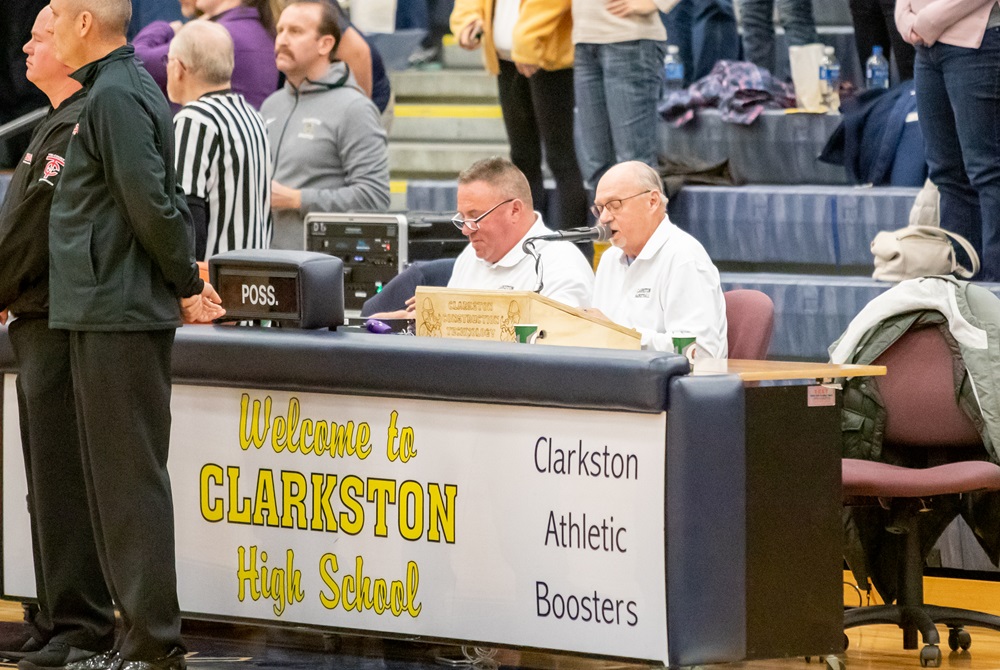
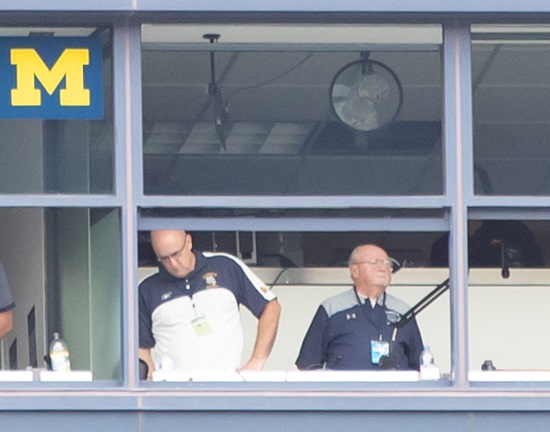
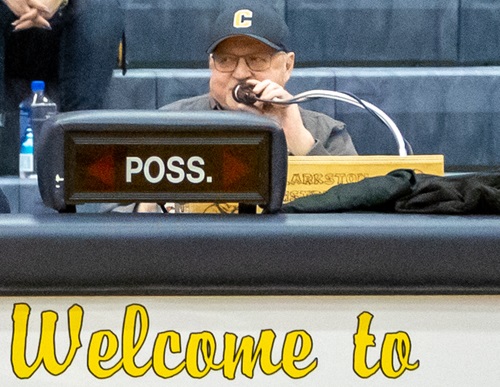
PHOTOS (Top) Neil Granlund, speaking into the microphone, announces during a Clarkston home basketball game. (Middle) Granlund, right, takes his place in the Michigan Stadium press box in advance of announcing Clarkston’s “Battle at the Big House” football game. (Below) Granlund narrates the action during another event at the school. (Photos by Larry Wright.)
This Week in High School Sports: 9/7/22
By
Jon Ross
MHSAA Director of Broadcast Properties
September 7, 2022
This week's edition highlights growth in MHSAA sports participation during the 2021-22 school year, awards Game Balls to standouts in soccer, football and golf; explains a volleyball rule change regarding teams switching benches between sets, and tells the Title IX story of graduated Paw Paw competitive cheer all-stater Paige Miller.
 The 5-minute program each week includes feature stories from MHSAA.com or network affiliates, along with "Be the Referee," a 60-second look at the fine art of officiating.
"This Week in High School Sports" is powered by MI Student Aid, a part of the Office of Postsecondary Financial Planning located within the Michigan Department of Treasury.
Listen to this week's show by Clicking Here.
Past editions
Aug. 31: Michigan Power Ratings and soccer seeding, Fenton's Gracie Olsen - Listen
Aug. 24: Redesigned MHSAA.com, key dates and how to watch football in 2022 - Listen