

The Inherent Risk of Sport Specialization
April 30, 2018
 By Bob Gardner
Executive Director of the National Federation of State High School Associations
One of the responsibilities that parents take most seriously is protecting their children from injury, whether it is buckling seat belts in a car or wearing a helmet while riding a bike. And when their kids become teenagers and want to participate in sports or other activities, parents do everything they can to keep their sons and daughters from getting hurt.
But not all injuries are caused by a twist, fall, collision or accident. Many are caused when young athletes repeat the same athletic activity so often that muscles, ligaments, tendons and bones don’t have time to recover—especially among middle school and high school students. These injuries can end promising careers, cost families tens of thousands of dollars, squash dreams and literally change lives.
Examples include elbow and arm injuries to teenagers who play baseball or softball all year long, shoulder injuries to year-round swimmers, wrist and elbow injuries to gymnasts, and stress fractures to soccer players.
The culprit, most often, is what’s commonly known as “sport specialization,” the process of playing the same sport all year long with the goal of either gaining a competitive edge or earning a college scholarship. It involves intense, year-round training in a single sport.
Research shows that sports specialization is putting teenage athletes at risk. According to a study commissioned by the National Federation of State High School Associations (NFHS) and conducted by researchers from the University of Wisconsin, high school athletes who specialize in a single sport are 70 percent more likely to suffer an injury during their playing season than those who play multiple sports.
The American Academy of Orthopedic Surgeons says much the same. It reports that “overuse injuries” (injuries caused when an athletic activity is repeated so often that parts of the body do not have enough time to heal) are responsible for nearly half of all sports injuries to middle school and high school students.
There is a solution. Young athletes should be encouraged to play multiple sports.
When student-athletes cross-train, they work different muscle groups and joints which, in fact, results in better overall conditioning. They also develop a new set of athletic skills like hand-eye coordination, balance, endurance, explosion and agility that are transferable to their primary sport. It’s no coincidence that 30 of the 32 first-round picks in the 2017 National Football League draft played multiple sports in high school.
Parents can play a key role in preventing these overuse injuries by encouraging their kids to play multiple sports rather than pushing them to specialize in one sport. They will have more fun, will be less likely to suffer burnout and will actually become better athletes.
Century of School Sports: On This Day, December 13, We Will Celebrate
By
Geoff Kimmerly
MHSAA.com senior editor
December 10, 2024
This Friday, December 13, 2024, the Michigan High School Athletic Association will commemorate its 100th anniversary, a special day selected from a milestone school year as the MHSAA continues to celebrate a “Century of School Sports.”
But why December 13?
Short answer: On that day, the first Representative Council of the newly-formed MHSAA met for the first time.
Longer explanation: The MHSAA’s predecessor – the Michigan Interscholastic Athletic Association – had provided oversight of school athletics from 1909-24, and adjourned its final annual meeting Dec. 5, 1924. The reasons for the end of the MIAA and formation of the MHSAA are fascinating on their own, and we’ll cover that at a later date.
But as for this important date we are discussing this week:
- At the end of the MIAA, all that remained was a committee elected to represent various sections of the state and various sizes and types of schools during the transition – a 12-member Representative Council.
- Prior to the MIAA’s conclusion, a basketball rules interpretation meeting had been scheduled and publicized for Saturday, Dec. 13, 1924, in Ann Arbor. Several athletic directors, basketball coaches and officials were expected to attend, and it was decided to also conduct the first meeting of the Representative Council that day as well.
- The Council meeting was held at the Michigan Union. Ten of 12 Council members were present, with the board including representatives from multiple regions and both peninsulas, schools large and small, public and nonpublic; junior high schools and the state department of education, and with expertise in physical education, administration and coaching – in essence, the same mix that makes up much of the Council a century later.
- Officers were elected, funds were transferred from the former MIAAA to the new MHSAA, a committee was appointed to begin discussing policies for junior high sports as they had begun to emerge, and the first Executive Committee – then known as the “Committee on Appeals” was formed to consider appeals of eligibility decisions made by the state director. The 1925 MHSAA Basketball Tournament was discussed and a committee formed to work toward those arrangements. Finally, a football eligibility situation was considered and a member school suspended, to be reinstated two months later after satisfying a series of conditions to make restitution for the use of ineligible players.
And the rest is history, with more made every year.
To commemorate this 100th anniversary, the MHSAA has received tributes from Gov. Gretchen Whitmer and Lt. Gov. Garlin Gilchrist II, and the Michigan Legislature signed as well by Sen. Sam Singh and Rep. Penelope Tsernoglou from the MHSAA office’s legislative districts.
The gubernatorial declaration states in part, “We honor the MHSAA’s rich legacy and the countless athletes, coaches, and volunteers who have contributed to the success of Michigan high school sports. The MHSAA’s commitment to enhancing the lives of student-athletes and strengthening communities across the state is truly remarkable.”
The legislature’s proclamation adds, “May this day serve as a testament to the MHSAA’s remarkable achievements and its enduring commitment to the advancement of high school athletics and the well-being of student-athletes across Michigan.”
Previous "Century of School Sports" Spotlights
Dec. 3: MHSAA Work Guided by Representative Council - Read
Nov. 26: Finals Provide Future Pros Early Ford Field Glory - Read
Nov. 19: Connection at Heart of Coaches Advancement Program - Read
Nov. 12: Good Sports are Winners Then, Now & Always - Read
Nov. 5: MHSAA's Home Sweet Home - Read
Oct. 29: MHSAA Summits Draw Thousands to Promote Sportsmanship - Read
Oct. 23: Cross Country Finals Among MHSAA's Longest Running - Read
Oct. 15: State's Storytellers Share Fall Memories - Read
Oct. 8: Guided by 4 S's of Educational Athletics - Read
Oct. 1: Michigan Sends 10 to National Hall of Fame - Read
Sept. 25: MHSAA Record Books Filled with 1000s of Achievements - Read
Sept. 18: Why Does the MHSAA Have These Rules? - Read
Sept. 10: Special Medals, Patches to Commemorate Special Year - Read
Sept. 4: Fall to Finish with 50th Football Championships - Read
Aug. 28: Let the Celebration Begin - Read
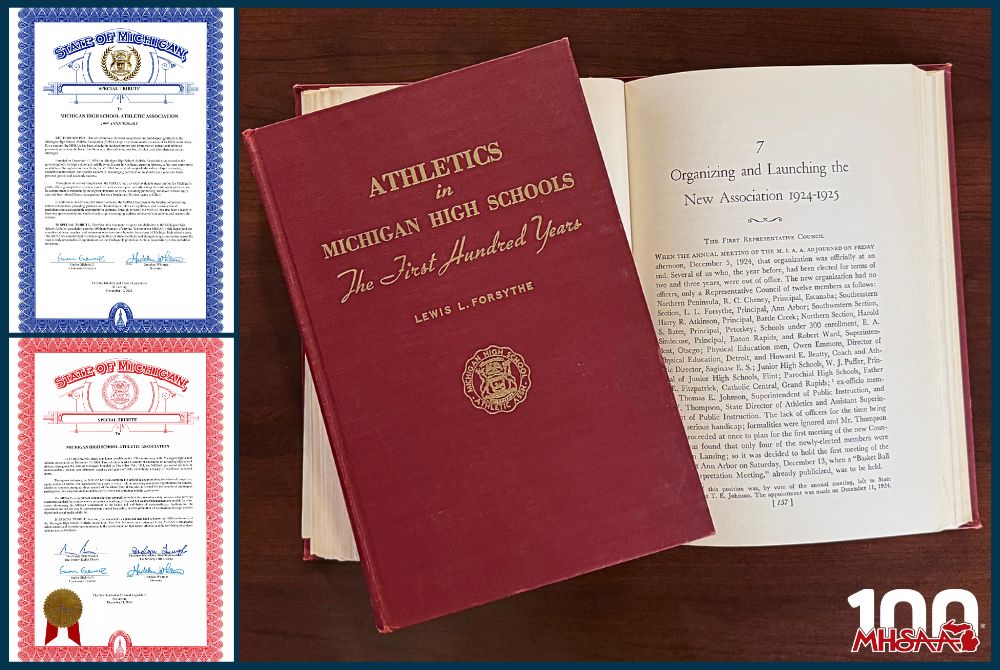
PHOTOS At left, gubernatorial and legislative commemorations recognize the MHSAA's 100th anniversary. At middle, the book "Athletics in Michigan High Schools - The First Hundred Years" is opened to the chapter introducing the early days of the MHSAA.