

Mason, Okemos Score for a Cure
By
Geoff Kimmerly
MHSAA.com senior editor
November 11, 2014
Three weeks remain in the MHSAA’s 2014 fall season, and we’ve collected a few notes to pass along as we wind down the final three sports before moving inside (except for skiing) for the winter.
 Below are an update on a fundraising game we previewed earlier, plus recognition for perfection at our Girls Golf Finals and another high honor for one of the top players in MHSAA volleyball history.
Score for a cure
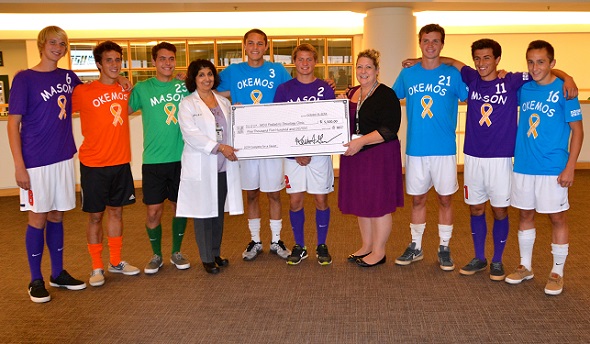
We wrote in September about an upcoming soccer game between Lansing-area powers that would raise money for pediatric cancer research. The “Compete for a Cause” game between Okemos and Mason on Sept. 13 was the third of what has become an annual event started by Mason’s team and coaching staff.
Attendance for this season’s game was nearly double the year before, and funds raised increased more than 500 percent.
The final tally: Roughly 1,400 fans attended the game, which raised $11,000 that was split between the CureSearch for Children’s Cancer national foundation and the Michigan State University Pediatric Oncology Clinic.
The first “Compete” game in 2012 raised $1,000, and the 2013 game drew 800 fans and raised about $2,000. This fall, Okemos was ranked No. 1 in Division 1 and Mason No. 7 in Division 2 when the game was played; it ended in a 1-1 tie. Both went on to postseason success – Okemos advanced to a Regional Final, and Mason fell to eventual Division 2 champion East Lansing in overtime in their Semifinal.
Only one shot needed
 It’s a rarity – most of the time. But for the second straight season, a player at the MHSAA Lower Peninsula Girls Golf Finals sunk a hole-in-one.
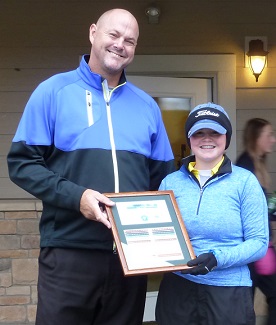
Grosse Pointe South’s Lucy Buzolitz aced the par-3 No. 12 at Bedford Valley in Battle Creek, dropping the shot from 97 yards out during the first round of Division 1 play. Buzolitz was one of two individual qualifiers from her team and shot a 92-97-189 for the two-day tournament.
At the 2013 Division 2 Final, Fenton then-sophomore Madison Shegos aced the par-3 18th hole at Michigan State University’s Forest Akers East.
Sportswoman of the Year
Former Leland and Penn State University volleyball standout and current U.S. national team setter Alisha Glass was a finalist for 2014 Team Sportswoman of the Year at the 35th Salute to Women in Sports gala in October in New York City.
The event, put on by the Women’s Sports Foundation, annually recognizes a Sportswoman of the Year for both individual and team sports based on nominations by sport governing bodies and the public. Glass was one of 10 candidates this year for the team award after being named USA Volleyball Indoor Female Athlete of the Year in 2013. She also was named International Federation of Volleyball’s best setter at the 2014 World Championship in Italy after helping the United States to the title.
Olympic gold medal-winning ice dancer Meryl Davis received the Sportswoman of the Year team award, while the individual award when to gymnastics all-around world champion Simone Biles.
PHOTOS: (Top) Members of the Mason and Okemos boys soccer teams present a check for $5,500 to the MSU Pediatric Oncology Clinic and Dr. Renuka Gera last month. (Middle) Lucy Buzolitz receives a plaque recognizing her hole-in-one at the Division 2 Golf Final from Bedford Valley head pro Dean Kolstad.

NFHS Voice: Salute Seniors with Spring on Hold
March 27, 2020
By Karissa Niehoff
NFHS Executive Director
A visitor to the local high school in late March would normally find boys and girls engaged in track and field, baseball, softball and lacrosse practices. Inside the building, some students would be involved with speech or debate activities. Unfortunately, this is not a normal year – far from it.
Spring sports playing fields are empty. High school sports and activities, with more than 12 million participants, are on pause, and high school athletes, coaches, athletic directors, parents and other fans are trying to determine when these programs will return.
The ever-changing news we are receiving almost on an hourly basis is more than one can comprehend as we all deal with this global health crisis. Each day, with the spread of the coronavirus, we try to determine what has changed since the day before. Can we go to work? Can we leave our house to go to the store?
Like every other activity in our nation, high school sports and activity programs are on hold. With all schools closed for varying amounts of time – some to the end of the academic year – millions of participants in spring sports and activities are on the sidelines awaiting the green light for competition to resume.
In past years, our member state associations and the 19,500 high schools across the country have had to postpone or cancel events for short periods of time due to weather or other factors, but this is unprecedented. The reality is that spring sports may never occur in some states – particularly those where schools are closed for the academic year. And this would be doubly disappointing in those states that were not able to conduct or complete state basketball championships.
The possibility of losing spring sports is particularly disappointing for graduating seniors. While everyone is affected by this health crisis and has their own issues to confront, it is important for everyone involved in high school activity programs to salute those seniors – boys and girls in sports and activities programs who have sacrificed for 3½ years but may not be able to reach the finish line.
While they may miss some of the final games and events, the benefits of being involved in these programs will carry them for a lifetime. The early-morning practices, offseason workouts and late-night studying after a day of activities will undoubtedly make them stronger and more dedicated in their future professions.
We thank all high school athletes and performing arts participants for the great memories – especially those who may not be able to complete their races or sing in the music ensemble this year. While some will have more competitive opportunities in sports and activities, for others that continued involvement may be in the form of coaching or officiating, but the impact of involvement in these programs will last a lifetime.
There have been times in the past when high school sports and performing arts helped individuals in communities through difficult times – events like weather-related disasters or school shootings as examples. We believe that these programs will play an even larger role once the coronavirus pandemic subsides and we are able to return to normalcy.
Why? Because after our days, weeks and perhaps months of social distancing, teamwork will help us all come back together, and there is no better demonstration of teamwork than education-based high school sports and activity programs.
We all anxiously await the day when the whistles blow and the curtains rise again.
Dr. Karissa L. Niehoff is in her second year as executive director of the National Federation of State High School Associations (NFHS) in Indianapolis, Indiana. She is the first female to head the national leadership organization for high school athletics and performing arts activities and the sixth full-time executive director of the NFHS, which celebrated its 100th year of service during the 2018-19 school year. She previously was executive director of the Connecticut Association of Schools-Connecticut Interscholastic Athletic Conference for seven years.