

NFHS Voice: Amateurism Benefits
October 9, 2019
By Karissa Niehoff
NFHS Executive Director
While we addressed a number of important issues with our member state associations at section meetings the past month, perhaps none of the topics are as significant as the tremor that occurred in California on September 30 – the signing of the “Fair Pay to Play Act” by California Governor Gavin Newsom.
Although there are more questions than answers at this point, this ruling would allow college athletes in the state of California to make money from their name, image and likeness through endorsement deals, sponsorships, autograph signings and other opportunities. The legislation is due to take effect in 2023.
Obviously, the NCAA opposes this legislation and is working through its governance structure to address the issue. As Mark Emmert, NCAA president, told the Indianapolis Star, “for all intents and purposes, athletes become employees of the schools. This is just a new form of professionalism and a different way of converting students into employees.”
And since it would not work for athletes in one state to be receiving money legally while athletes in the other 49 could not, a national bill similar to California’s is already being considered by U. S. Representative Anthony Gonzalez of Ohio.
Needless to say, the NFHS and its member state associations oppose the California ruling as it could further erode the concept of amateurism in the United States. At the high school level, current issues with parents pushing their kids into specialization in the fight for scholarships would only be exacerbated as they considered the “best offer” from colleges.
In the aforementioned Indianapolis Star article, Emmert noted the following: “Under the California law, there would be complete elimination of all of those rules (regulations related to shoe companies). It would also include the use of agents in that process and the agent could represent high school students.”
There is nothing more sacred and fundamental to the past – and future – history of high school sports in the United States than the concept of amateurism. While this California ruling addresses college sports directly, it undoubtedly would have an impact on sports at the high school level as well.
The signing of the “Fair Pay to Play Act” comes on the heels of the Alston v. NCAA case earlier this year in which a federal judge in California found the NCAA’s scholarship rules to be illegal – to a point. The NFHS filed an amicus curiae brief in support of the NCAA noting the following:
“Amateurism in athletics is not only valuable for its own sake, but also is a key aspect of a well-rounded education. The NFHS is concerned that the district court’s opinion does not fully appreciate either the concept of amateurism or the many benefits it brings to college and high school sports – and to American sports in general.
“... If amateurism were to give way to professionalism at the collegiate level ... high schools would struggle to fulfill their ultimate goal of preparing large numbers of well-rounded individuals for futures beyond athletics. … The NCAA should be afforded the freedom to define amateurism in a way that preserves the ideal of the student-athlete in higher education which would protect important values of education-based sports at all levels.”
The NFHS will continue to support the NCAA in its efforts to preserve amateurism as it is our belief that paying student-athletes – whether it is in the form of selling one’s name, image or likeness, or whether it eventually becomes a paycheck – will erode the spirit of sport at all levels in this country.
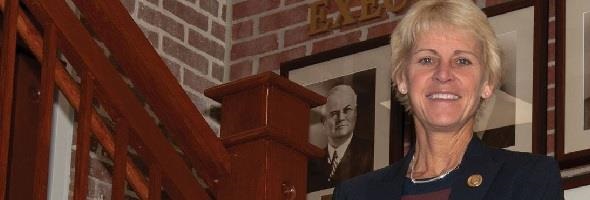
Dr. Karissa L. Niehoff is in her second year as executive director of the National Federation of State High School Associations (NFHS) in Indianapolis, Indiana. She is the first female to head the national leadership organization for high school athletics and performing arts activities and the sixth full-time executive director of the NFHS, which celebrated its 100th year of service during the 2018-19 school year. She previously was executive director of the Connecticut Association of Schools-Connecticut Interscholastic Athletic Conference for seven years.
This Week In High School Sports: 1/26/22
By
Jon Ross
MHSAA Director of Broadcast Properties
January 26, 2022
This week's edition celebrates three Michigan coaches recently named national Coach of the Year in their respective sports by the NFHS Coaches Association, awards Game Balls to high achievers in basketball and hockey, explains the wrestling inspection process and closes with a high-scoring hoops performance from Port Huron Northern. 
The 5-minute program each week includes feature stories from around the state from the MHSAA’s Second Half or network affiliates, along with "Be The Referee," a 60-second look at the fine art of officiating.
"This Week in High School Sports" is powered by MI Student Aid, a part of the Office of Postsecondary Financial Planning located within the Michigan Department of Treasury.
Listen to this week's show by Clicking Here.
Previous editions
Jan. 18: Midland Dow girls basketball, retiring coaches on all-time wins lists – Listen
Jan. 11: Battle of the Fans X "Challenge Round," officiating on the islands – Listen
Jan. 4: Onsted boys basketball, Oxford Strong – Listen
Dec. 15: Winter championship calendar, KLAA/MIHL Memorial Showcase – Listen
Dec. 8: 2021 Bush Award honorees, remembering Tom Rashid – Listen
Dec. 1: 11-Player Football Finals review – Listen
Nov. 23: Volleyball, LP Girls Swimming & Diving, 8-Player Football Finals review – Listen
Nov. 16: Lower Peninsula Cross Country continued, weekend preview – Listen
Nov. 9: Lower Peninsula Cross Country, Boys Soccer Finals review – Listen
Nov. 2: Title IX at 50 celebration, Fall championship broadcasts – Listen
Oct. 27: Upper Peninsula Cross Country Finals review, soccer/volleyball playoff update – Listen
Oct. 20: Lower Peninsula Girls Golf & Boys Tennis Finals review – Listen
Oct. 13: Middle school/junior high cross country Regionals, football playoff selection – Listen
Oct. 6: Upper Peninsula girls tennis champions, football broadcast update – Listen
Sept. 29: Girls swimming & diving "Meet of Champions," Schoolcraft's star kicker – Listen
Sept. 22: Spartan Invitational "elite" races, John U. Bacon's "Let Them Lead" – Listen
Sept. 15: Volleyball powers face off, Tiger Teusink's tennis legacy – Listen
Sept. 8: Fall sports rules changes, Adrian Lenawee Christian inspiration – Listen
Sept. 1: Boys soccer seeding process, Beaver Island athletics – Listen
Aug. 25: Return of Fall sports, “enhanced strength-of-schedule” football playoff format – Listen