

NFHS Voice: Lights Signal Thanks, Hope
April 24, 2020
By Karissa Niehoff
NFHS Executive Director
The closing of schools and the cancelling of spring activities is a disappointing end to high school for this year’s senior class. However, there is still reason for optimism.
We anticipate that senior athletes and activity participants in the class of 2020 will move on to the highest of leadership roles in their chosen professions in the years to come.
Prior to this year, these seniors have accrued the general benefits of high school sports and other activity programs in which students learn self-discipline, build self-confidence and develop skills for practical situations – teamwork, fair play and hard work. Not to mention that many have higher grade-point averages, better attendance records and are set for a higher success rate in their chosen careers.
Seniors in this year’s class, however, will be among the toughest graduates ever as their lives have been the bookends to two of the worst tragedies in our nation’s history. Born sometime during the 2001-02 school year, which began with the horrific events of September 11, 2001, these resilient 2020 graduates had an abrupt ending to their high school days with the ongoing national health crisis.
Understanding their disappointment of not getting to compete this spring, people from coast to coast are expressing their support for these high school students.
With an idea apparently born in Texas, further developed in Colorado and supported by many others during the past several weeks, lights at high school stadiums throughout the country have been brightening the night-time skies. The #BeALight hashtag accompanies post after post of schools participating in this recognition of seniors who are missing their final season of high school sports or performing arts.
In some cases, the lights come on at 8:20 (20:20 in military time) and glow for 20 minutes, 20 seconds – a connection to the 2020 spring season at hand. Currently, 38 states have officially cancelled spring sports and activities due to the COVID-19 pandemic, and it is likely more will follow.
Among the traditional spring sports of track & field, baseball, softball, lacrosse, tennis and golf, almost three million girls and boys will be affected by this shutdown, including upward of one million seniors.
These lights have been turned on to say thanks to those seniors and to let them know they will be missed. Their contributions to high school activity programs will be remembered forever, and the benefits they received will guide them throughout their chosen careers.
Electric bills notwithstanding, perhaps these lights can burn for 20 minutes every night until the games return later this year. The lights signify hope – a hope that these lights will burn again this fall to showcase high school sports and performing arts.
While the timing of the return of high school sports and activities will rest with each state high school association in consultation with local governments and state health officials, the positive impact on communities nationwide will be tremendous. Once all the critical medical precautions have been addressed, high school sports and performing arts could take center stage once again. Although it is still too early to forecast the return of high school sports, its impact could be extraordinary.
With the loss of many non-school and club sport opportunities due to financial issues, high school sports and performing arts could fill an even larger void in the lives of our nation’s youth. And we look forward to that time ahead when student-athletes are on the field and fans are in the stands. Be safe. Stay healthy.
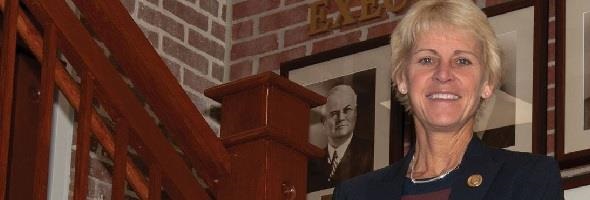
Dr. Karissa L. Niehoff is in her second year as executive director of the National Federation of State High School Associations (NFHS) in Indianapolis, Indiana. She is the first female to head the national leadership organization for high school athletics and performing arts activities and the sixth full-time executive director of the NFHS, which celebrated its 100th year of service during the 2018-19 school year. She previously was executive director of the Connecticut Association of Schools-Connecticut Interscholastic Athletic Conference for seven years.
NFHS Voice: 'New Normal' Sportsmanship
May 20, 2020
By Karissa Niehoff
NFHS Executive Director
The “new normal” is one of the many terms we hear repeatedly as the country begins its return to normal activities from the COVID-19 pandemic. Keeping six feet apart from other people, wearing a mask and frequent washing of hands are three of those important warnings.
And then there is the new “no-no” that cuts at the heart of high school sports – the handshake. Shaking hands has been a part of our culture for centuries and a mainstream of high school sports forever. It is hard to imagine high school sports without handshakes.
In addition to emotional displays among team members involving handshakes, high-fives and hugs, the handshake has been a way of demonstrating good sportsmanship toward the opponent.
In wrestling, for instance, shaking hands before a match is actually a part of the rules, which, of course, will have to be relaxed for the coming season. There are handshakes at the coin toss in football and before the opening jump ball in basketball.
After a hard-fought, back-and-forth tennis match, players meet at the net to shake hands – congratulating each other for their efforts. The actions are the same after golfers battle each other for 18 holes – removing the cap and shaking hands.
These age-old practices demonstrate respect for the opponent, and in the case of post-game handshakes, graciousness in victory or defeat.
The emotions in high school sports are often off the chart, with end-of-game celebrations by players, coaches and fans involving handshakes, high-fives and hugs. So, as the early phases of return to sports occur this fall, how do we meet social distance guidelines and continue to exhibit emotions and emphasize sportsmanship, which typically have involved touching between individuals?
While the social-distancing and no-contact guidelines are necessary – at least for the short term – to diminish the spread of the virus, they should not dampen the enthusiasm and emotion by everyone involved with high school sports. We hope these types of restrictions will be lifted at some point down the road, but for now, this is our “new normal.”
The absence of these time-honored ways to express respect for the opponent does not diminish the importance of displaying sportsmanship in high school sports. In fact, we believe concern for fairness and displays of kindness, respect and graciousness will be more pronounced once high school sports resume; however, the methods of sharing these feelings will be different.
Although perhaps not as endearing as a handshake, high-five or hug, there are other ways to express these feelings and emotions – for the opponent as well as teammates.
Some alternatives to consider are a slight bow with the palms pressed together, an air high-five, a smile and quick wave, a double-tap of the right hand across the heart and a wink with the thumbs up. Certainly, there are other possibilities – in fact, teams could develop their own methods for demonstrating sportsmanship to their opponents and celebrating big plays or victories with teammates. Through their resilience and great spirit, we look forward to how the millions of participants in high school sports and activities will accept this challenge.
There will be many concessions necessary to resume athletic competition, and shaking hands is one that must cease – at least for now. However, let’s view this change as an opportunity to find new ways to showcase sportsmanship in high school sports.
Dr. Karissa L. Niehoff is in her second year as executive director of the National Federation of State High School Associations (NFHS) in Indianapolis, Indiana. She is the first female to head the national leadership organization for high school athletics and performing arts activities and the sixth full-time executive director of the NFHS, which celebrated its 100th year of service during the 2018-19 school year. She previously was executive director of the Connecticut Association of Schools-Connecticut Interscholastic Athletic Conference for seven years.