


NFHS Voice: Madness to Maddening
March 23, 2020
By Karissa Niehoff
NFHS Executive Director
March Madness took on another meaning for everyone in the sports world during the week of March 9 – a week like none other in the history of organized sports with the acceleration of the coronavirus (COVID-19) in the United States.
The Madness was not the bouncing of basketballs in arenas around the country. Instead it was organization after organization trying to determine the viability of continuing to operate – particularly after the suspension of the NBA season and the cancellation of the NCAA Division I Men’s and Women’s Basketball Championships.
And NFHS-member state high school associations were among those organizations faced with making decisions because the heightened state of the coronavirus pandemic occurred in the middle of state high school basketball tournaments across the country. While 13 states had completed their tournaments, the remainder were faced with tough decisions throughout the week.
By the end of that week, another four states were able to complete their girls and boys basketball tournaments – although all of these states had to impose extreme limits on the number of fans in attendance.
About two-thirds of our member state associations had to shut down their tournaments. At this point, 19 state associations have cancelled their state basketball tournaments, while 15 others have postponed or suspended their events, although the hope of completing them seems to fade with each passing day.
In addition to basketball, some states were in the midst of conducting ice hockey, gymnastics and swimming championships. While most of those sports championships, along with wrestling, were completed, some states were forced to suspend or cancel these as well.
Because of varying information from state health leaders, the Centers for Disease Control and Prevention (CDC) and state governors, some states were able to continue playing longer than others. Each state’s high school basketball tournament is one of the anticipated events of the year – particularly for residents in towns with schools playing for a state title.
From start to finish of state basketball tournaments in the 50 states plus the District of Columbia, more than one million fans trek to gymnasiums to watch these events. This year, however, many of these fans, along with about half of the 950,000 boys and girls who play high school basketball, were not able to experience March Madness.
And if this wasn’t enough, spring sports seasons and championships are at risk – mainly because schools are closed in many states, which means the discontinuation of school activity programs. The NCAA has cancelled all spring sports championships; and while state associations haven’t cancelled spring championships yet, athletics and activities programs are on hold for a set period of time – or indefinitely in some states.
While the loss of college and professional sports has an enormous impact on everyday life, considering that events surrounding the coronavirus affect some 19,500 high schools and 12 million participants in high school sports and performing arts activities, the impact on high school sports is perhaps even larger.
We support our 51 member state association leaders as they continue to work through these challenges. The loss of state basketball championships in many states is a sizeable financial challenge ahead as they work to continue to make state-level athletics and activities programs available.
On many occasions, we have written about the value of high school sports and activities. This month, we have witnessed the disappointment of thousands and thousands of players and fans who were not able to experience a state championship – many of whom were “going to state” for the first time.
High school sports is different from every other level of sport as these programs are a vital part of communities across our nation. Two weeks ago, when the doors were closed in many gymnasiums, it was confirmation of the desire and need for education-based high school sports and activities in the United States.
During this time of imposed social distancing, it is a time to step back and be thankful for these programs in our nation’s schools.
Dr. Karissa L. Niehoff is in her second year as executive director of the National Federation of State High School Associations (NFHS) in Indianapolis, Indiana. She is the first female to head the national leadership organization for high school athletics and performing arts activities and the sixth full-time executive director of the NFHS, which celebrated its 100th year of service during the 2018-19 school year. She previously was executive director of the Connecticut Association of Schools-Connecticut Interscholastic Athletic Conference for seven years.
Flyers to Terriers, Quakers & Orioles
December 15, 2020
By Ron Pesch
Special for Second Half
Education and all that comes with it, in case you haven’t noticed, is changing. Of course, that’s always been the case. Virtual learning is simply the latest transformation.
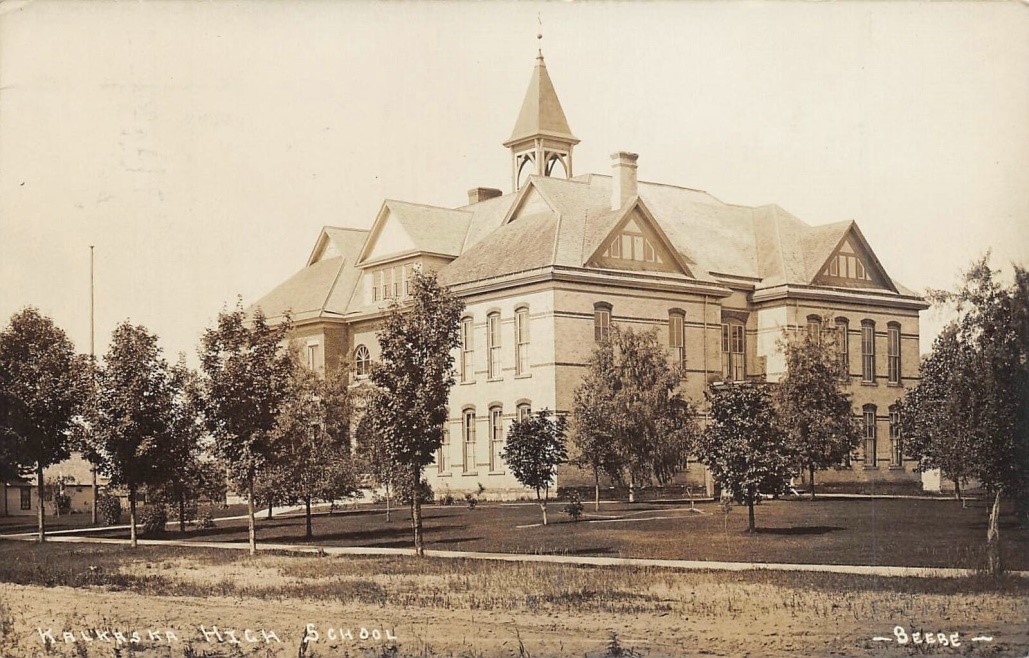
Once we were a nation filled with one-room school houses. By 1910, postcard evidence shows that, at least in Michigan, nearly every town of size had a high school, and that these buildings were showcases for community pride. From wood to brick to limestone, many of the earliest structures had bell towers. By the 1920s, in larger cities, small schools run by neighborhood churches were quite common. Most from those days were multiple-story buildings.
In hindsight, some of those buildings seem incredibly large for the communities they served. Others, too small – especially come the post-war baby boom era, when the suburbs exploded with growth and opportunity and Michigan’s major cities began to shrink in size. The 1950s and 1960s saw numerous Upper Peninsula and rural schools consolidate, while various big-city suburban districts split into two.
 Continued development beyond the first ring of suburbs and decreasing birth rates have combined, with the introduction of school of choice in 1996, to played havoc with enrollments and facilities in more recent times. Today, public and private academies seem to pop up and disappear overnight.
For someone trying to follow along, there are plenty of challenges.
A TOOLBOX
Historians, like many others, require a toolbox to accomplish their work. One of my favorite tools is a spreadsheet that I created several years back. I refer to it as “The List.” It’s my Master List of Michigan High Schools, and I reference it often. But lately, the document has been in a bit of disarray.
It’s been a mess before. Without a focused sabbatical or a grant, it likely will never be polished quite to my satisfaction.
Lost somewhere in time
Scattered to the four winds are details about the naming of schools, their consolidations, relocations and closings. Sadly, stories of how and why schools selected nicknames are often forgotten.
Parochial schools can present challenges of their own. Seemingly countless have opened, closed, consolidated or relocated over the years in Michigan. The city of Detroit alone has played host to a least 32 “Saint” high schools, from St. Agatha to St. Vincent.
 Detroit Catholic Central’s history includes five sites in three separate cities. As noted in my document, Catholic Central is an “All-Boys” school and today located in Novi. Few recall that, beginning in the fall of 1928, there was also a Detroit Girls Catholic Central. It closed in 1969.
Grand Rapids Catholic Central, founded in 1906, states it is the “oldest coeducational Catholic high school in the nation.” They have been known as the Cougars since 1930 or before. Muskegon Catholic Central consolidated three local schools – St. Mary, St. Joseph and St. Jean – and opened in the fall of 1953.
Flint Powers represents another example. My spreadsheet notes that the school’s full name is Flint Powers Catholic Central, and that it was named in honor of Rev. Luke M. Powers. The athletic teams are nicknamed the Chargers. The school was formed by the merger of seven Genesee County schools in 1970 – Flint Catholic schools Holy Redeemer, St. Agnes, St. John Vianney, St. Mary, St. Matthew, St. Michael and Mt. Morris St. Mary. Within the spreadsheet, I also capture their team nicknames: Flyers, Crusaders, Hornets, Wildcats, Panthers, Warriors, and Shamrocks, valuable information in case I find opportunity to write about their athletic accomplishments.
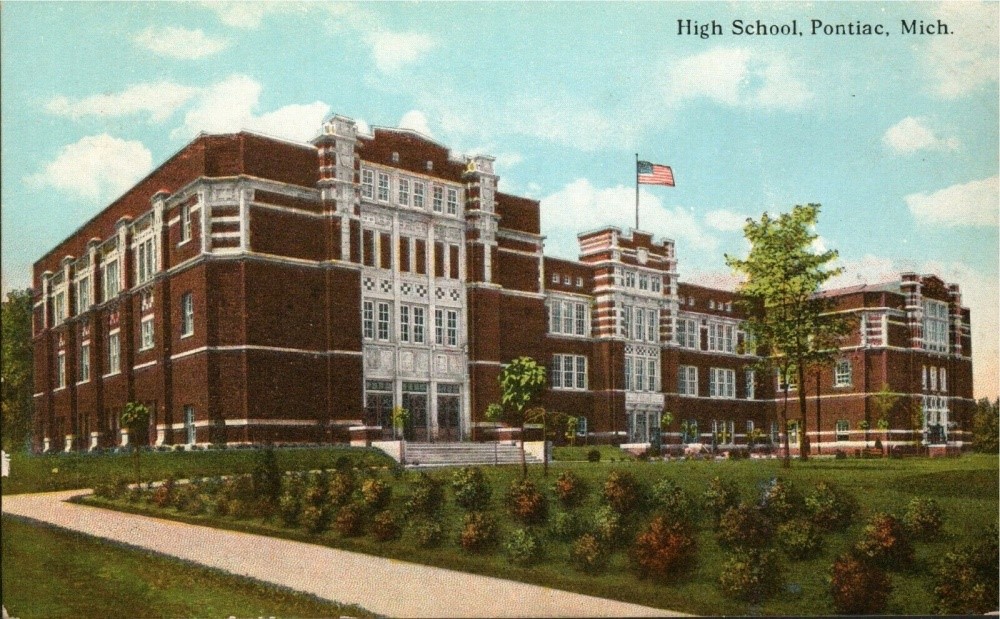
Garden City High School split into Garden City East and West in the mid-1960s, then reunited beginning with the 1982-83 school year. Royal Oak divided into Dondero and Kimball high schools in the late ’50s. They again unified in 2006. Pontiac High School split into Central and Northern in 1958. They merged back into Pontiac High in 2009.
More recently, in 2012, Wyoming Park and Wyoming Rogers merged. Ypsilanti Willow Run and Ypsilanti High School consolidated into Ypsilanti Community Schools in 2013.
Flint’s oldest high school, Central, shuttered in 2009, followed by Flint Northern in 2013. Albion was absorbed into Marshall in 2013. Word is Saginaw and Saginaw Arthur Hill will soon unite.
 Once, Michigan had four high schools that used “Flyers” as their nickname: previously mentioned Flint Holy Redeemer, Detroit St. Andrew, Grosse Pointe St. Paul and Willow Run, which used the nickname as a nod to the area’s ties to Airforce Plant 31, constructed by Ford to manufacture twin-finned B-24 bombers during the early 1940s for the war effort. Today, there are no schools left in Michigan that carry the nickname.
“The List” reminds me that Ferndale changed from the “Railsplitters” to the “Eagles” when they moved from old Ferndale Lincoln High into the newly-opened Ferndale High School in the fall of 1958. They are not to be confused with the “Railsplitters” of Ypsilanti Lincoln or Lincoln Park.
Caledonia once used “Scotties” as the nickname for its athletic teams, but the students chose to change the nickname to the more intimidating “Fighting Scots” in the late 1960s. (I’m still trying to chase down the actual school year of the alteration.)
“The List” explains why the Midland “Chemics” have a lion named Vic for a mascot. (It seems that in 1938, a new high school was built and “the Student Union decided to start some new traditions in order to display pride in their new high school. The school purchased a stuffed lion – a symbol of pride – to be used as a mascot. The name Vic was chosen for the mascot in short for the word ‘Victory’, voted in by the students.”)
Uniqueness
Distinctive nicknames fascinate me, but I always want the story behind the choice. I have written on the subject previously. Digging around the internet, I recently found a reference that was new to me. Alpena St. Anne’s high school athletic teams apparently were nicknamed the “Couturemen.”
The dictionary describes “Couture” as a designer, maker and seller of custom clothing. The word is French in origin. So I shipped off an e-mail the other day to a parish secretary in Alpena, with a question about the very unusual nickname. My question worked its way to Fr. Frank Muszkiewicz.
“St. Anne Church had been the "French" church here in Alpena when there were the more ethnic heritage Catholic communities,” he responded. “My understanding is that St. Anne had a high school until 1951, when Catholic Central High School opened in Alpena …
“Looking at a history book of St. Anne Church in Alpena,” he continued, “I did see a couple of pictures of boys' basketball teams from the 1920's and 1940's, however it seems the team name was the "Big Reds". So, I'm not sure where the "Couturemen" name came from that you found.”
From the late 1920s into the 1940s, it became quite popular to tie nicknames to teams. But before a moniker was assigned, it wasn’t unusual for newspaper writers to refer to a team by the school colors, or blend the last name of a coach with the word “men” when penning a story about a local squad. For example, Bay City Central’s teams often were called “Nevittmen” after coach Garland Nevitt before taking on the nickname “Wolves” around 1927. Muskegon’s teams were “Jacksmen” after their coach, J. Francis Jacks, before they were called the “Big Reds.”
A December 1940 newspaper, covering a game between Ludington St. Simon and St. Anne, gives a hint that this might be the case at St. Anne’s. A player at St. Anne, who happened to foul out of the game, had the last name, Couture. Perhaps there is a similar connection in St. Anne’s history.
Identities
In September 1928, Lansing Eastern athletic teams became known as the Quakers. “The name is derived from the location of the school,” stated the Lansing State Journal, explaining the unusual choice. “Pennsylvania was the original home of the Quakers of the Colonial period of our history, and the new high school, being situated on Pennsylvania Avenue, will be known by the name of the original settlers in the Keystone State.”
 In a November 1929 contest conducted by the State Journal, East Lansing, “long without a nickname,” became the Trojans. “The nickname was the choice of more than 50 per cent of the students.”
In May 1930, The Ludington Daily News noted that “Recently the Northern Michigan Big Six Athletic conference stimulated interest among pupils of the six cities in athletics and team competition … High School pupils of the respective towns proposed nicknames for their school teams and indicated their favorite by vote. Manistee chose the name of ‘Chippewas,’ Traverse City, ‘Trojans,’ Petoskey ‘Northmen,’ Cadillac ‘Vikings’ and Big Rapids ‘Cardinals.’ The time-honored name of ‘Orioles’ was voted to be retained by Ludington high school pupils, completing the list of six schools.”
Impressed, the Daily News quickly went to work to sponsor a county-wide contest with schools in Oceana County to select team nicknames. Later in the month, they announced results of the project.
“Scottville high school teams will henceforth be known as ‘Spartans,’ and Freesoil aggregation as ‘Buccaneers.’
“The team nicknames were decided upon by pupils of their respective institutions under a program of selections sponsored by the News.
“Two schools, Custer and Shelby, will retain their original team titles, (Ludington) St. Simon’s and Hart have not announced a final decision and Pentwater and Walkerville have made no report.”
Scottville’s choice of “Spartans” succeeded the name ‘Canners’ which had been used for a number of years, “a significant, but an unpicturesque appellation.” A rich agricultural part of the state, Scottville was home to a huge W.R. Roach and Co. canning facility. It closed in 2000 after nearly 90 years in business, displacing nearly 300 workers. “Wolverines” had also “won a goodly number of votes as did ‘Hornets.’”
“Cardinals” was retained at Custer.
“Word from Coach T.T. Thatcher at Shelby discloses Shelby’s choice as ‘Pee Wees.’ A selection made last year.
“Shelby voted in 1929 to use that name,’ he says, ‘and since then we have used an emblem on all our suits showing a Pee Wee and S.H.S on it. Our school colors are purple and white so the name is symbolic of the colors.”
For two of the schools, the decisions must have been relatively short-lived. By 1934, Shelby was using the nickname “Tigers.” Freesoil’s nickname had evolved into “Pirates” by the 1940s.
Earlier this year, the Hillsdale Daily News did a series of articles on the history of nicknames for schools in its coverage area. Hillsdale became the ‘Hornets’ in October 1932 following a poll of current football players and faculty. The Daily News at the time announced the nickname had won by a wide margin. Pittsford, it’s believed, first introduced its use of “Wildcats” “around the time the district consolidated in 1938.” At Waldron, “Spartans” was selected over “Lions” and “Bears” in a contest run by the school newspaper, also in 1938. “Students at the time were likely influenced by Waldron’s proximity to Michigan State University, among other factors,” noted the paper.
 The Daily News piece on Litchfield was of special interest to me. The only high school in Michigan nicknamed Terriers, I didn’t know much about its origins – only that from my previous research, the nickname had survived a proposed alteration by the Litchfield Student Council during the 1956-57 school year.
“They aroused quite a discussion within the student body as to the idea of changing the name of our team – Terriers.” stated the school’s yearbook. “But the idea was dropped.”
“According to Litchfield schools employee Judy Bills, the Litchfield Terriers mascot came about through the influence of former teacher and coach Al Terry in the 1930s,” stated the Daily News article. “It was while Terry was teacher and coach in Litchfield schools that the athletic teams became known as the Litchfield Terriers, Bills said.”
For a historian, sometimes answers spur more questions.
Was Litchfield’s team nickname also swayed by Major League Baseball?
Allen Terry coached at Litchfield from 1932 through the fall of 1940 before continuing his career at Plainwell High School.
Interestingly, during that same timespan, a future MLB Hall of Fame inductee, Bill Terry, served as player-manager of the New York Giants. His team’s often grabbed newspaper headlines with a reference to the phrase, “Terry’s Terriers” in the connected article.
 Did the sharing of “Terry” as a last name influence the nickname selection in Litchfield?
Who knows what the future holds for education, school districts and team nicknames across Michigan. Ypsilanti Community School students in grades 7-12 picked Grizzlies over Trailblazers and Flyers in 2013. There are six “Bears,” two “Black Bears” and a single “Polar Bears” on the MHSAA current active lists. Now there is one “Grizzlies.”
Today, “The List” contains 1,438 active and inactive high schools and totals 289 unique nicknames.
Wait.
There’s a St. Helen Charlton Heston Academy? It’s named after the actor, who played Moses in “The Ten Commandments.” It seems he spent part of his childhood in the area.
Make that 1,439.
(Thanks Eric Albright for the ‘Vic the Lion’ Story. I continue to seek out information on old departed high schools in Michigan as well as the stories behind nicknames. Please drop me a line.)
 Ron Pesch has taken an active role in researching the history of MHSAA events since 1985 and began writing for MHSAA Finals programs in 1986, adding additional features and "flashbacks" in 1992. He inherited the title of MHSAA historian from the late Dick Kishpaugh following the 1993-94 school year, and resides in Muskegon. Contact him at [email protected] with ideas for historical articles.
PHOTOS: (Top) Logos which have come, and sometimes gone along with those MHSAA schools through the years. (2) Kalkaska High School – from a postcard postmarked 1908. (3) Old Pontiac High School, built in 1913-14, became known as Pontiac Central once Pontiac Northern opened in 1958. (4) Ypsilanti Willow Run’s Flyers logo. (5) The logo used by Lansing Eastern’s Quakers. (6) Litchfield’s Terrier, as it appeared on the cover of the 1963 yearbook. (7) The logo for St. Helen Charlton Heston Academy’s Patriots. (Images collected by Ron Pesch.)