

NFHS Voice: Madness to Maddening
March 23, 2020
By Karissa Niehoff
NFHS Executive Director
March Madness took on another meaning for everyone in the sports world during the week of March 9 – a week like none other in the history of organized sports with the acceleration of the coronavirus (COVID-19) in the United States.
The Madness was not the bouncing of basketballs in arenas around the country. Instead it was organization after organization trying to determine the viability of continuing to operate – particularly after the suspension of the NBA season and the cancellation of the NCAA Division I Men’s and Women’s Basketball Championships.
And NFHS-member state high school associations were among those organizations faced with making decisions because the heightened state of the coronavirus pandemic occurred in the middle of state high school basketball tournaments across the country. While 13 states had completed their tournaments, the remainder were faced with tough decisions throughout the week.
By the end of that week, another four states were able to complete their girls and boys basketball tournaments – although all of these states had to impose extreme limits on the number of fans in attendance.
About two-thirds of our member state associations had to shut down their tournaments. At this point, 19 state associations have cancelled their state basketball tournaments, while 15 others have postponed or suspended their events, although the hope of completing them seems to fade with each passing day.
In addition to basketball, some states were in the midst of conducting ice hockey, gymnastics and swimming championships. While most of those sports championships, along with wrestling, were completed, some states were forced to suspend or cancel these as well.
Because of varying information from state health leaders, the Centers for Disease Control and Prevention (CDC) and state governors, some states were able to continue playing longer than others. Each state’s high school basketball tournament is one of the anticipated events of the year – particularly for residents in towns with schools playing for a state title.
From start to finish of state basketball tournaments in the 50 states plus the District of Columbia, more than one million fans trek to gymnasiums to watch these events. This year, however, many of these fans, along with about half of the 950,000 boys and girls who play high school basketball, were not able to experience March Madness.
And if this wasn’t enough, spring sports seasons and championships are at risk – mainly because schools are closed in many states, which means the discontinuation of school activity programs. The NCAA has cancelled all spring sports championships; and while state associations haven’t cancelled spring championships yet, athletics and activities programs are on hold for a set period of time – or indefinitely in some states.
While the loss of college and professional sports has an enormous impact on everyday life, considering that events surrounding the coronavirus affect some 19,500 high schools and 12 million participants in high school sports and performing arts activities, the impact on high school sports is perhaps even larger.
We support our 51 member state association leaders as they continue to work through these challenges. The loss of state basketball championships in many states is a sizeable financial challenge ahead as they work to continue to make state-level athletics and activities programs available.
On many occasions, we have written about the value of high school sports and activities. This month, we have witnessed the disappointment of thousands and thousands of players and fans who were not able to experience a state championship – many of whom were “going to state” for the first time.
High school sports is different from every other level of sport as these programs are a vital part of communities across our nation. Two weeks ago, when the doors were closed in many gymnasiums, it was confirmation of the desire and need for education-based high school sports and activities in the United States.
During this time of imposed social distancing, it is a time to step back and be thankful for these programs in our nation’s schools.
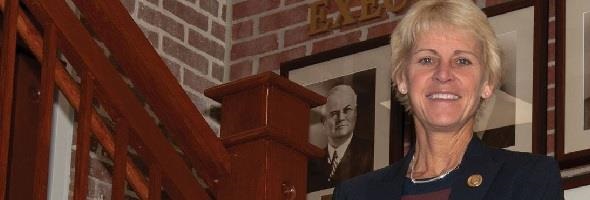
Dr. Karissa L. Niehoff is in her second year as executive director of the National Federation of State High School Associations (NFHS) in Indianapolis, Indiana. She is the first female to head the national leadership organization for high school athletics and performing arts activities and the sixth full-time executive director of the NFHS, which celebrated its 100th year of service during the 2018-19 school year. She previously was executive director of the Connecticut Association of Schools-Connecticut Interscholastic Athletic Conference for seven years.
NFHS Voice: Salute Seniors with Spring on Hold
March 27, 2020
By Karissa Niehoff
NFHS Executive Director
A visitor to the local high school in late March would normally find boys and girls engaged in track and field, baseball, softball and lacrosse practices. Inside the building, some students would be involved with speech or debate activities. Unfortunately, this is not a normal year – far from it.
Spring sports playing fields are empty. High school sports and activities, with more than 12 million participants, are on pause, and high school athletes, coaches, athletic directors, parents and other fans are trying to determine when these programs will return.
The ever-changing news we are receiving almost on an hourly basis is more than one can comprehend as we all deal with this global health crisis. Each day, with the spread of the coronavirus, we try to determine what has changed since the day before. Can we go to work? Can we leave our house to go to the store?
Like every other activity in our nation, high school sports and activity programs are on hold. With all schools closed for varying amounts of time – some to the end of the academic year – millions of participants in spring sports and activities are on the sidelines awaiting the green light for competition to resume.
In past years, our member state associations and the 19,500 high schools across the country have had to postpone or cancel events for short periods of time due to weather or other factors, but this is unprecedented. The reality is that spring sports may never occur in some states – particularly those where schools are closed for the academic year. And this would be doubly disappointing in those states that were not able to conduct or complete state basketball championships.
The possibility of losing spring sports is particularly disappointing for graduating seniors. While everyone is affected by this health crisis and has their own issues to confront, it is important for everyone involved in high school activity programs to salute those seniors – boys and girls in sports and activities programs who have sacrificed for 3½ years but may not be able to reach the finish line.
While they may miss some of the final games and events, the benefits of being involved in these programs will carry them for a lifetime. The early-morning practices, offseason workouts and late-night studying after a day of activities will undoubtedly make them stronger and more dedicated in their future professions.
We thank all high school athletes and performing arts participants for the great memories – especially those who may not be able to complete their races or sing in the music ensemble this year. While some will have more competitive opportunities in sports and activities, for others that continued involvement may be in the form of coaching or officiating, but the impact of involvement in these programs will last a lifetime.
There have been times in the past when high school sports and performing arts helped individuals in communities through difficult times – events like weather-related disasters or school shootings as examples. We believe that these programs will play an even larger role once the coronavirus pandemic subsides and we are able to return to normalcy.
Why? Because after our days, weeks and perhaps months of social distancing, teamwork will help us all come back together, and there is no better demonstration of teamwork than education-based high school sports and activity programs.
We all anxiously await the day when the whistles blow and the curtains rise again.
Dr. Karissa L. Niehoff is in her second year as executive director of the National Federation of State High School Associations (NFHS) in Indianapolis, Indiana. She is the first female to head the national leadership organization for high school athletics and performing arts activities and the sixth full-time executive director of the NFHS, which celebrated its 100th year of service during the 2018-19 school year. She previously was executive director of the Connecticut Association of Schools-Connecticut Interscholastic Athletic Conference for seven years.