

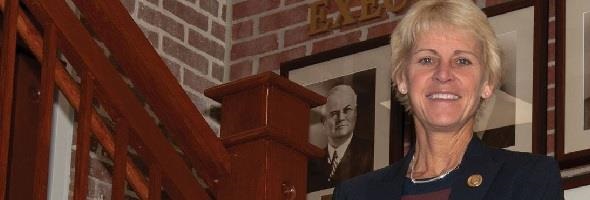
NFHS Voice: March Madness Begins Again
March 4, 2020
By Karissa Niehoff
NFHS Executive Director
The calendar has turned to March, which in the world of high school sports can only mean one thing – Basketball. It is time for state tournaments, March Madness and, yes, the annual rhetoric about the merits of the shot clock.
For the almost one million boys and girls who participate in high school basketball, there is nothing quite like the state tournament. Although there are great memories from the one-class days, led by Carr Creek’s almost upset of powerhouse Ashland in Kentucky in 1928 and Milan’s Cinderella victory in Indiana in 1954, today, basketball provides more opportunities for girls and boys teams to be crowned state champion than any other sport.
This month, about 450 girls and boys teams will earn state basketball titles in championships conducted by NFHS member state associations. Multiple team champions are crowned for both boys and girls in all states but two, with the majority of states sponsoring tournaments in 4-6 classifications for each, and four states conducting state championships in seven classes.
That is truly March Madness, which is appropriate since the term was first used in connection with high school basketball. Although the tag line became familiar to millions on a national scale in relation to the NCAA Division I Men’s Basketball Championship, the NCAA shares a dual-use trademark with the Illinois High School Association (IHSA), thanks to H. V. Porter, the first full-time executive director of the NFHS.
In his final year as IHSA executive director in 1939, Porter published his “March Madness” essay in reference to the mania surrounding the IHSA’s annual state basketball tournament. Eight years later, in a 1947 Associated Press article, Porter said, “Naturally, we think basketball has done a lot for high school kids, but it’s done something for the older people, too. It has made community life in general a lot more fun each winter.”
While many things have changed in the past 73 years, the value of high school sports – and especially state basketball tournaments – remains as strong as ever today. In some states, seemingly the entire community will travel to the site of the state tournament in support of the high school team.
As a footnote to the use of March Madness, Scott Johnson – recently retired assistant executive director of the IHSA in his book “Association Work” – discovered through research that the first recorded mention of March Madness in relation to basketball occurred in 1931 by Bob Stranahan, sports editor of the New Castle Courier-Times in Indiana.
While the sport remains strong and March Madness is set to begin in earnest across the nation, there is a belief by some that the addition of a shot clock would make the game even better.
Although there are some arguments for implementing the shot clock, the
NFHS Basketball Rules Committee, similar to the other 14 NFHS rules committees, must make decisions based on what is best for the masses – the small schools with less than 100 students as well as large urban schools with 3,000-plus students. Rules changes will always be made with considerations for minimizing risks, containing costs and developing rules that are best for high school athletes.
Nine of our member state associations have elected to use a shot clock in their states, which certainly adds to the clamor for its implementation nationally. And, we at the NFHS have read the headlines, seen the social media posts and received the phone calls advocating for the shot clock’s adoption. However, the Basketball Rules Committee will continue to assess the shot clock based on the aforementioned considerations, as well its members representing all areas of the country.
We encourage everyone to support their local high school teams by attending this year’s exciting state basketball tournaments.
Dr. Karissa L. Niehoff is in her second year as executive director of the National Federation of State High School Associations (NFHS) in Indianapolis, Indiana. She is the first female to head the national leadership organization for high school athletics and performing arts activities and the sixth full-time executive director of the NFHS, which celebrated its 100th year of service during the 2018-19 school year. She previously was executive director of the Connecticut Association of Schools-Connecticut Interscholastic Athletic Conference for seven years.
This Week In High School Sports: 10/23/20
October 22, 2020
This edition features the Okemos boys tennis team's MHSAA Finals championship, presents Game Balls to Muskegon football's Myles Walton and the Houghton girls and boys cross country teams, presents a "You Make the Call" for football and concludes with a review of the weekend's Lower Peninsula Girls Golf Finals.
The 5-minute program leads off each week with feature stories from around the state from the MHSAA’s Second Half or network affiliates. "Be The Referee," a 60-second look at the fine art of officiating, comes in the middle of the show and is followed by a closing MHSAA "Perspective."
Listen to this week's show by Clicking Here.
Past editions
Oct. 16: Byron Center volleyball, girls golf aces - Listen
Oct. 9: Grand Rapids Union football, first 2020-21 champions - Listen
Oct. 2: East Lansing football, late Port Huron sportswriter Jim Whymer - Listen
Sept. 25: Sturgis football, soccer official Alexus Little - Listen
Sept. 18: COVID-19 review, this year's broadcast opportunities - Listen