

NFHS Voice: March Madness Begins Again
March 4, 2020
By Karissa Niehoff
NFHS Executive Director
The calendar has turned to March, which in the world of high school sports can only mean one thing – Basketball. It is time for state tournaments, March Madness and, yes, the annual rhetoric about the merits of the shot clock.
For the almost one million boys and girls who participate in high school basketball, there is nothing quite like the state tournament. Although there are great memories from the one-class days, led by Carr Creek’s almost upset of powerhouse Ashland in Kentucky in 1928 and Milan’s Cinderella victory in Indiana in 1954, today, basketball provides more opportunities for girls and boys teams to be crowned state champion than any other sport.
This month, about 450 girls and boys teams will earn state basketball titles in championships conducted by NFHS member state associations. Multiple team champions are crowned for both boys and girls in all states but two, with the majority of states sponsoring tournaments in 4-6 classifications for each, and four states conducting state championships in seven classes.
That is truly March Madness, which is appropriate since the term was first used in connection with high school basketball. Although the tag line became familiar to millions on a national scale in relation to the NCAA Division I Men’s Basketball Championship, the NCAA shares a dual-use trademark with the Illinois High School Association (IHSA), thanks to H. V. Porter, the first full-time executive director of the NFHS.
In his final year as IHSA executive director in 1939, Porter published his “March Madness” essay in reference to the mania surrounding the IHSA’s annual state basketball tournament. Eight years later, in a 1947 Associated Press article, Porter said, “Naturally, we think basketball has done a lot for high school kids, but it’s done something for the older people, too. It has made community life in general a lot more fun each winter.”
While many things have changed in the past 73 years, the value of high school sports – and especially state basketball tournaments – remains as strong as ever today. In some states, seemingly the entire community will travel to the site of the state tournament in support of the high school team.
As a footnote to the use of March Madness, Scott Johnson – recently retired assistant executive director of the IHSA in his book “Association Work” – discovered through research that the first recorded mention of March Madness in relation to basketball occurred in 1931 by Bob Stranahan, sports editor of the New Castle Courier-Times in Indiana.
While the sport remains strong and March Madness is set to begin in earnest across the nation, there is a belief by some that the addition of a shot clock would make the game even better.
Although there are some arguments for implementing the shot clock, the
NFHS Basketball Rules Committee, similar to the other 14 NFHS rules committees, must make decisions based on what is best for the masses – the small schools with less than 100 students as well as large urban schools with 3,000-plus students. Rules changes will always be made with considerations for minimizing risks, containing costs and developing rules that are best for high school athletes.
Nine of our member state associations have elected to use a shot clock in their states, which certainly adds to the clamor for its implementation nationally. And, we at the NFHS have read the headlines, seen the social media posts and received the phone calls advocating for the shot clock’s adoption. However, the Basketball Rules Committee will continue to assess the shot clock based on the aforementioned considerations, as well its members representing all areas of the country.
We encourage everyone to support their local high school teams by attending this year’s exciting state basketball tournaments.
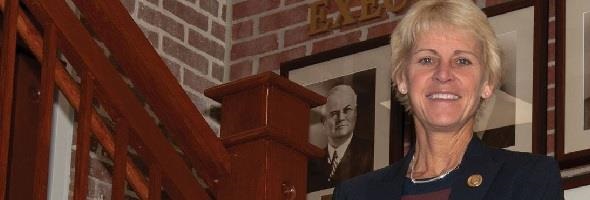
Dr. Karissa L. Niehoff is in her second year as executive director of the National Federation of State High School Associations (NFHS) in Indianapolis, Indiana. She is the first female to head the national leadership organization for high school athletics and performing arts activities and the sixth full-time executive director of the NFHS, which celebrated its 100th year of service during the 2018-19 school year. She previously was executive director of the Connecticut Association of Schools-Connecticut Interscholastic Athletic Conference for seven years.
NFHS Voice: Nationally, Lost Spring Ends
May 8, 2020
By Karissa Niehoff
NFHS Executive Director
On Monday, the New Jersey State Interscholastic Athletic Association became the 51st and final NFHS member state high school association to cancel its spring sports championships due to the Coronavirus pandemic.
The cancellation announcements began in late March and stretched to early May as states made every attempt possible to conduct spring sports and other activity programs.
Driven by a desire to offer perhaps a few weeks of competition – particularly for graduating seniors – many states waited as long as possible to move from postponed to cancelled, ultimately forced to make decisions when schools were closed to in-person learning for the remainder of the academic year.
While the leaders of our state associations knew that spring activities could not occur if schools did not re-open, and that the health and safety of the millions of participants ultimately drove these decisions, having to make these announcements was perhaps the most difficult task they had experienced as state leaders.
“We are disappointed for the thousands of New Jersey student-athletes who will be unable to compete this spring,” said Larry White, executive director of the New Jersey State Interscholastic Athletic Association. “While we remained hopeful to the end, and left open every possibility, competition simply is not feasible given the circumstances. It has been a harrowing time for everyone, and we know our student-athletes are extremely disappointed. That said, these unfortunate circumstances may have put an intriguing challenge in the path of our young people. As New Jersey’s own Vince Lombardi once said, ‘It's not whether you get knocked down, it's whether you get up.’ We’re confident all our kids will get back up and stand tall.”
Rhonda Blanford-Green, commissioner of the Colorado High School Activities Association, showed her emotions in making the difficult decision in her state:
“This decision, unlike the many decisions our office makes over the course of a year, has been extremely difficult because we are personally connected as former participants and officials, current parents and grandparents of graduating seniors, as well as educators and members of our high school communities. Our hats are off to the many seniors who have shown maturity and resolve as their culminating year of high school has been impacted beyond activities and athletics due to the worldwide COVID-19 pandemic. The Class of 2020 will not be forgotten.”
Craig Anderson, executive director of the Illinois High School Association, said, “Our thoughts are with all the impacted students, coaches and communities, especially the seniors. It will be difficult for them to find a silver lining in all of this, but we stress that even if they don’t get the chance to compete again at the high school level, they are better for having been a part of their respective high school teams. They were exposed to life lessons in teamwork, leadership and overcoming adversity that are difficult to replicate elsewhere.”
What was at stake and who was affected by these cancellation announcements? More than 500 girls and boys spring sports championships in about 18 sports and involving about three million student-athletes. Along with multiple classes for both boys and girls in track & field, other sports affected this spring were baseball, softball, lacrosse, golf, tennis, soccer, flag football, boys volleyball, water polo, weightlifting, gymnastics, riflery, judo, Unified track & field and ultimate Frisbee. Also grounded were perhaps another million participants in band, choir, orchestra, speech, debate, robotics and other activity programs.
And last, but far from least, we remember the thousands of volunteers who make these events happen every year – ticket-takers, concession stand workers, booster club parents, meet officials and the leaders in communities throughout the country where these events were planned. We thank these individuals for their faithful service year after year, and we look forward to the day we are all back together again.
Dr. Karissa L. Niehoff is in her second year as executive director of the National Federation of State High School Associations (NFHS) in Indianapolis, Indiana. She is the first female to head the national leadership organization for high school athletics and performing arts activities and the sixth full-time executive director of the NFHS, which celebrated its 100th year of service during the 2018-19 school year. She previously was executive director of the Connecticut Association of Schools-Connecticut Interscholastic Athletic Conference for seven years.