

NFHS Voice: MLK Provides Reminder
January 22, 2020
By Karissa Niehoff
NFHS Executive Director
On Monday, the nation observed Martin Luther King Jr. Day for the 35th time. This annual remembrance of the civil rights leader and his remarkable efforts in the 1950s and 1960s to combat racism in the United States continues as one of the most significant days on the calendar every year.
King’s “I Have a Dream” speech in Washington, D.C. in 1963 – one of the most iconic speeches in history – was the defining moment of the civil rights movement and led to the Civil Rights Act of 1964, which made desegregation a prerequisite to school funding and further strengthened the Supreme Court’s 1954 ruling in Brown v. Board of Education of Topeka.
As a result, separate schools for African Americans ended and King’s dream of equality for everyone began to occur.
Thanks, in part, to the efforts of King, who was a member of his school’s debate team at Booker T. Washington High School in Atlanta, blacks and whites were assimilated in schools and in athletics and other activities such as speech and debate.
A few years later in the early 1970s with the passage of Title IX, girls – both white and black – were provided the opportunity to participate in high school sports. With this landmark legislation on the heels of the civil rights movement, high school sports and activities were for EVERYONE.
Amazingly, participation in high school sports increased from 3.9 million to 6.4 million in seven years between 1971-72 and 1977-78 – a jump of about 2.5 million. Why? The opportunity to participate was now available to all.
High school athletes – male and female, black and white and other races – began to work together and excel both individually and as teams. Many have seized these opportunities and had a profound impact within their communities and nationally.
In the past five classes of the NFHS National High School Hall of Fame, 13 of the 22 athletes were minority males and females, including the likes of Derrick Brooks, Dusty Baker, Seimone Augustus, Nicole Powell, Lisa Fernandez, Nikki McCray and Marlin Briscoe. Other females were Tracey Fuchs, Carrie Tollefson, Missy West, Joni Huntley, Jackie Stiles and Cindy Brogdon.
In previous classes, there were Ozzie Newsome, Chauncey Billups, Kevin Johnson, Janet Evans, Sean Elliott, Cheryl Miller, Archie Griffin, Jackie Joyner-Kersee and Kim Mulkey.
Can you imagine the storied history of high school sports without these individuals?
Thanks to the efforts of many people in the 1960s and 1970s, there are more women and minorities in leadership positions today. Nine of our member state high school associations are led by minorities, including three females – Que Tucker of North Carolina, Sally Marquez of New Mexico and Rhonda Blanford-Green of Colorado.
Despite these advances in opportunities the past 50-plus years, the late Dr. King would be disappointed to hear about some of the disrespectful behavior in and around high school sports the past few years. Since our column in late October, we have heard of other racially-related incidents. Indeed, pain still occurs.
As we reflect on the tremendous efforts of Dr. Martin Luther King Jr. to bring everyone together, let it be a further reminder that all student activity participants – regardless of race, religion, political views or gender identity – should be treated with respect.
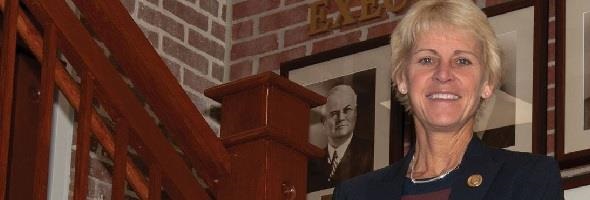
Dr. Karissa L. Niehoff is in her second year as executive director of the National Federation of State High School Associations (NFHS) in Indianapolis, Indiana. She is the first female to head the national leadership organization for high school athletics and performing arts activities and the sixth full-time executive director of the NFHS, which celebrated its 100th year of service during the 2018-19 school year. She previously was executive director of the Connecticut Association of Schools-Connecticut Interscholastic Athletic Conference for seven years.
NFHS Voice: Give Thanks for Officials
February 19, 2020
By Karissa Niehoff
NFHS Executive Director
While the behavior of parents and other fans at high school games is still a work in progress, there is some good news on the officiating front.
Last fall, we reported on a growing shortage of officials nationwide – even reaching a crisis stage in some areas as games were being cancelled. Through a nationwide recruitment effort, progress is being made in attracting more people to the high school officiating avocation.
Thanks to the NFHS’ #BecomeAnOfficial campaign that was launched in the spring of 2017, more than 4,000 men and women across the country have registered and become certified officials. Many of these individuals are former high school athletes who want to remain involved in sports, earn some extra income and stay in shape, including first responders such as police officers, firefighters and EMTs.
On the flip side, however, is the fear that any gains in new officials coming in the front door are being offset by other officials heading out the back door because of the continued boorish behavior on the part of parents and other fans.
Rickey Neaves, associate director of the Mississippi High School Activities Association, is struggling to cover all basketball games in his state in his role as officials’ coordinator.
“Fans and coaches alike feel freer to downgrade officials, and holler and scream at them, as opposed to the way it was 10 years ago,” Neaves said. “You can see where it is getting worse and worse with parents and coaches blaming officials or staying on an official to the point where they’re just not going to take it, so they just get out.”
Unfortunately, we continue to hear reports like this from across the country. A recent survey conducted by Officially Human: Behind the Stripes that was completed by about 19,000 respondents in 14 states indicated that the problem persists, with fans who do not know the rules being the main culprit.
If efforts by the NFHS at the national level – and others at state and local levels – to attract more people to officiating are to be successful, unsportsmanlike behavior on the part of parents and other fans must cease or we will lose some of these new officials within two years.
While we recognize the task of improving the culture at high school events is challenging and is one more item on the busy plates of school administrators, it is essential if we are to retain officials.
Brenda Hilton, founder of Officially Human: Beyond the Stripes, said, “The time is now for all of us to realize that officials are human and their existence and hard work at sporting events allows all of us to enjoy the games that we love. We must start to humanize officials now before the whistles fall silent.”
Recognition and thanks should also be a part of the game plan. We must regularly share our appreciation for the men and women who officiate high school sports.
Dana Pappas, commissioner of officials for the New Mexico Officials Association, shared the following with officials in her state during a special appreciation week:
“Never think that what you do as an official doesn’t matter because it does. Never let one contest where the fans are exceedingly brutal and the scrutiny is overly intense derail your love for what you do. Never think that you are not making a difference because you most definitely are. You are educators, role models and guardians of the integrity of the sport you officiate. You officiate because you care about kids, you care about your chosen sport and you care about your community.”
Instead of viewing these officiating issues as a crisis, let’s see them as an opportunity to impact lives through education-based athletics.
Dr. Karissa L. Niehoff is in her second year as executive director of the National Federation of State High School Associations (NFHS) in Indianapolis, Indiana. She is the first female to head the national leadership organization for high school athletics and performing arts activities and the sixth full-time executive director of the NFHS, which celebrated its 100th year of service during the 2018-19 school year. She previously was executive director of the Connecticut Association of Schools-Connecticut Interscholastic Athletic Conference for seven years.