


NFHS Voice: No HS Football Link to CTE
October 21, 2019
By Karissa Niehoff
NFHS Executive Director
When it comes to the long-term effects of concussions in sports, there is a wide range of information published – almost on a daily basis. Unfortunately, much of the media coverage as it relates to high school sports – and particularly the sport of football – is misleading.
Last week, the Concussion Legacy Foundation introduced its new public-service announcement that compared youth football dangers to smoking. As the pre-teen football players puff on cigarettes, the voiceover says, “Tackle football is like smoking, the younger I start, the longer I’m exposed to danger.”
The “Tackle Can Wait” campaign by the foundation is an attempt to steer children under the age of 14 into flag football. Although establishing a finite age may be difficult, reducing contact at youth levels is certainly a positive. USA Football is doing just that nationally through its Football Development Model. Likewise, the 51 member state associations of the National Federation of State High School Associations (NFHS) have enacted limitations on contact during preseason and practice sessions.
Our concern is the term “exposed to danger.” These types of messages continue to spread unwarranted fear to parents of high school student-athletes. The “danger” refers to reports that players who incur repeated concussions can develop chronic traumatic encephalopathy (CTE).
A 2017 study from the Journal of American Medical Association (JAMA) linked CTE in the brains of deceased National Football League players. Even if this report is accurate, these are individuals who endured repeated blows to the head for 20 to 25 years BEFORE any concussion protocols were in place.
Less publicized is a study by Dr. Munro Cullum and his colleagues at the Peter O’Donnell Jr. Brain Institute, which is a part of the University of Texas Southwestern Medical Center in Dallas. Cullum’s group studied 35 former NFL players age 50 and older who had sustained multiple concussions throughout their careers. The findings showed no significant association between the length of the individuals’ careers, the number of concussions and their cognitive function later in life.
Two studies, two different conclusions. Regardless of the outcome, however, they are not applicable to kids playing football before and during high school. There is absolutely no linkage to CTE at these levels, and the word “danger” should not be a part of the discussion.
A more applicable and significant study was also published in JAMA in 2017. In a study of about 4,000 men who graduated from Wisconsin high schools in 1957, there was no difference in cognitive function or decline between those who played football and those who did not as they reached 65 years of age. We would assume the majority of these individuals discontinued football after high school.
With more than one million boys – and girls – playing the contact sport of football each year, severe injuries do occur from time to time, but parents should know that efforts to lessen the risk of a catastrophic injury, including head injuries, have never been stronger than they are today.
In fact, new data from the National High School Sports-Related Injury Surveillance Study indicates some positive trends in concussion rates. The study, which was released in the American Academy of Pediatrics online issue of Pediatrics last week, indicated that concussion rates during football practices dropped from 5.47 to 4.44 concussions per 10,000 athletic exposures between the 2013-14 and 2017-18 seasons.
In addition, repeat concussion rates across all sports declined from 0.47 to 0.28 per 10,000 exposures during the same time period.
Concussion laws are in place in every state. All NFHS sports rules books have concussion management protocols. Helmet-to-helmet hits are not allowed in football. Limits on contact in preseason and practice in football are in place in every state.
After considering all the available research, we encourage parents to let their kids play their sport of choice in high school, but we would discourage moving away from football – or any contact sport – solely based on the fear of developing CTE later in life.
Dr. Karissa L. Niehoff is in her second year as executive director of the National Federation of State High School Associations (NFHS) in Indianapolis, Indiana. She is the first female to head the national leadership organization for high school athletics and performing arts activities and the sixth full-time executive director of the NFHS, which celebrated its 100th year of service during the 2018-19 school year. She previously was executive director of the Connecticut Association of Schools-Connecticut Interscholastic Athletic Conference for seven years.
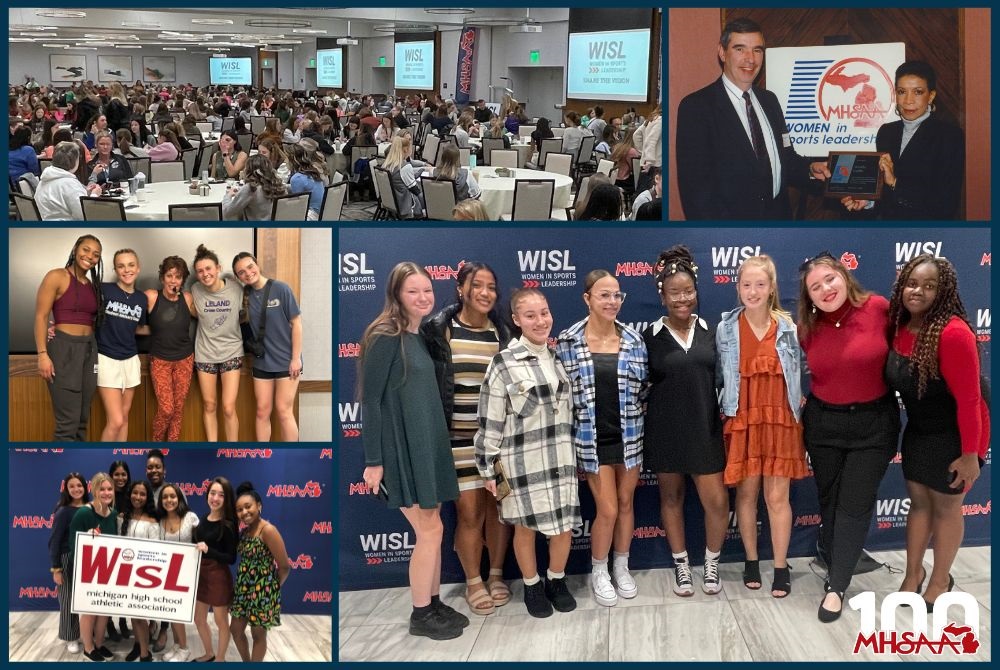
Century of School Sports: WISL Conference Continues to Inspire Aspiring Leaders
By
Geoff Kimmerly
MHSAA.com senior editor
February 4, 2025
There has long been a mighty sense of pride at the MHSAA for its Women In Sports Leadership Conference – which remains the nation’s first, largest and longest-serving event promoting the roles of females in athletics.
The event has continued to grow tremendously since the first group of 130 administrators, coaches, high school and college students assembled in Lansing in 1989. It’s easy to argue as well that the WISL Conference has become even more impactful over its 26 editions, the most recent beginning a year ago today with the theme “Share the Vision.”
Nearly 800 participants – mostly female high school student-athletes – attended last year’s two-day event, where they were able to engage in several of 36 workshops and learn from a group of 45 speakers with expertise in a wide variety of sports-related fields. The WISL Conference has welcomed Olympians, leaders in Michigan government and Hall of Fame coaches at all levels of athletics among several who have put their voices to the goals of encouraging women and growing their presence at all levels of sport.
Attracting women back to coaching and officiating was the mission of the first WISL Conference – percentages of both had fallen dramatically since the dawn of Title IX nearly two decades prior had led to rapid growth in athletic competitive opportunities for females at various levels. The first WISL events were organized by MHSAA assistant director Suzanne Martin, under the leadership as well of then-executive director Jack Roberts, until Martin retired in December 2002. Fun fact: The first Michigan legislative resolution recognizing Feb. 5 as Girls and Women In Sports Day statewide (in addition to nationally) was presented during the 1990 WISL Conference.
Kathy Vruggink Westdorp took over the WISL program upon joining the MHSAA staff as assistant director during the 2003-04 school year after more than two decades as a teacher, coach and administrator in the Grand Rapids area. Under her leadership, WISL has continued to build and thrive – it’s currently an every-other-year event, generally hosted during the first weekend in February although the 25th WISL took place during October 2022 as part of the culmination of the MHSAA’s year-long celebration of “Title IX at 50.” Topics covered still include coaching and teaching and learning leadership, but also sports nutrition and performance, empowerment and goal-setting, and several more areas of interest.
In 1990, the MHSAA also awarded its first of now 38 Women In Sports Leadership Awards, recognizing pioneers who have elevated athletics in Michigan as pioneers, advocates, voices and leaders, particularly at the interscholastic level. The 39th Women In Sports Leadership Award winner will be announced later this month.
Previous "Century of School Sports" Spotlights
Jan. 28: Michigan's National Impact Begins at NFHS' Start - Read
Jan. 21: Awards Celebrate Well-Rounded Educational Experience - Read
Jan. 14: Predecessors Laid Foundation for MHSAA's Formation - Read
Jan. 9: MHSAA Blazes Trail Into Cyberspace - Read
Dec. 31: State's Storytellers Share Winter Memories - Read
Dec. 17: MHSAA Over Time - Read
Dec. 10: On This Day, December 13, We Will Celebrate - Read
Dec. 3: MHSAA Work Guided by Representative Council - Read
Nov. 26: Finals Provide Future Pros Early Ford Field Glory - Read
Nov. 19: Connection at Heart of Coaches Advancement Program - Read
Nov. 12: Good Sports are Winners Then, Now & Always - Read
Nov. 5: MHSAA's Home Sweet Home - Read
Oct. 29: MHSAA Summits Draw Thousands to Promote Sportsmanship - Read
Oct. 23: Cross Country Finals Among MHSAA's Longest Running - Read
Oct. 15: State's Storytellers Share Fall Memories - Read
Oct. 8: Guided by 4 S's of Educational Athletics - Read
Oct. 1: Michigan Sends 10 to National Hall of Fame - Read
Sept. 25: MHSAA Record Books Filled with 1000s of Achievements - Read
Sept. 18: Why Does the MHSAA Have These Rules? - Read
Sept. 10: Special Medals, Patches to Commemorate Special Year - Read
Sept. 4: Fall to Finish with 50th Football Championships - Read
Aug. 28: Let the Celebration Begin - Read
(MHSAA file photos.)