


NFHS Voice: Punish Bad Fan Behavior
October 2, 2019
By Karissa Niehoff
NFHS Executive Director
About four weeks ago, we distributed an op-ed suggesting that inappropriate behavior by parents and other adult fans at high school sporting events was causing many officials to quit before they even reached two years on the job.
Although we received mostly positive support from this article, some people thought we went too far in telling parents to “act your age” and “stay in your own lane.” On the contrary, perhaps we should have been more direct.
Last week, one of our member state associations shared a resignation letter it had received from a 20-year veteran soccer official who had taken all the abuse he could handle. A portion of that letter follows:
“Soccer parents: you are absolutely 100% the reason we have a critical refereeing shortage and games are being cancelled left and right. And you are at least a part of the reason I’m done here. The most entitled among you are the ones that scream the loudest. And every time you do this, you tell your son or daughter the following:
‘I do not believe in you, I do not believe in your team, I do not believe in your collective ability to overcome your own adversity and you absolutely will not win and cannot do this without me tilting the table in your favor.’
“On behalf of myself and so many other referees – and I say this with every ounce of my heart and soul – shut up about the referees, and let your kids rise or fall as a team, as a FAMILY. Because the vast majority of you truly have no idea what you’re talking about, and even if you have a legitimate gripe about one play or one decision, you’re not fixing anything.”
And if that wasn’t enough, last week the Eastern Panhandle Youth Football League in West Virginia released the following statement:
“Unfortunately, it has come to the point that because of the abuse, negativity and utter disrespect shown to our officials from parents, coaches and most recently from our players, the Eastern Panhandle Officials Association president stated today that the association will no longer schedule officials for our league games at any field. This means effective immediately all remaining games are cancelled.”
This statement is from a youth league, which means the coaches are likely also parents of players, and the players are sons and daughters who are emulating their parents’ behavior.
So, no, our previous message was not too direct or emphatic. The kind of boorish parental behavior that compels a 20-year soccer official to quit cannot be allowed to continue. While we would hope that parents and other fans would embrace the concepts of education-based athletics by respecting the efforts of those men and women who officiate high school sports, that unfortunately is not occurring in some cases.
As a result, schools must adopt and enforce a strict, fan behavior policy. In soccer, a player receives a “yellow card” as a first warning for unsportsmanlike conduct. If the action occurs again, the player is hit with a “red card” and is ejected from the contest. Some schools have implemented a similar penalty structure for parents and other fans – not just at soccer games but all high school events. If the inappropriate behavior and verbal abuse of officials continues after one warning, the person is removed from the venue. There must be consequences for these offenders before we lose any more officials.
Most of the 7.9 million participants in high school sports are on the fields and courts every day to have fun and compete as a team with their classmates, and the 300,000-plus officials assist in that process. Now, if parents would let the players play and the officials officiate!
Dr. Karissa L. Niehoff is in her second year as executive director of the National Federation of State High School Associations (NFHS) in Indianapolis, Indiana. She is the first female to head the national leadership organization for high school athletics and performing arts activities and the sixth full-time executive director of the NFHS, which celebrated its 100th year of service during the 2018-19 school year. She previously was executive director of the Connecticut Association of Schools-Connecticut Interscholastic Athletic Conference for seven years.
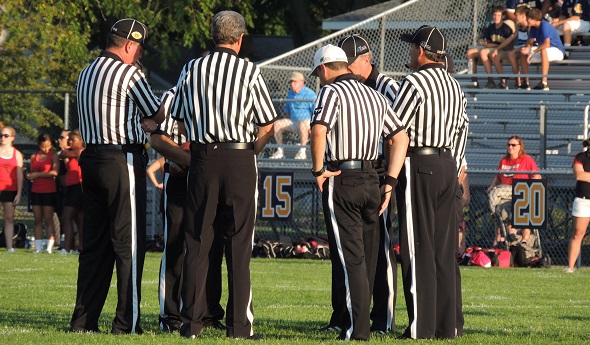
Timeout to Appreciate Officials
September 23, 2013
By Kevin Wolma
Hudsonville athletic director
Wolma is in his third school year as athletic director at Hudsonville and previously coached basketball and golf. Below is a recent “30-second timeout” he wrote for the Hudsonville district newsletter.
We were five seconds away from one of the greatest upsets in the history of Caledonia basketball.
During the regular season, South Christian had beaten us by more than 30 points on two different occasions. The District Finals became the site for the third contest between the two schools on a warm March day.
We were able to slow them down just enough to stay within striking distance until late in the fourth quarter, when we finally took the lead for the first time. South Christian had one last chance with seven seconds left on the clock. After a timeout, they in-bounded the ball from the sideline and their player forced up a shot. I could see it was going to be short from my viewpoint, and my heart began to race with adrenaline as I could sense the impossible was going to become possible.
What happened next has stuck with me for the rest of my life, as one of the South Christian players pushed one of our players in the back, grabbed the rebound, and put the ball in the basket with one second left.
Game over. South Christian wins the District championship.
For the next eight years as a varsity basketball coach, I held a grudge against officials for that one call. Twelve years later, after I was done coaching, I went back and watched the game over again for the first time. I almost turned the video off when they in-bounded the ball in those last seven seconds because I did not want to relive that moment and the ensuing emotions that took place.
While watching I discovered something.
The South Christian player did not shove my player as much as I thought, and our players did not box out like I had thought, which made it easier for them to get the rebound and score. Looking back, did I even tell my players to box out during that last timeout before the ball was in-bounded?
At that moment it became very clear to me that what we see during a game may be clouded because we want our team to gain every advantage and every call in order for them to be successful. Perception is not reality. Officials are human. They will make mistakes just like the coaches and players do during a game.
There still has never been a game that has been decided by an official. Some people will say that the Class B Semifinal boys basketball game (in 2010) was decided on an official’s call when they ruled one of Forest Hills Northern’s player's foot was on the line on his last-second shot when in reality his foot clearly was behind the line. That call cost them a chance to play in the (MHSAA) Finals.
Coach Steve Harvey was quoted in the paper as saying, "We had opportunities to take care of the game before it even came down to that shot.” In the moment it seemed like that one play cost Forest Hills Northern the game, but there were over 50 possessions on offense and defense that preceded the play and potential outcome.
Having the opportunity to spend time with officials inside the locker room has made it very evident they are serious about their jobs and calling the best game they can. I have had requests from officials to have a monitor available to break down film an hour and a half before their contest begins to see strengths and weaknesses in their placement and mechanics from prior contests. I have had officials upset at halftime or after a game because they realized they made a mistake. I have had officials contact me personally after a game to apologize for a call made during the contest.
In the business world and also in education we use the word collaboration a lot. Officials collaborate before, during, and after every contest to garner more knowledge so they can continue to improve.
This is not even their full time job. Officials do what they do because they love the game and want to give back to the sport that made an impact on them.
The next time we are at a game and we think the officials missed a call, let’s take a 30-second timeout to gather our emotions so we do not say anything we will regret later. Instead let’s spend our energy cheering on our teams to be the best they can be.