


NFHS Voice: Regardless of Future Direction, Multiple Sports/Activities is Best Choice
By
Karissa Niehoff
NFHS Executive Director
May 7, 2021
The values of participating in high school activities – sports, speech and debate, music, theatre and other programs – are well-documented.
A majority of the 12 million-plus participants in education-based activities have higher grade-point averages, are more disciplined and self-confident. In addition, research indicates that participation in high school activities is often a predictor of later success – in college, a career and becoming a contributing member of society.
This past year, the importance of these activities was demonstrated further through the consequences that occurred when these programs suddenly were unavailable.
The social, emotional and mental health of students was affected. When sports and activities no longer were available, many students self-reported symptoms of depression and anxiety. With less physical activity and no involvement in these programs, there were state-reported higher incidences of youth suicide. The research is sobering, and the link between participation in activities and overall health has arguably never been so clear.
So, there is a hope that the expected return to full programming this fall will begin the healing process.
And, if the opportunity to play one sport or activity is a positive step, the chance for involvement in multiple sports or activities throughout the entire school year has untold benefits – for the majority of students who are involved in high school activities to compete with their friends for fun, as well as those who are hoping to play sports at higher levels.
For many students, the experience of playing on a high school team may be the most positive aspect of their lives, and the high school coach or director of a speech or music group may be the most positive role model they have.
So, the return of these activities in schools nationwide is crucial. These programs provide a welcoming place and a means for support, guidance and direction. And when one sport or activity season ends, students should be encouraged to become involved in another activity the next season. Students can also enjoy multiple activities concurrently, such as participating on a sports team while also belonging to a performing arts group.
In a recent article in High School Today magazine, counselors at a school in Delaware reported that the most successful students applying to college and for scholarships are those involved in multiple sports, band, debate and other activities.
In some cases, the opportunity to participate in activities is the chief motivator to attend classes, graduate from high school, obtain a job and begin a career. Playing multiple sports and/or being a part of multiple arts and activities keeps students engaged throughout the school year.
Playing multiple sports is also the best direction for the 3 to 5 percent of high school athletes who will play at the college level. Many parents believe for their son or daughter to earn a college scholarship, they have to specialize in one sport year-round. This is simply not true.
As opposed to playing one sport year-round, playing multiple sports often affords student-athletes a better chance of landing a college athletic scholarship or, for the most elite athletes, having their name called in the NFL or NBA draft.
Consider this year’s NFL draft. Of the 32 first-round draft picks, 27 played one additional sport other than football in high school, and 10 of the 32 played two other sports. Amazingly, one individual – Jaelan Phillips – played five sports (football, basketball, baseball, volleyball and track & field) at Redlands (California) High School.
The list of high-profile professional athletes who played multiple sports in high school rather than focusing on one sport year-round includes the likes of Patrick Mahomes, Tom Brady, Aaron Rodgers, Joe Mauer, Bo Jackson, Alex Rodriguez and John Elway among numerous others.
The advantages of playing multiple sports rather than specializing in one sport are numerous. Students who play multiple sports have a reduced risk of overuse injuries, are able to learn from multiple coaches, participate in cross-training which leads to better athleticism, have better mental development and teamwork skills, and have a reduced chance of burnout in sports.
A number of successful business men and women were highly involved in high school and college sports or performing arts as well. Meg Whitman, CEO of Hewlett-Packard, was the captain of her swimming team and also played lacrosse, tennis and basketball. Former Whole Foods CEO Walter Robb was the captain of the Stanford soccer team. Bank of America CEO Brian Moynihan played rugby at Brown University.
Whether the goal is to participate in high school sports and activities to have fun with their peers, or to achieve a college athletic scholarship, or to be a lifelong participant, the best route to achieving a successful, healthy balance in life is to participate in multiple sports and other activities.
Dr. Karissa L. Niehoff is in her third year as executive director of the National Federation of State High School Associations (NFHS) in Indianapolis, Indiana. She is the first female to head the national leadership organization for high school athletics and performing arts activities and the sixth full-time executive director of the NFHS, which celebrated its 100th year of service during the 2018-19 school year. She previously was executive director of the Connecticut Association of Schools-Connecticut Interscholastic Athletic Conference for seven years.
English's Hall of Fame Contributions to St. Francis Continue Behind Camera Lens
By
Tom Spencer
Special for MHSAA.com
October 9, 2025
The name Julie English is now synonymous with Traverse City St. Francis football.

English spent her first two decades contributing to the school behind the scenes, helping the Gladiators launch boys and girls soccer programs, and scoring volleyball and basketball. She served as team manager for boys and girls soccer and even bus driver, so to speak, for the latter.
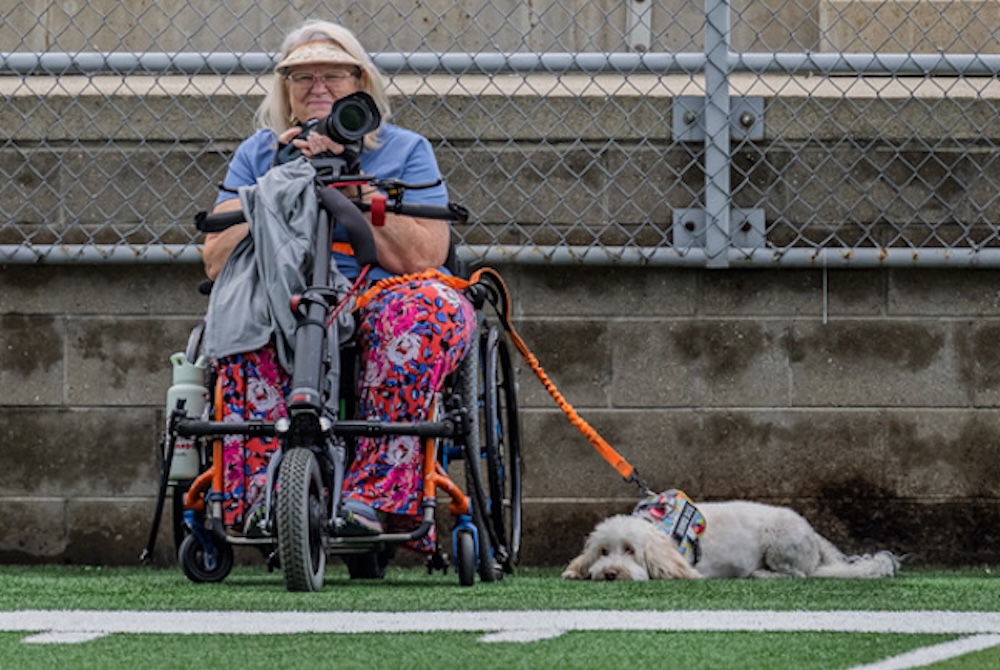
She’s also very noticeable on the sidelines of football, soccer and volleyball games, taking pictures with the aid of a motorized wheelchair.
This past Saturday, she was front and center. She was inducted into the Grand Traverse Area Catholic Schools Hall of Fame – established in 2007 to recognize individuals who inspire others by being exemplary role models.
English was paralyzed 10 years ago as she reached the end of a zip line while chaperoning a girls soccer team trip weeks ahead of the 2015 season. Many recall snow on the ground as she went first, intending to take pictures of the team as they planned to follow. She decided to go first that March day despite a fear of heights.
“It was all part of God's plan because I am afraid of heights – I really had to talk myself into going on the zip line,” said English, who considers it a freak accident and doesn’t discourage anyone from giving zip lining a try. “I was thinking, you know, I'm trying to convince these girls to step outside their comfort zone. And if I'm too afraid to do something like that, what kind of an example am I? So I breathed it and went up and actually it was fun – until it wasn't.“
Past TCSF athletic director Tom Hardy introduced English at the induction ceremony last weekend. He lauded the “amazing women he had the privilege” of working with during his 18-year tenure.
“While such a devastating event might have broken many, it only served to strengthen Julie's unwavering faith,” Hardy said. “She approaches each day with grace, fully aware of the challenges ahead, yet she embraces them with joy, love, and laughter. Following her accident, Julie dove deeper into her passion of photography.”
English now generously volunteers her time capturing St. Francis athletic events and creating lasting memories for students and their families through her lens, leaving school officials, coaches, players and supporters in awe.
Current TCSF athletic director Aaron Biggar has personally been touched by English’s work, through her photographs of his boys playing football for St. Francis. He’s thrilled to have English for home game, and she also travels to – and is welcomed by – volleyball, football and soccer opponents.
 “Julie’s ability to capture those life events for parents who are watching the game and not taking pictures, has been such a gift for our community,” Biggar said. “She's been around so long and (is) so accepted by our community. And even by opposing teams, they allow her to be on the field and make precautions and stuff so she can. Our opponents in other schools have also been so accommodating of her and helping.”
English was at Thirlby Field last week capturing the Glads’ big Homecoming win over Boyne City, 20-13. She won’t be on the road tonight as the Glads put their undefeated football record on the line against Pontiac Notre Dame Prep. But she will be back on the football sidelines Oct. 18 when St. Francis hosts Jackson Lumen Christi. And she’ll also be on the sidelines next week when the boys soccer team continues what it hopes will be another deep run into the postseason.
English’s humility, deep faith, and enduring optimism have had a profound and lasting impact, supporters note. Not surprisingly, her biggest concern as she takes pictures today is not her safety – it is the safety of the home and visiting athletes.
“I think sometimes I make people nervous, but I am always cognizant of what's going on, because the last thing I want to do is hurt anybody, like, have them run into me and then get hurt,” English said. “I want to be where I can get a good picture, but definitely not where someone could get injured if they ran into me.”
English’s photos are treasures for St. Francis families, points out Mike Kanitz, who was inducted into the Hall of Fame alongside English. In fact, he nominated her. Kanitz is the junior varsity girls basketball coach, volleyball game manager, volleyball announcer and volleyball scorekeeper, football press box manager, and the Glads’ soccer game manager.
“Julie’s ability to capture time for SF families, I mean, is priceless,” said Kanitz, who also can be found at the scorer’s table for boys basketball. “She catches kids in their level of joy, and it's cool. It's a snapshot in time, and she does it for every family. I mean, this is all free. She posts it all free. She doesn’t charge anybody. And she she's such a hard worker. She's everywhere.”
Kanitz vividly recalls English’s efforts to bring soccer to St. Francis. It happened in 2002. The Glads first had a club team coached by volunteer Reggie Rix.
“She had to fight some hurdles and it was a lot of work, and to start a new sport – her vision was the correct vision,” Kanitz said. “There were coaches, but Julie was really the one that took care of everything. Julie was fair to all children. She wanted all kids to have that good experience of high school sports.”
Kanitz, one of many who regularly see English’s photos and read her inspiring messages on social media, finds it difficult to think about the zip line accident. His daughter was one of the St. Francis soccer players waiting to come down the line next.
 “It's still hard for me to actually think about and talk about, but Julie's handled it better than anybody,” he said. “Her faith in God is so strong, and her message she writes … these Facebook stories about where she's at in her journey … they're moving and people read them, and it affects people.”
Early on, Julie recognized the vital importance of a Catholic education for her children and committed herself wholeheartedly to making it a reality, Hardy recalled. In addition to operating a full-time in-home daycare for more than 30 years, she worked weekends to help make ends meet and ensure that her four children – Ian, Caitlin, Jordan and Chelsea – remained enrolled in the Catholic schools.
As the owner of a daycare business, English drove a 12-passenger blue van. She often emptied the car seats in time to get 11 players – including Caitlin and Chelsea – to soccer games wherever TCSF was playing.
Caitlin English played on the first TCSF girls soccer team in 2002. She presented Hardy with a petition to offer soccer, signed by St. Francis athletes. As a club, English is proud to say, the team won all 17 of its games. When soccer became a school-sponsored varsity sport a year later, it was a cooperative with Traverse City Christian called Liberty.
Ian English was on the field for St. Francis boys’ first game, played through a co-op also with TC Christian during the fall of 2008. Chelsea English also played soccer for the Glads. Jordan English played rugby.
Ian, Jordan and Chelsea were at Julie’s induction ceremony. Caitlin, now living in the Grand Rapids area, was unable to attend because she is coaching soccer for her own daughter, Emilia, although Julie’s son-in-law did attend.
English gets around today with a vehicle adapted for her. She is supported regularly by Ian and Chelsea, along with a mother of nearby Kingsley High School athletes. She’s been spotted on the sidelines taking pictures at Kingsley volleyball and soccer matches, too. English also has been able to get to Grand Rapids and capture her granddaughter’s early soccer days with her camera.
She is enjoying a new beginning with soccer as well as her newer role for the Glads.
“Back in the day, I was able to run the clock, take pictures and do the book,” English said. “I don't think my brain would handle all of that now, but, you know, it was it was fun to do at the time. Not being able to do daycare anymore and not being able to do the things I did at St. Francis are the hardest things about being in a wheelchair – just not being able to do all the things I used to do.”
This spring marked the 10-year anniversary of the accident. English said she never asks, “Why me?” Rather, she is determined to can find the good and take advantage it.
Hardy agreed.
“Julie has said, ‘Never doubt who and what God puts in front of you,’” Hardy said. “This encapsulates the guiding ethos of her life.”
 Tom Spencer is a longtime MHSAA-registered basketball and soccer official, and former softball and baseball official, and he also has coached in the northern Lower Peninsula area. He previously has written for the Saginaw News, Bay County Sports Page and Midland Daily News. He can be reached at [email protected] with story ideas for Manistee, Wexford, Missaukee, Roscommon, Ogemaw, Iosco, Alcona, Oscoda, Crawford, Kalkaska, Grand Traverse, Benzie, Leelanau, Antrim, Otsego, Montmorency, Alpena, Presque Isle, Cheboygan, Charlevoix and Emmet counties.
PHOTOS (Top) Longtime Traverse City St. Francis supporter Julie English readies for her next shot while attending a Gladiators football game this season. (Middle) English captures a few frames. (Below) English recently was inducted into the Grand Traverse Area Catholic Schools Hall of Fame. (Top two photos by Rick Sack/TC Rick Photo. Below photo by Tom Spencer.)