

NFHS Voice: Security Wake-Up Call
December 4, 2019
By Karissa Niehoff
NFHS Executive Director
Given the increase in school-related shootings since the Columbine massacre 20 years ago, perhaps it is not surprising that these acts of violence are no longer confined to regular school hours.
The tragic shooting – and eventual death of an innocent 10-year-old – at a New Jersey high school football game last month made headlines across the country and was a somber reminder that events occurring after school hours are subject to the same type of senseless violence.
This was not the first shooting at a high school sporting event this year – actually it was the 23rd according to the National Center for Spectator Sport Safety and Security (NCS4) – but the death of Micah Tennant and the eventual conclusion of the game five days later at the Philadelphia Eagles’ stadium drew nationwide coverage.
Camden High School and Pleasantville High School finished the playoff game at a nearly empty Lincoln Financial Field before a few hundred family members and friends as the stadium was closed to the public. Larry White, New Jersey State Interscholastic Athletic Association executive director, said the decision to finish the game was made by both schools “to provide closure and send a powerful message that acts of violence and those who perpetrate them will not win.”
High school sporting events traditionally have been safe gathering places for fans to attend and celebrate the accomplishments of high school student-athletes – particularly the sport of football. And we must do whatever is necessary to make sure these venues remain safe and secure.
Reports have been encouraging about attendance as state football playoffs have concluded in many states. In Indiana, about 20,000 people attended the Class 5A championship at Lucas Oil Stadium in Indianapolis on the day after Thanksgiving.
We want to ensure that our stadiums remain open for everyone to attend. The fans – students, parents, other family members, friends, community residents – are what make education-based athletics different from non-school sports.
More intense security plans have been in existence at college and professional sports venues for many years; it is essential that leaders in high school sports move after-school safety and security to the top of their priority lists.
In addition to school athletic events that typically start in early evening hours, security plans also should be in place for practices inside and outside the school building.
Many resources are available for high school athletic administrators to implement an after-school safety and security program, including the free online education course on the NFHS Learning Center at www.NFHSLearn.com. “Afterschool Security” provides practical strategies for developing and implementing a school safety team and an after-school activities supervision plan.
As was the case with increased security at airports after September 11, 2001, the results of heightened safety plans for after-school activities may be an inconvenience for some individuals. However, plans must be in place to ensure that high school stadiums and arenas remain open for the almost eight million participants in high school sports, as well as the estimated 350 million fans annually.
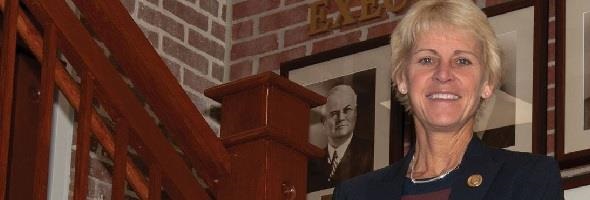
Dr. Karissa L. Niehoff is in her second year as executive director of the National Federation of State High School Associations (NFHS) in Indianapolis, Indiana. She is the first female to head the national leadership organization for high school athletics and performing arts activities and the sixth full-time executive director of the NFHS, which celebrated its 100th year of service during the 2018-19 school year. She previously was executive director of the Connecticut Association of Schools-Connecticut Interscholastic Athletic Conference for seven years.
NFHS Voice: Lights Signal Thanks, Hope
April 24, 2020
By Karissa Niehoff
NFHS Executive Director
The closing of schools and the cancelling of spring activities is a disappointing end to high school for this year’s senior class. However, there is still reason for optimism.
We anticipate that senior athletes and activity participants in the class of 2020 will move on to the highest of leadership roles in their chosen professions in the years to come.
Prior to this year, these seniors have accrued the general benefits of high school sports and other activity programs in which students learn self-discipline, build self-confidence and develop skills for practical situations – teamwork, fair play and hard work. Not to mention that many have higher grade-point averages, better attendance records and are set for a higher success rate in their chosen careers.
Seniors in this year’s class, however, will be among the toughest graduates ever as their lives have been the bookends to two of the worst tragedies in our nation’s history. Born sometime during the 2001-02 school year, which began with the horrific events of September 11, 2001, these resilient 2020 graduates had an abrupt ending to their high school days with the ongoing national health crisis.
Understanding their disappointment of not getting to compete this spring, people from coast to coast are expressing their support for these high school students.
With an idea apparently born in Texas, further developed in Colorado and supported by many others during the past several weeks, lights at high school stadiums throughout the country have been brightening the night-time skies. The #BeALight hashtag accompanies post after post of schools participating in this recognition of seniors who are missing their final season of high school sports or performing arts.
In some cases, the lights come on at 8:20 (20:20 in military time) and glow for 20 minutes, 20 seconds – a connection to the 2020 spring season at hand. Currently, 38 states have officially cancelled spring sports and activities due to the COVID-19 pandemic, and it is likely more will follow.
Among the traditional spring sports of track & field, baseball, softball, lacrosse, tennis and golf, almost three million girls and boys will be affected by this shutdown, including upward of one million seniors.
These lights have been turned on to say thanks to those seniors and to let them know they will be missed. Their contributions to high school activity programs will be remembered forever, and the benefits they received will guide them throughout their chosen careers.
Electric bills notwithstanding, perhaps these lights can burn for 20 minutes every night until the games return later this year. The lights signify hope – a hope that these lights will burn again this fall to showcase high school sports and performing arts.
While the timing of the return of high school sports and activities will rest with each state high school association in consultation with local governments and state health officials, the positive impact on communities nationwide will be tremendous. Once all the critical medical precautions have been addressed, high school sports and performing arts could take center stage once again. Although it is still too early to forecast the return of high school sports, its impact could be extraordinary.
With the loss of many non-school and club sport opportunities due to financial issues, high school sports and performing arts could fill an even larger void in the lives of our nation’s youth. And we look forward to that time ahead when student-athletes are on the field and fans are in the stands. Be safe. Stay healthy.
Dr. Karissa L. Niehoff is in her second year as executive director of the National Federation of State High School Associations (NFHS) in Indianapolis, Indiana. She is the first female to head the national leadership organization for high school athletics and performing arts activities and the sixth full-time executive director of the NFHS, which celebrated its 100th year of service during the 2018-19 school year. She previously was executive director of the Connecticut Association of Schools-Connecticut Interscholastic Athletic Conference for seven years.