

NFHS Voice: Thank You to All Coaches
January 29, 2021
By Karissa Niehoff
NFHS Executive Director
Earlier this week, the NFHS recognized more than 700 individuals for their efforts as high school coaches during the 2019-20 school year, including 23 as National Coaches of the Year.
The accomplishments of the national recipients are extraordinary, but comments about their roles as education-based coaches are even more telling as to why they were selected.
Mary Beth Bourgoin, field hockey coach at Winslow High School in Maine, who, although she has won 173 games, said, in an article in the Portland Press-Herald, “It’s not about winning and losing. It’s about relationships and having fun.”
Donna Moir has won three state championships as girls basketball coach at Sacred Heart Academy in Louisville, Kentucky, but is known more for her sportsmanship, humility and kindness.
Jerry Petitgoue, basketball coach at Cuba City (Wisconsin) High School, who has won 963 games in 53 years, led his team to an unblemished 25-0 record before the pandemic cancelled the state tournament.
In an article for SWNew4u.com, Petitgoue said, “I’m very proud to receive this recognition for Cuba City High School and the community. I’m happy it comes during these trying times. Every little positive thing is uplifting these days.”
Mary Jo Truesdale, softball coach at Sheldon High School in Sacramento, California, has won 759 games and eight California Interscholastic Federation-Sac Joaquin Section championships, but was unable to coach her team last spring due to the pandemic.
“I worry about the well-being of my players, especially the seniors who don’t have a next season to play in high school,” said Truesdale in an article in the Sacramento Bee. “We know there are more things going on in life that are much bigger than softball, and that’s what we’re all learning.”
Ron Murphy, baseball coach at Rio Rancho (New Mexico) High School, is second all-time in his state with 567 victories but was only able to lead his team to a few wins last spring before the coronavirus shut down the program and ended hopes for a state tournament.
Despite his own success, Murphy was more focused on his players in a recent article in the Albuquerque Journal, noting that, “The thing that gets me most excited about this award is that it brings national attention to Rio Rancho High School baseball.”
Doug Hislop, wrestling coach at Imbler (Oregon) High School, has coached for 50 years and remains active at 73 years of age, continuing to teach kids lessons on and off the mat.
David Halligan, soccer coach at Falmouth (Maine) High School, has led his teams to 12 state titles. In an article in the Portland Press Herald, Halligan said, “I’m proud that we’ve had a lot of good players and good programs for a lot of years. I find a lot of joy in coaching at the high school level. I love seeing how kids develop from freshmen to seniors and how they grow as people.”
These are but a few of the individuals selected for national honors in 2019-20 – all of whom have impacted student-athletes in positive ways for decades.
When it comes to honoring coaches for the 2020-21 school year, we should give a shout-out to every individual involved in high school education-based athletics for their tremendous efforts leading programs through the pandemic. Next to frontline health-care workers, there is no group of individuals to whom we should be more indebted than high school coaches.
Prior to the pandemic, a high school coach’s job was already a next-to-impossible 24-7 mission. In addition to preparing for the daily “Xs and Os,” interscholastic coaches spend countless hours in mentorship capacities with student-athletes off the field or court, answer tough questions from parents, teach classes during the school day and handle a number of never-ending, always-changing daily tasks.
This year, coaches are faced with other tasks related to COVID-19, which, in some cases, involve keeping team members connected and motivated in a virtual setting.
There is pressure on coaches to maintain protocols related to the pandemic and stay on course so the games can continue. The additional daily checklist is endless: sanitize equipment, remind students to wear masks and maintain social distancing, temperature and wellness checks with students, follow an endless list of protocols if a student tests positive, and the list goes on and on.
The tasks of high school coaches seem larger than life this year, and these men and women deserve our utmost respect and appreciation. In addition to parents, and perhaps in lieu of parents in some cases, high school coaches are helping student-athletes survive the pandemic and maintain a healthy outlook on life.
We salute this year’s award recipients – and all high school coaches – for their commitment to keeping our country’s future leaders – high school students – on track during one of the most trying years in our nation’s history.
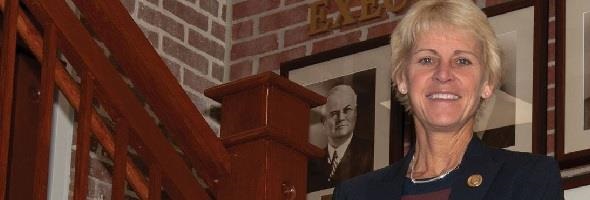
Dr. Karissa L. Niehoff is starting her third year as executive director of the National Federation of State High School Associations (NFHS) in Indianapolis, Indiana. She is the first female to head the national leadership organization for high school athletics and performing arts activities and the sixth full-time executive director of the NFHS, which celebrated its 100th year of service during the 2018-19 school year. She previously was executive director of the Connecticut Association of Schools-Connecticut Interscholastic Athletic Conference for seven years.
Ann Arbor Greenhills Athletics Recognized as 'Exemplary' by NIAAA
By
Geoff Kimmerly
MHSAA.com senior editor
July 29, 2022
Ann Arbor Greenhills’ athletic department has been selected for a Quality Program Award from the National Interscholastic Athletic Administrators Association (NIAAA), becoming the first Michigan school to receive the exemplary-level honor since the QPA was introduced in 2009.
Programs were considered by the NIAAA based on 10 assessment categories that aspire to “encourage measurement, planning and goal setting aimed at continuous improvement of local school athletic programs.” Greenhills will be recognized for the achievement during December’s NIAAA/NFHS National Athletic Directors Conference in Nashville, Tenn.
Greenhills sponsors 21 sports, and 247 of the school’s 355 students during the 2021-22 school year participated on at least one team.
"At Greenhills, we have always prided ourselves on continuous improvement, and aim to provide an exemplary experience for all of our student-athletes,” athletic director Meg Seng said. “The NIAAA Quality Program assessment guided us through a comprehensive examination of our entire athletic program. This exercise affirmed many of our strengths and also highlighted areas in which we can continue to improve.
“We remain motivated to measure, innovate and improve our program to benefit the student experience. While we are extremely grateful and proud for the recognition, the true value came while engaging in a thorough audit and working alongside dedicated colleagues during the process."
Greenhills previously received an Exemplary Athletic Program Award in 2017 from the Michigan Interscholastic Athletic Administrators Association (MIAAA).
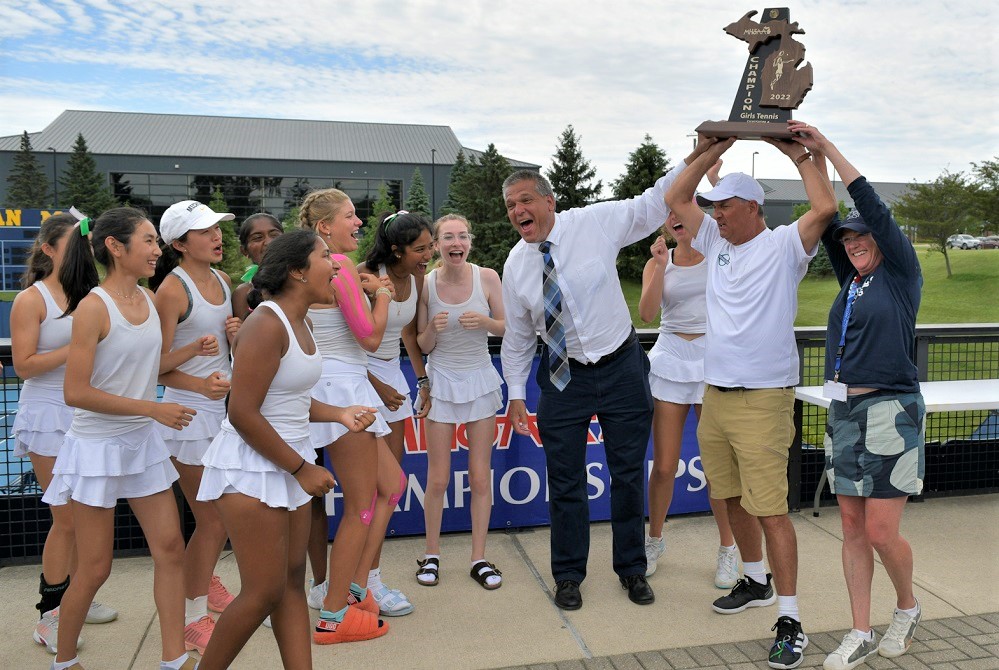
PHOTO The Ann Arbor Greenhills girls tennis team celebrates its Lower Peninsula Division 4 championship won last month. (Click for more from High School Sports Scene.)