

NFHS Voice: Thank You to All Coaches
January 29, 2021
By Karissa Niehoff
NFHS Executive Director
Earlier this week, the NFHS recognized more than 700 individuals for their efforts as high school coaches during the 2019-20 school year, including 23 as National Coaches of the Year.
The accomplishments of the national recipients are extraordinary, but comments about their roles as education-based coaches are even more telling as to why they were selected.
Mary Beth Bourgoin, field hockey coach at Winslow High School in Maine, who, although she has won 173 games, said, in an article in the Portland Press-Herald, “It’s not about winning and losing. It’s about relationships and having fun.”
Donna Moir has won three state championships as girls basketball coach at Sacred Heart Academy in Louisville, Kentucky, but is known more for her sportsmanship, humility and kindness.
Jerry Petitgoue, basketball coach at Cuba City (Wisconsin) High School, who has won 963 games in 53 years, led his team to an unblemished 25-0 record before the pandemic cancelled the state tournament.
In an article for SWNew4u.com, Petitgoue said, “I’m very proud to receive this recognition for Cuba City High School and the community. I’m happy it comes during these trying times. Every little positive thing is uplifting these days.”
Mary Jo Truesdale, softball coach at Sheldon High School in Sacramento, California, has won 759 games and eight California Interscholastic Federation-Sac Joaquin Section championships, but was unable to coach her team last spring due to the pandemic.
“I worry about the well-being of my players, especially the seniors who don’t have a next season to play in high school,” said Truesdale in an article in the Sacramento Bee. “We know there are more things going on in life that are much bigger than softball, and that’s what we’re all learning.”
Ron Murphy, baseball coach at Rio Rancho (New Mexico) High School, is second all-time in his state with 567 victories but was only able to lead his team to a few wins last spring before the coronavirus shut down the program and ended hopes for a state tournament.
Despite his own success, Murphy was more focused on his players in a recent article in the Albuquerque Journal, noting that, “The thing that gets me most excited about this award is that it brings national attention to Rio Rancho High School baseball.”
Doug Hislop, wrestling coach at Imbler (Oregon) High School, has coached for 50 years and remains active at 73 years of age, continuing to teach kids lessons on and off the mat.
David Halligan, soccer coach at Falmouth (Maine) High School, has led his teams to 12 state titles. In an article in the Portland Press Herald, Halligan said, “I’m proud that we’ve had a lot of good players and good programs for a lot of years. I find a lot of joy in coaching at the high school level. I love seeing how kids develop from freshmen to seniors and how they grow as people.”
These are but a few of the individuals selected for national honors in 2019-20 – all of whom have impacted student-athletes in positive ways for decades.
When it comes to honoring coaches for the 2020-21 school year, we should give a shout-out to every individual involved in high school education-based athletics for their tremendous efforts leading programs through the pandemic. Next to frontline health-care workers, there is no group of individuals to whom we should be more indebted than high school coaches.
Prior to the pandemic, a high school coach’s job was already a next-to-impossible 24-7 mission. In addition to preparing for the daily “Xs and Os,” interscholastic coaches spend countless hours in mentorship capacities with student-athletes off the field or court, answer tough questions from parents, teach classes during the school day and handle a number of never-ending, always-changing daily tasks.
This year, coaches are faced with other tasks related to COVID-19, which, in some cases, involve keeping team members connected and motivated in a virtual setting.
There is pressure on coaches to maintain protocols related to the pandemic and stay on course so the games can continue. The additional daily checklist is endless: sanitize equipment, remind students to wear masks and maintain social distancing, temperature and wellness checks with students, follow an endless list of protocols if a student tests positive, and the list goes on and on.
The tasks of high school coaches seem larger than life this year, and these men and women deserve our utmost respect and appreciation. In addition to parents, and perhaps in lieu of parents in some cases, high school coaches are helping student-athletes survive the pandemic and maintain a healthy outlook on life.
We salute this year’s award recipients – and all high school coaches – for their commitment to keeping our country’s future leaders – high school students – on track during one of the most trying years in our nation’s history.
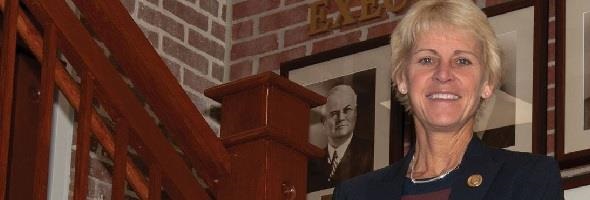
Dr. Karissa L. Niehoff is starting her third year as executive director of the National Federation of State High School Associations (NFHS) in Indianapolis, Indiana. She is the first female to head the national leadership organization for high school athletics and performing arts activities and the sixth full-time executive director of the NFHS, which celebrated its 100th year of service during the 2018-19 school year. She previously was executive director of the Connecticut Association of Schools-Connecticut Interscholastic Athletic Conference for seven years.
Niles' Arnold Remembered as Teacher & Leader, 'Doing Exactly What He was Meant To Do'
By
Scott Hassinger
Special for MHSAA.com
January 13, 2026
NILES – Throughout his 22-year career coaching varsity girls basketball at Niles High School, Jim Arnold required one thing from his players.
 Just have fun.
"Jim always stressed to his players that the one thing he wanted them to do when on the floor was to just have fun playing the game," said George Brawley, who served 15 seasons as one of Arnold's assistant coaches at various levels.
Arnold, 81, died Dec. 9 following an extended illness.
But throughout his career, Arnold's teams did much more than just enjoy themselves. The Benton Harbor native built a highly-successful program at Niles, where he achieved an overall win-loss record of 360-139 from 1986-2008, with 19 winning seasons. Under Arnold's watch, the Vikings captured seven conference titles, 10 District championships – including nine straight from 1997-2005 – and five Regional crowns.
Among Arnold's other accomplishments were being named Class B Coach of The Year by The Associated Press in 1998 and receiving honorable mention in 1997, along with selection by the Basketball Coaches Association of Michigan as Region 5 Coach of the Year in 2002 and 2004. He was also named conference Coach of the Year seven times and received the Herb Quade Memorial Sportsmanship Award for the 2002-2003 season.
Arnold also coached Niles to back-to-back District championships in softball in 1993 and 1994.
As young athlete himself, Arnold excelled on the baseball diamond. A successful player while at Benton Harbor, he also played on Twin City American Legion teams and was known as a team captain and a coach on the field. Arnold later had an invitation to try out at the professional level with the Baltimore Orioles, but an injury ended his pursuit of that dream.
Arnold later played third base for Bargain Center, a slow-pitch softball team that won a regional championship and went on to play in the national title game in St. Louis, Mo.
 His daughters Sonya and Allison were among the athletes that Arnold mentored during his coaching career. Sonya (Martinez), his oldest daughter, played for her father in eighth grade.
"He made the game fun, and you wanted to do your best because you didn't want to disappoint him. He poured his heart into each and every practice and game because preparation mattered to him. He demanded excellence, and every player became better because of his coaching ability," said Martinez, a 1986 Niles graduate.
Allison (Clay) his youngest daughter, played on the 1990 Niles varsity squad that finished 25-1, winning conference, District and Regional titles. She is a 1991 graduate.
"It was awesome playing for my dad. Some of my best memories in my life were during that time,” Clay said. “He had high standards and inspired others to be the best version of themselves. He put his heart and soul into what he did, and I had a front-row seat to that."
Linda Arnold has fond memories as a coach's wife.
"I loved watching my husband coach because of the joy it brought him. His passion, intensity and the love he had for his players was genuine,” she said. “It was more than a game. It was more about developing players in the area of discipline, teamwork and giving your all. Even in the busiest part of the season, he always made me feel like a priority. I didn't just watch a coach. I watched a man doing exactly what he was meant to do.
"My husband coached with passion, but he loved his family with intention. My girls would go to his practices and we all attended his games, and we had the team over for team dinners. His players were a part of our extended family. He made sure we felt a part. He was the best coach in the world, and he was mine."
Jim Arnold was highly respected by his coaching peers. He was kind and treated everyone with dignity. The community of Niles knew what he stood for and they knew his standards were high. He was admired for his preparation and understanding of the game as well as his commitment to doing things the right way. He was strict but fair and treated everyone the same, whether you were the star player or last one off the bench, Martinez explained.
"Developing his players' character was far more important to him than winning," she said. "Dad lived what he taught. He modeled humility, hard work and lived a life of integrity. He made people better by being a part of their lives."
When Jim Arnold first began his junior high teaching career in Niles, he also coached the boys junior high basketball team. There were no girls basketball teams at the time, so a girl tried out for the boys team. She was good enough to make the team, so Arnold kept her. The following school year, the principal asked Arnold to organize a girls team – and the rest was history.
Former Niles varsity girls basketball coach Jessica Johnson, a teammate of Clay’s, recalls the experience of playing for Coach Arnold.
 "Coach Arnold taught us discipline, resilience and always required 110 percent effort from you. He would instill confidence in you while still holding you accountable," said Johnson, now an assistant women’s basketball coach at Southwestern Michigan College.
Johnson recalls Arnold's use of comic strips as a teaching tool to help his players improve upon their mistakes.
"If you had a game where you didn't shoot very well or took questionable shots, he would place pictures of bricks in the gym the day following the game," Johnson said.
"Coach Arnold went out of his way to build that relationship and trust with his players. He gave us lessons that extended way beyond the court that made us better people."
Mark Haase, a Niles alumnus and the current Vikings head varsity boys basketball coach, also had the privilege of playing for Arnold.
"I played freshman basketball for Coach Arnold. It was one of the most disciplined and well-conditioned teams I ever played on. He ran a tight ship, but it was done out of love and concern for his players. He has a great family and is a Niles legend," Haase said.
Niles athletic director Matt Brawley referred to Arnold as an amazing teacher, coach and individual in the school and community.
"Coach Arnold would never ask you to do anything he wouldn't do. He was very structured and expected a lot out of his players, and he got results without excuses,” Brawley said. “He was a true leader of Niles athletics. He was an unbelievably kind and humble individual.”
 Scott Hassinger is a contributing sportswriter for Leader Publications and previously served as the sports editor for the Three Rivers Commercial-News from 1994-2022. He can be reached at [email protected] with story ideas for Berrien, Cass, St. Joseph and Branch counties.
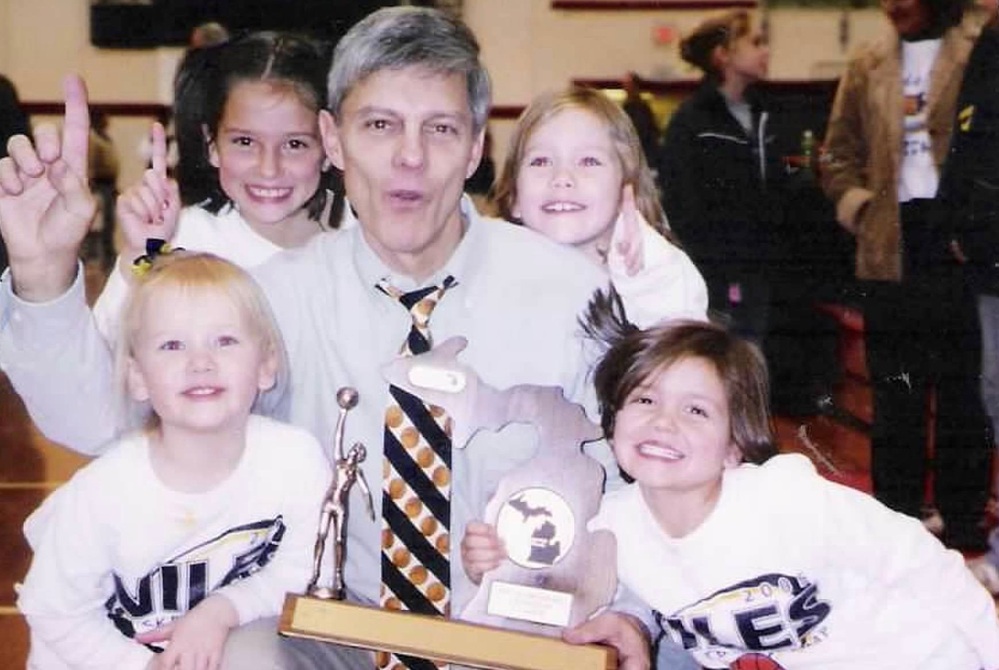
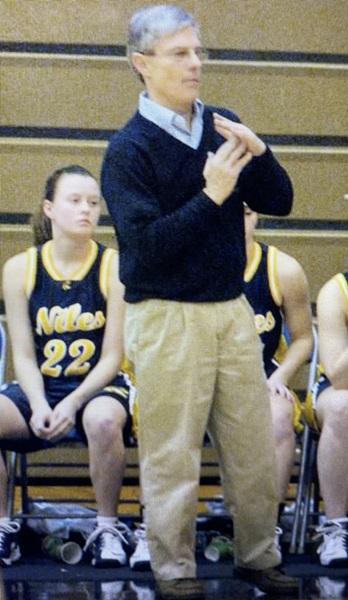
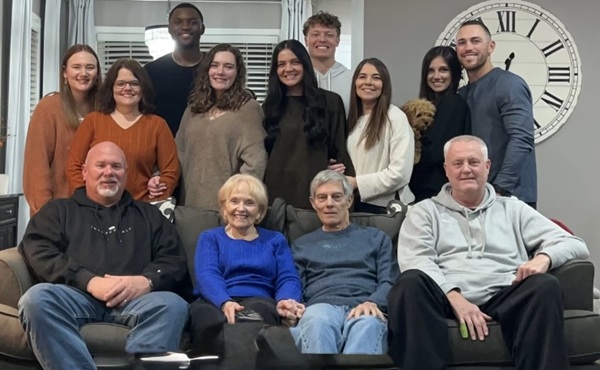
PHOTOS (Top) Jim Arnold poses for a photo with his granddaughters following a Niles girls basketball game. (Middle) Arnold signals for a timeout. (Below) Linda and Jim Arnold, seated (middle) take a photo with their daughters and their families. (Photos courtesy of the Niles athletic department and Arnold family.)