

NFHS Voice: Time for Teachable Moments
September 6, 2019
By Karissa Niehoff
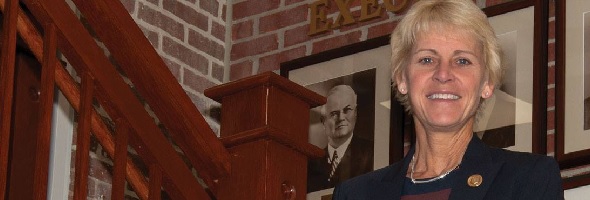
NFHS Executive Director
Welcome to another year of educational opportunities through high school sports and other activity programs in our nation’s schools. These programs provide many teachable moments not available in the classroom, and we look forward to making an impact on the more than 12 million young people involved in these vital activities.
Many states opened their high school football seasons during the final weekends of August. Thousands of other high school students will be involved in volleyball, cross country, field hockey, soccer and other sports this fall. And then there are those boys and girls involved in speech, debate, music and other cocurricular activity programs.
The NFHS distributed its most anticipated news release of the year earlier last week – the Annual Sports Participation Survey. The number of boys and girls involved in high school sports has been spiraling upward annually since 1988 – an amazing 29 consecutive years. However, due to several factors, the 2018-19 figure dipped to 7,937,491, which is the third-highest total in the 50-year history of the survey.
We have been aware for some time that the number of kids involved in youth sports has been declining. In addition, a decline in the number of public school students has been predicted for a number of years, so there simply may be fewer students in schools.
Understandably, the focus will be on the sport of football. While there were no states with significant drops in boys 11-player football, most states reported slight declines, which amounted to 30,000 participants nationally. However, a comparison of the figures from the past two years indicates that the average number of boys involved in 11-player football on a per-school basis dropped from 73 to 70, which would include freshman, junior varsity and varsity teams.
In some cases, schools are starting and/or increasing programs in 6-player, 8-player and 9-player football as participation numbers were up in all three versions of the game. And participation by girls in 11-player football has doubled in the past 10 years to 2,404 participants last year.
The survey confirmed that schools are not dropping the sport of football, which is great news. We continue to work with our state associations and groups such as USA Football to reduce contact and teach proper tackling skills at the youth level to increase the interest level as kids reach junior high school and high school.
While we hope that the numbers will return in football, we are pleased with the continued growth in several other sports, including volleyball, soccer and lacrosse. Since 2012, participation in girls lacrosse and boys lacrosse has increased 19 percent with a combined 213,452 participants in 2018-19. Girls and boys soccer has gained 70,668 participants since 2012 (a nine percent increase) and now has a combined 853,182 participants.
Seemingly, schools have something for everyone as the survey indicated participation by high school students in 70 different sports, as well as numerous adapted and Unified sports for students with disabilities. Schools are providing opportunities in bowling, badminton, flag football, archery, Ultimate Frisbee, bass fishing, crew and many, many others.
Ultimately, the goal of the NFHS and its 51-member state associations is to ensure that all students have an opportunity to enjoy healthy participation, achievement and good sportsmanship in education-based activities. We are excited about these opportunities as another school year begins.
Dr. Karissa L. Niehoff is beginning her second year as executive director of the National Federation of State High School Associations (NFHS) in Indianapolis, Indiana. She is the first female to head the national leadership organization for high school athletics and performing arts activities and the sixth full-time executive director of the NFHS, which celebrated its 100th year of service during the 2018-19 school year. She previously was executive director of the Connecticut Association of Schools-Connecticut Interscholastic Athletic Conference for seven years.

This Week in High School Sports: 10/8/26
By
Jon Ross
MHSAA Director of Broadcast Properties
October 8, 2026
This week's edition highlights the champions of this season's Upper Peninsula Girls Tennis Finals and awards Game Balls to more high achievers in football, tennis and volleyball.
 The 5-minute program each week includes feature stories from MHSAA.com or network affiliates, along with "Be the Referee," a 60-second look at the fine art of officiating.
"This Week in High School Sports" is powered by MI Student Aid, a division within the Department of Lifelong Education, Advancement, and Potential (MiLEAP).
Listen to this week's show by Clicking Here.
Previous 2026-27 editions
Oct. 1: 2026 MHSAA Football Playoff schedules - Listen
Sept. 24: Pontiac Notre Dame Prep coach Betty Wroubel's record pursuit - Listen
Sept. 17: Mattawan/Battle Creek Central's high-scoring football matchup - Listen
Sept. 10: 2025-26 MHSAA participation national rankings - Listen
Sept. 3: 2025-26 MHSAA postseason attendance - Listen
Aug. 27: Officiate Michigan Day, What's My Why - Listen