

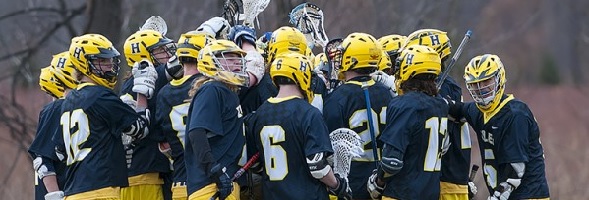
One Word for 2015-16: Partnership
August 20, 2015
 By Kevin Wolma
Hudsonville athletic director
One word. Every year before the school year starts I choose one word to help me focus on what is important and shed all the other clutter in my life. I try to choose a word that will help me in my professional and personal life.
The word I choose for the 2015-16 school year is partnership. After choosing my word, I realized the word partnership can further enhance our already strong athletic program too.
Often roadblocks are put up in athletic programs that do not allow the program to reach its fullest potential. This creates a separation within a program where all the partners involved detach themselves from the goals/values set by the organization. We see this in every organization, but this article is going to specifically discuss the partnerships between parents, coaches, student athletes and officials.
When I first started coaching basketball, I encountered a situation where parents were unhappy about what they thought was a reduced role for their student athlete on the team. He was a starter his sophomore and junior year, but the dynamics of the team his senior year required that I move him because he was one of my best offensive players that could help the second unit. He would play about the same number of minutes, but his role would change.
As a coaching staff, we believed this change helped the team and the student athlete by allowing him to use his strengths as an offensive player. He would have more opportunities to score than he would have if he was a starter. We were trying to do what was best for the team and individual but the parents did not see it that way.
Reasoning only made the situation worse as they felt he was entitled to start. They did not appreciate the fact that we were trying to give him more opportunities to reach his fullest potential. The parents went as far as starting a petition to remove me as head coach along with telling anyone who would listen how bad I was as a coach. This lack of partnership hurt our team. The student athlete complained openly to other players on the team, which created a negative atmosphere in the locker room, and the parents created a negative atmosphere in the stands. Needless to say that was a tough season to build a cohesive group.
This story provides insight on how one isolated incident can have an impact on so many other partnerships. The parent/coach partnership was strained along with the player/coach partnership. This inhibited the growth of the team to become the best it could because of the negative culture created. The parent/child partnership was also directly affected because the parents took on the role of an agent or defender and not one of a supporter or advisor. Just think if the parents talked to their child and said, “This is a great opportunity for you and your team. You could see a lot of benefit by supplying the scoring load off the bench. If this makes the team better, you should embrace it.” The outcome and season could have had an entirely different feel by handling the situation differently.
During the season there is going to be some adversity and “why” moments, but having an open and positive communication line with the coach and your child is the key to forming positive partnerships. You don’t have to always agree with the decisions, but how you handle the “why” moments will have a profound impact on your child and the team he or she plays on.
The other type of partnership that is not described in my story, but is becoming more and more fractured every year, is the parent/fan/official partnership. Last year I had a group of officials ask me to sit in the stands of an opposing team section because of how degrading those fans were toward the officials. On more than one occasion I had to talk to a group of fans and ask them to keep it positive. Most of the time they looked at me as if to say, “You can’t tell me what I can and can’t say.”
The one thing that people do not understand is that yelling at an official has no bearing on the game. An official has never changed a call based on what a fan has to say. In the last two years there has been a steady decline of officials leaving the profession and very few officials entering the profession. Do you blame them? Who wants to work 2-3 days a week and get yelled at for two hours.
Let's be different. To improve this partnership, let’s give them applause when the officials are introduced for each contest. After the game thank them for their time and efforts. I encourage anyone out there who has an interest in officiating to give it a try. You can have a powerful impact on student athletes.
Partnership is a very important part of high school athletics. I encourage everyone to make my word for 2015-2016 a part of your experience with high school sports as well. Together, let’s cheer on your teams and make this the best year yet.
Wolma has served as Hudsonville's athletic director since 2011 and previously coached boys varsity basketball and girls varsity golf among other teams. He also previously taught physical education and health.
This Week in High School Sports: 11/20/24
By
Jon Ross
MHSAA Director of Broadcast Properties
November 20, 2024
In this week's edition, we provide some quick 8-player football history in advance of this weekend's pair of Finals, present Game Balls to high achievers in volleyball and tell how the Southwest 10 Conference is recruiting volleyball officials from among current players via the MHSAA Legacy Program.
 The 5-minute program each week includes feature stories from MHSAA.com or network affiliates, along with "Be the Referee," a 60-second look at the fine art of officiating.
"This Week in High School Sports" is powered by MI Student Aid, a division within the Department of Lifelong Education, Advancement, and Potential (MiLEAP).
Listen to this week's show by Clicking Here.
Previous 2024-25 Editions
Nov. 13: "Flashback 100" series, flashback to Escanaba's football championship - Listen
Nov. 6: Boys Soccer Finals, Lower Peninsula Cross Country Finals review - Listen
Oct. 30: 2024 Football Playoffs, Lower Peninsula Boys Tennis Finals review - Listen
Oct. 23: Lower Peninsula Girls Golf Finals, Upper Peninsula Cross Country Finals reviews - Listen
Oct. 16: MHSAA Football Playoffs primer, MHSAA/Farm Bureau Scholar-Athlete Awards - Listen
Oct. 9: National High School Hall of Fame, Upper Peninsula Girls Tennis Finals - Listen
Oct. 2: MHSAA record book, 2024 Boys Soccer Tournament schedule - Listen
Sept. 25: NFHS Network streaming, DeWitt's high-scoring football matchup - Listen
Sept. 18: Cheboygan broadcaster Mike Grisdale, Michigan's national participation ranking - Listen
Sept. 11: MHSAA baseball stars in MLB, 2024 Boys Soccer Tournament - Listen
Sept. 5: Highlighting MHSAA record setters, 50th Football Playoffs - Listen
Aug. 28: MHSAA Summer Olympians, "Century of School Sports" celebration - Listen