

Parents Master Art of Schedule Juggling
By
Pam Shebest
Special for MHSAA.com
October 18, 2016
If it’s Tuesday, it must be volleyball — or is it soccer or maybe swimming?
 Time to check the calendar, the phone app or the white board.
To keep up with two or more students involved in different sports in the same season, families have devised their own ways for keeping track of schedules.
The Carpenters, who have sons Matthew and Alex at Kalamazoo Hackett Catholic Prep, use several calendars, including a master schedule in the kitchen.
The Perkins, whose daughters Lauren and Audrey attend Mattawan High School, rely mostly on the phone app Cozi to keep schedules straight.
For the parents, it’s a question of logistics and juggling, which sometimes takes a lot of creativity.
“We have electronic calendars and paper calendars to look at every morning,” dad Tim Carpenter said. “We talk about who’s going where and who’s going to do what at the start of each day to figure it out.
“I keep a sports calendar to share with all the family so they can see the different things going on. If we are ever home at night without a game, it’s a strange feeling.”
 Besides the composite kitchen calendar, “We also have our iPhone calendar so we both can see one another’s calendar at the same time,” mom Julie Carpenter said.
“It’s pretty much Monday through Saturday, some game or practice. Sunday it’s Mass, groceries and laundry.”
The Perkins use a phone organizer app called Cozi.
“We try to get all the schedules in there so everybody knows where everybody else is,” mom Valerie Perkins said. “I usually have a white board on the kitchen counter that I update weekly, and it kind of tracks who’s got what when.
“The girls’ meets are on opposite days. Like Audrey will have something on Monday, Wednesday and Lauren has Tuesday and Thursday. Occasionally they both have Saturdays. Then we divide and conquer, for sure.”
With five children, the Carpenters try to split time evenly between all the activities.
Matthew, a senior, is Hackett’s soccer goalkeeper and Alex, a sophomore, plays junior varsity football. Oldest son, Josh, a sophomore at Michigan Tech, plays broom ball – and while his parents don’t travel to watch him play, the games are webcast during the winter.
The activities won’t end soon. Bennett, a sixth grader and Bethany, a third grader, both at St. Augustine in Kalamazoo, also are involved in sports.
The Carpenters try to attend all of their children’s games together, but sometimes that is not possible.
In that case, “We usually base it on who’s closer,” Tim Carpenter said. “If there’s one game south near where I work in Portage (at MANN+HUMMEL), I’ll usually go to that.
 “If Julie (who works at Borgess-ProMed Physician Pediatrics in Richland) has only seen one of Alex’s games and I’ve seen two, she’ll go to Alex’s. We try to keep it even.”
Both parents were introduced to new sports once their sons got involved.
“(Our sons) haven’t done tennis or golf,” Julie Carpenter said. “Soccer’s got more action and excitement; basketball is similar. Skiing was neat because it’s such a close-knit community. Cross country was fun because it was a very team environment.
“I had not seen cross country before, but when Josh started cross country it was really exciting because we thought ‘OK, how much can you get out of cross country as a spectator?’ It was pretty exciting for us just to run from spot to spot. They’re such a close-knit group of kids.”
Whether there are five children or two, as in the Perkins family, parents face the same dilemma: trying to juggle work, practices and events.
“We usually try to trade off so we get an even mix of seeing the girls,” said Valerie Perkins, who works at Bronson Urology in Kalamazoo. “Sometimes Rob’s schedule dictates that. Sometimes it’s who’s ever closest.”
Rob Perkins, who works at TRW in Mattawan, said sometimes there’s a glitch.
“When they give us advance warning of what’s going on and it doesn’t change, then I can work around it,” he said.
“The only time it gets frustrating is when something changes at the very last minute, or maybe it was always the same and the girls’ stories change at the last minute,” he added, laughing.
Neither parent was familiar with the sports their daughters chose.
“With dive, Lauren started in eighth grade, so it evolved from a summer camp and she really enjoyed it,” Rob Perkins said. “We kind of fell into Kyle Oberhill, who’s the diving coach for (Kalamazoo College) and he manages the facilities for Western (Michigan University).
“He’s just really easy-going. (Lauren) excelled in it right away. As a freshman, she broke the school record. That kind of kept her motivated to keep going.”
Oberhill also had a workshop for parents to explain the intricacies of competitive diving, and that helped. Audrey, meanwhile, took on another sport new to her parents when she started playing volleyball in seventh grade.
 “We didn’t know much about it, but the important thing to know about it is she enjoys it,” her dad said.
Rob Perkins said it would be much easier if volleyball and dive were not in the same season, but there is an upside.
“I would say, generally speaking, being in sports certainly builds their self-confidence, keeps them occupied.”
Their mother said she can see a positive influence of sports on their girls.
“I think sports have definitely improved them,” she said. “They’ve learned how to become leaders and work as a team, and I really appreciate that.
“I can see it develop in both of them over the years. Both are captains of their teams.”
And both sets of athletes said it’s important to see their parents at their games.
“It gives me more confidence,” Alex Carpenter said, “and makes me feel good that they want to see me play.”
 Pam Shebest served as a sportswriter at the Kalamazoo Gazette from 1985-2009 after 11 years part-time with the Gazette while teaching French and English at White Pigeon High School. She can be reached at [email protected] with story ideas for Calhoun, Kalamazoo and Van Buren counties.
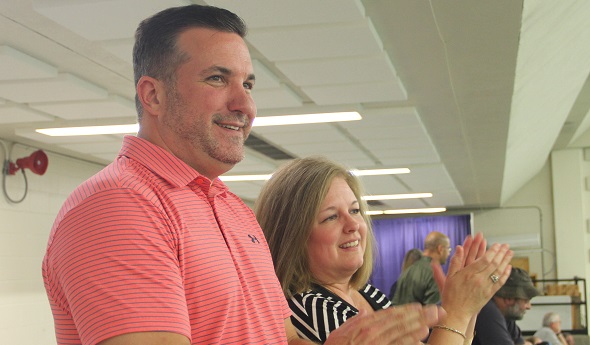
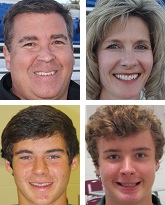
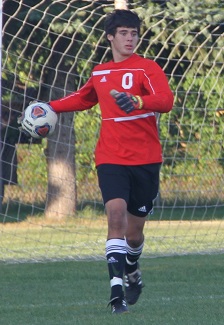
PHOTOS: (Top) Mattawan parents Rob and Valerie Perkins cheer on their daughter Lauren during a recent swimming & diving meet. (Middle top) The Carpenters, clockwise from top left: Tim, Julie, Alex and Matthew. (Middle) The Perkins daughters, Lauren (left) and Audrey. (Middle below) Matthew, the Hackett soccer goalkeeper, looks to pass after gathering up a loose ball. (Below) Lauren Perkins dives during a meet. (Lauren Perkins head shot by Becky Anderson Photography, all other photos by Pam Shebest.)
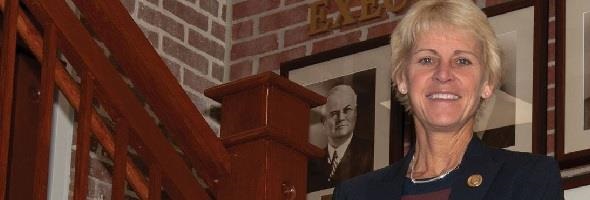
NFHS Voice: Salute Seniors with Spring on Hold
March 27, 2020
By Karissa Niehoff
NFHS Executive Director
A visitor to the local high school in late March would normally find boys and girls engaged in track and field, baseball, softball and lacrosse practices. Inside the building, some students would be involved with speech or debate activities. Unfortunately, this is not a normal year – far from it.
Spring sports playing fields are empty. High school sports and activities, with more than 12 million participants, are on pause, and high school athletes, coaches, athletic directors, parents and other fans are trying to determine when these programs will return.
The ever-changing news we are receiving almost on an hourly basis is more than one can comprehend as we all deal with this global health crisis. Each day, with the spread of the coronavirus, we try to determine what has changed since the day before. Can we go to work? Can we leave our house to go to the store?
Like every other activity in our nation, high school sports and activity programs are on hold. With all schools closed for varying amounts of time – some to the end of the academic year – millions of participants in spring sports and activities are on the sidelines awaiting the green light for competition to resume.
In past years, our member state associations and the 19,500 high schools across the country have had to postpone or cancel events for short periods of time due to weather or other factors, but this is unprecedented. The reality is that spring sports may never occur in some states – particularly those where schools are closed for the academic year. And this would be doubly disappointing in those states that were not able to conduct or complete state basketball championships.
The possibility of losing spring sports is particularly disappointing for graduating seniors. While everyone is affected by this health crisis and has their own issues to confront, it is important for everyone involved in high school activity programs to salute those seniors – boys and girls in sports and activities programs who have sacrificed for 3½ years but may not be able to reach the finish line.
While they may miss some of the final games and events, the benefits of being involved in these programs will carry them for a lifetime. The early-morning practices, offseason workouts and late-night studying after a day of activities will undoubtedly make them stronger and more dedicated in their future professions.
We thank all high school athletes and performing arts participants for the great memories – especially those who may not be able to complete their races or sing in the music ensemble this year. While some will have more competitive opportunities in sports and activities, for others that continued involvement may be in the form of coaching or officiating, but the impact of involvement in these programs will last a lifetime.
There have been times in the past when high school sports and performing arts helped individuals in communities through difficult times – events like weather-related disasters or school shootings as examples. We believe that these programs will play an even larger role once the coronavirus pandemic subsides and we are able to return to normalcy.
Why? Because after our days, weeks and perhaps months of social distancing, teamwork will help us all come back together, and there is no better demonstration of teamwork than education-based high school sports and activity programs.
We all anxiously await the day when the whistles blow and the curtains rise again.
Dr. Karissa L. Niehoff is in her second year as executive director of the National Federation of State High School Associations (NFHS) in Indianapolis, Indiana. She is the first female to head the national leadership organization for high school athletics and performing arts activities and the sixth full-time executive director of the NFHS, which celebrated its 100th year of service during the 2018-19 school year. She previously was executive director of the Connecticut Association of Schools-Connecticut Interscholastic Athletic Conference for seven years.