

Play it Safe: Basics of Proper Helmet Use
February 4, 2020

Henry Ford Health System
If you or your child plays sports or participates in physically risky activities, wearing a helmet could be lifesaving. While no helmet is concussion-proof, wearing one can help reduce the risk of serious head injuries.
"Helmets are made with materials that help reduce impact to the head, protecting the skull from damage," says Jeffrey Kutcher, M.D., a sports neurologist who treats athletes at the Henry Ford Kutcher Clinic for Concussion and Sports Neurology. "You should be wearing a helmet whether you're playing a contact sport or riding something on a hard surface, such as a bike, scooter, skateboard or rollerblades."
Head Injury Prevention 101: Helmet Buying Basics
All helmets are certified at the same level for multi-use recreational activities. So there's no need to search for a specific seal or rating. Instead, when you're purchasing a helmet — or getting one second-hand — focus on these four factors:
How you’ll use it:
Pay attention to the risks involved with the activity you're doing. If you're biking, skiing or snowboarding, for example, you're wearing a helmet in case you get hit, not because you'll get hit.
There are two types of helmets: single-impact and multiple-impact. Single-impact helmets are made with foam materials that break down when hit as part of their force mitigating strategy. These helmets work well for bicycling, skateboarding, skiing or snowboarding. Multiple-impact helmets, such as those designed for sports like football, hockey and lacrosse, can withstand many hits over an entire season. The materials in these helmets don't break down, but rather compress and regain their original form.
"A helmet may perform better in the lab — for example, the dummy brain will experience 98Gs of force instead of 100Gs — but 2Gs of force probably won't make enough of a difference with a one-time injury," Dr. Kutcher says. "But 2Gs less force per hit for a linebacker who suffers multiple blows on a daily basis for many years? That could make a big difference.”
If football is your sport, the National Football League provides a helmet rating system that assesses helmets based on their ability to mitigate force over time.
How it fits:
Helmets fit differently depending on the make, style and type of sport they’re made for. "The key is making sure the helmet covers the entire skull and doesn't move around when in use," Dr. Kutcher says. The helmet should sit on the head without falling forward or backward. If you're relying only on a chinstrap to keep it in place, you don't have the right fit.
How comfortable it is:
Not all helmet brands fit every head. Helmet designs vary just like running shoes do. When you're shopping for a helmet, make sure it's snug, but not tight or uncomfortable. Comfort is critical, especially for kids. "You don't want a child to develop a negative association with wearing a protective helmet," Dr. Kutcher says.
What condition it’s in:
To get the most protection, your helmet should be in top condition. Do not wear a cracked or broken helmet, or one that has been involved in a crash or similar event (unless it's a multiple-impact design). An impact can crush foam materials. And don't allow the helmet to get too hot or cold — that can cause the materials to break down over time.
Get the Best Helmet Fit for Your Head
Properly wearing a helmet provides the greatest defense against injury — more than any style or brand. To make sure your helmet is secure, follow these rules:
· Measure head circumference: Every helmet brand provides a size chart, along with instructions about how to select the best fit. To get the best measurement, use a cloth tape to measure your head circumference. Place the tape about an inch above the eyebrows, keeping it level from front to back. If the measurement falls between sizes, select the smaller size.
· Pay attention to hairstyles: Make sure to try the helmet on with the hairstyle you'll have during the activity. A long-haired bike rider who gets a short haircut may require a helmet adjustment.
· Watch your vision: The helmet should not block your vision. You should be able to see straight ahead and side to side.
To Wear a Helmet or Not To Wear a Helmet: When to Play It Safe
There are several sports that don't require wearing a helmet. But if you or your child is involved in rugby or soccer, or another sport where helmets are optional, that doesn’t mean you're in the clear.
"It's important to base any decision about whether or not to wear a helmet in conjunction with your sports neurologist," notes Dr. Kutcher. "Your past medical history and current health status may still warrant the use of a helmet."
Unsure whether you're at risk of sustaining a head injury? Get a brain health baseline evaluation. Proper consideration of your brain health includes a physical examination, along with a personal and family medical and neurological history. It also offers you an opportunity to learn how to best protect your head.
Related Topic: 7 Tips for Recovering Mentally After a Sports Injury
Dr. Jeffrey Kutcher is a sports neurologist at the Henry Ford Concussion and Sports Neurology Clinic and the global director of the Kutcher Clinic.
Want to learn more? Henry Ford Health System sports medicine experts are treating the whole athlete, in a whole new way. From nutrition to neurology, and from injury prevention to treatment of sports-related conditions, they can give your athlete a unique game plan.
Visit henryford.com/sports or call (313) 972-4216 for an appointment within 24 business hours.
Century of School Sports: MHSAA Programs Prioritize Health & Safety
By
Geoff Kimmerly
MHSAA.com senior editor
April 29, 2025
Rank the top 10 conversations anyone would choose to have when it comes to school sports – be it talking up top teams, the latest stars, past champs, etc. – and advances in health & safety probably come in somewhere around No. 27.
But no topic has been or will remain more important to generating and maintaining successful athletic programs at every level of sport – including the high school and junior high/middle school levels administered by the MHSAA.
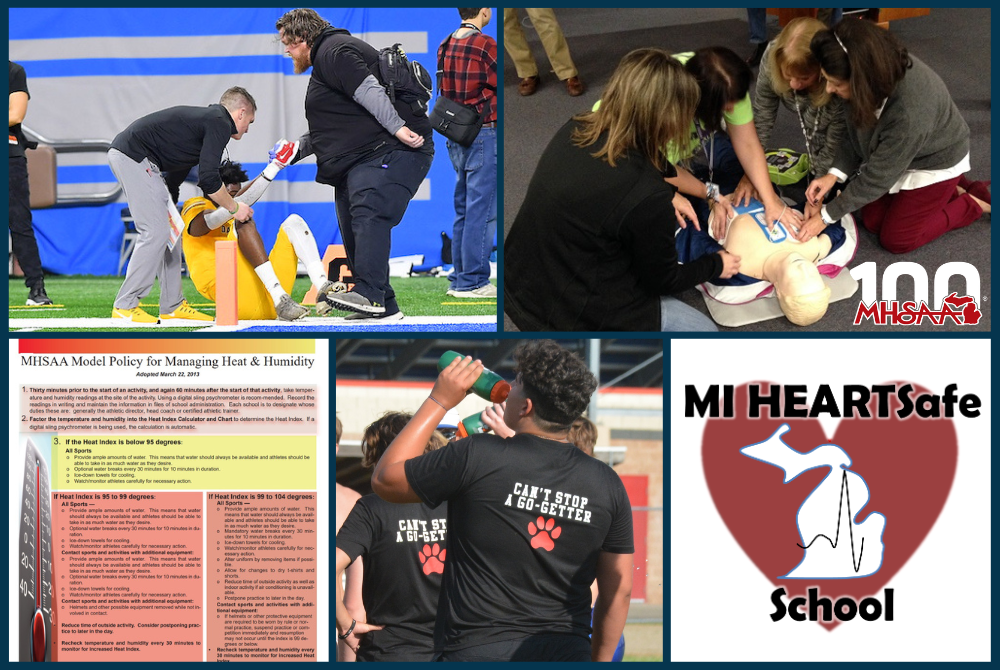
From the start of organized school athletics in Michigan more than 100 years ago, health and safety have been priorities. Sports safety concerns – especially in football – helped drive the creation of organized sport administration. Longtime policies – like the one ceasing activity for 30 minutes for lightning or thunder – have become part of daily life in athletics. Other measures, like MHSAA-provided insurance coverage to assist families who experience catastrophic injuries in school practices and competitions, aren’t even known by most – but can be life-altering for those who require those benefits.
For most of this century, the MHSAA’s health & safety initiatives have focused on the “4 Hs” coined by retired executive director Jack Roberts – Health Histories, Heads, Heat and Hearts. Those were the drive of much of his work especially over the final decade of his tenure before he retired in 2018 after 32 years.
Current executive director Mark Uyl’s time leading the association has seen the MHSAA begin work in mental health and create a Sports Medicine Advisory Committee (SMAC) during the 2019-20 school year. He also led the MHSAA through its successfully safe return to play amid COVID-19 and the pandemic’s aftermath.
Health and safety information is contained in every preseason coaches meeting, which all coaches (head and assistant) are required to take. The MHSAA also has a strong relationship with the Michigan Athletic Trainer’s Society (MATS), who have a representative serving on every MHSAA sport committee along with the SMAC.
Along the lines of major initiatives, here are highlights:
Histories: Although pre-participation physicals long have been required, the MHSAA took a significant step incorporating student and family history with the introduction of new physical forms in 2011. The current form includes several questions not only about the participant receiving the physical, but also heart-related questions about family members.
Heads: The MHSAA was among the first states to adopt a return-to-play protocol requiring an athlete to be cleared by a doctor, physician’s assistant or nurse practitioner, with that protocol also not allowing the athlete to return to participation until at least the next day after a possible head injury. At the start of the 2015-16 school year, the MHSAA launched the largest state-led sideline testing pilot program for concussions, providing a pair of screening tests so those injuries could be detected during practice and competition. Also since 2015-16, the MHSAA has required member high schools to report all potential head injuries and several details including when they took place (practice or competition) and how long students were treated before returning to activity – another first-of-its-kind initiative nationally. The MHSAA currently works with the University of Michigan Concussion Center to provide the most up-to-date information on the subject.
Heat: Long a megaphone for hydration and other best practices for preventing heat-related illnesses, the MHSAA took a major step with the creation of its “Model Policy for Heat and Humidity” for the 2013-14 school year that designates limits to activities (including a complete stop) based on heat index. While the policy is mandated for MHSAA Tournament activity, several schools have adopted the policy for the regular season as well. The MHSAA continues annually to renew awareness of heat management with its “Heat Ways” preseason guide for fall sports.
Hearts: The MHSAA has focused on providing tools so that as many people as possible are prepared to help during a cardiac event. Beginning with the 2015-16 school year, all varsity head coaches have been required to have CPR certification – and that requirement has been extended to head coaches at all high school and junior/middle school levels, ensuring that at least one person on site for every game and practice is trained in this life-saving technique. The MHSAA also has worked with MI HEARTSafe to in part get more AEDs into schools. Beginning this school year, the MHSAA required schools to build emergency action plans (EAPs) specific to sport and venue. And, as noted above, the preparticipation physical also asks questions about an athlete’s family history of heart health, so medical professionals can identify early situations that may require further investigation.
Mental Health: Annual rules meetings include required training in the be nice. program provided by the Mental Health Foundation of West Michigan. The MHSAA also has worked with Ithaca athletic director Terry Hessbrook to promote his B#4 Foundation and its work in suicide prevention and mental health awareness.
Sports Medicine Advisory Committee: The SMAC, made up of experts from the medical and educational communities, meets twice a year to consider topics and make recommendations relevant to health and safety in school sports.
Insurance: All the way back in 1940-41, the MHSAA became one of the first state associations nationally to provide accident benefit insurance to its constituents. The insurance provided over the years has evolved into a catastrophic claims policy beginning with the 1970-71 school year, and then in 2015-16 to include benefits specific to head injuries. The MHSAA’s insurance policy continues to cover deductibles and co-pays left unpaid by other policies for head injuries resulting during school practices or competitions, and at no cost to either schools or families.
There have been other notable moments over the years. Often, the MHSAA has taken action on health and safety issues before other governing bodies have produced mandates – for example, during the 1999-2000 season, MHSAA ice hockey players were required for the first time to wear neck guards that did not become mandatory nationally until this past winter.
More recently, the MHSAA instituted acclimatization rules specific to football and also limits on the amount of practice contact – to the minute – allowed per week. The MHSAA also has chimed in on air pollution created by wildfires, mosquito-borne eastern equine encephalitis and other situations that could potentially impact school sports, and partners with the United Dairy Industry of Michigan to provide nutrition information and awareness at events and on the MHSAA website.
These aren’t the first subjects that come to mind when fans talk about school sports – and that’s fine. But it’s our job, with school administrators, coaches and officials, to always have them front of mind – and we gladly do so to keep sports as safe as possible for hundreds of thousands of athletes whose achievements remain our favorite topics of conversation as well.
Previous "Century of School Sports" Spotlights
April 23: Patches Signify Registered Officials' Role in MHSAA Story - Read
April 16: Student Advisory Council Gives Voice to Athletes - Read
April 9: State's Storytellers Share Spring Memories - Read
April 2: Sharp Leadership Synonymous with MHSAA Success - Read
March 25: Athletic Directors Indispensable to Mission of School Sports - Read
March 18: 2025 Finals Begin Next Half-Century of Girls Hoops Championships - Read
March 11: Boys Basketball's Best 1st to Earn MHSAA Finals Titles - Read
March 5: Everything We Do Begins with Participation - Read
Feb. 25: Slogans & Logos Remain Unforgettable Parts of MHSAA History - Read
Feb. 19: MHSAA Tickets Continue to Provide Fan-Friendly Value - Read
Feb. 11: We Recognize Those Who Make Our Games Go - Read
Feb. 4: WISL Conference Continues to Inspire Aspiring Leaders - Read
Jan. 28: Michigan's National Impact Begins at NFHS' Start - Read
Jan. 21: Awards Celebrate Well-Rounded Educational Experience - Read
Jan. 14: Predecessors Laid Foundation for MHSAA's Formation - Read
Jan. 9: MHSAA Blazes Trail Into Cyberspace - Read
Dec. 31: State's Storytellers Share Winter Memories - Read
Dec. 17: MHSAA Over Time - Read
Dec. 10: On This Day, December 13, We Will Celebrate - Read
Dec. 3: MHSAA Work Guided by Representative Council - Read
Nov. 26: Finals Provide Future Pros Early Ford Field Glory - Read
Nov. 19: Connection at Heart of Coaches Advancement Program - Read
Nov. 12: Good Sports are Winners Then, Now & Always - Read
Nov. 5: MHSAA's Home Sweet Home - Read
Oct. 29: MHSAA Summits Draw Thousands to Promote Sportsmanship - Read
Oct. 23: Cross Country Finals Among MHSAA's Longest Running - Read
Oct. 15: State's Storytellers Share Fall Memories - Read
Oct. 8: Guided by 4 S's of Educational Athletics - Read
Oct. 1: Michigan Sends 10 to National Hall of Fame - Read
Sept. 25: MHSAA Record Books Filled with 1000s of Achievements - Read
Sept. 18: Why Does the MHSAA Have These Rules? - Read
Sept. 10: Special Medals, Patches to Commemorate Special Year - Read
Sept. 4: Fall to Finish with 50th Football Championships - Read
Aug. 28: Let the Celebration Begin - Read