

Radio Neighbors Begin 77th Years in HS Sports

September 6, 2018

By John Johnson
MHSAA Director of Broadcast Properties

Local radio coverage of high school sports can still be found in a lot of places these days – and for a couple of stations, they’re celebrating 77 years of service to school sports in 2018-19.

WTCM-AM in Traverse City and WJMS-AM in Ironwood are literally adjacent on your radio dial, but they’re 250 miles apart as the crow flies across Lake Michigan and through a lot of northeast Wisconsin. In 1941, they started their streak of broadcasting the preps into their local communities.

Mind you, there weren’t that many radio stations as you might think back then, when it was the only electronic medium. WJMS had signed on in November of 1931 and was only one of two stations in the Upper Peninsula at the time and one of 19 statewide, according to Federal Radio Commission records. One of the early issues the station faced was interference with its signal because of the density of iron mines in the area. 

When WTCM went on the air early in 1941, there were still only 28 radio stations in our state; five were in the U.P., and WTCM was the only station in the Lower Peninsula north of Saginaw.

Les Biederman owned WTCM and was quickly persuaded by the locals to broadcast a Traverse City High School basketball game.

“So he got the equipment ready and got everything set up, they got permission and everything,” said Jack O’Malley, current program director at the station and a long-time play-by-play voice. “The night of the game, the superintendent says ‘You can’t do the game – the local newspaper is not real happy. They said if people listen to the game, they won’t buy the newspaper in the morning. So you can’t do the game.’
“So the town had already been told – they were promoting it; and when 7 o’clock rolled around, they went on the air and they announced they were going to do the game tonight, but permission had been revoked, so we can’t do it. And then they left the microphones open at the gym so that everybody could hear the basketball dribbling, the crowd cheering, the horns honking.

“About 15 minutes later, the superintendent was at Les’ door, saying that the phones had gone crazy, you’ve got to do the game. They started with the game and we’ve been doing high school sports ever since.”

WTCM added football and other sports to the mix over time, which played well with Traverse City High School being the only public school in town. The station’s focus these days is football, alternating between Central and West High Schools.

“The whole idea is that we’re part of the community, and WTCM has always been a community radio station,” O’Malley said. “High school sports are all about community. People say, I remember when this kid played on that team and you watch all the kids as they grow up. It’s really a connection through the ages.”

The Biederman family continues to serve radio listeners in the north, with Ross Biederman as the president of what has become the Midwestern Broadcasting Company with four stations in the Traverse City market and two in the Alpena area. And yes, one of the Alpena stations is involved in covering high school sports.

The paper trail isn’t quite as tidy when documenting the history at WJMS. The station moved from its original frequency of 1420 to 1450 after being on the air for about six years, then to 630 in 1947 and its present 590 on the AM dial in 1968. Veteran observers of U.P. radio concluded that WJMS began broadcasting high school games in 1941, which was confirmed by several newspaper articles in the old Ironwood Times from that year.

The station’s signal footprint, which would eventually reach from Marquette to well west of Duluth, Minn., by day, was the early stomping grounds for some great broadcasters.

“I can remember when I was 9 or 10 years old, listening to Bob Olson and Joe Blake doing high school basketball and football in the early 60’s,” said Rod Halverson, who currently calls games for the station.  “We had four local schools, Hurley (Wis.), Bessemer, Ironwood and Wakefield, which were all in the Michigan-Wisconsin Conference; and we covered those four schools. I remember listening and seeing those guys at the basketball games.”

Bob Olson, who died earlier this year, and Joe Blake went on from WJMS to purchase WMPL in Hancock in 1969. Olson would spend 35 years behind the microphone calling Michigan Tech ice hockey games and was legendary for his high-pitched tag going into commercial breaks: “This is Huskie Hockey from Houghton!” Blake would purchase WCKD in Ishpeming in 1971 (which later became WMQT-WZAM in Marquette) and run its operations until his death in 2004, calling Northern Michigan ice hockey and volleyball games. Both gentlemen received all kinds of accolades over the years.

But it was the style of an another announcer who followed Olson and Blake – Harry Rizze – who Halverson has worked hard to apply as he calls the games now.

“Harry Rizze was doing games when I started playing basketball,” Halverson said. “He made the games really personable. He would get to know the players by their first names – and he would use their first names on the air sometimes – that’s how close he got to the program. I thought it was a really nice touch. I’m doing some of that now, and I’m trying to emulate the two guys before me – Harry Rizze and Gary Aho.”

And in a place like the Iron Range of the Western U.P., there’s nothing like local radio covering local high school games.

“Some of the players I broadcast now, I played against their dads,” Halverson said.  “You get to know everybody.  Up here, we cover all of the schools the best we can.  I feel bad for the areas that don’t have radio coverage.”

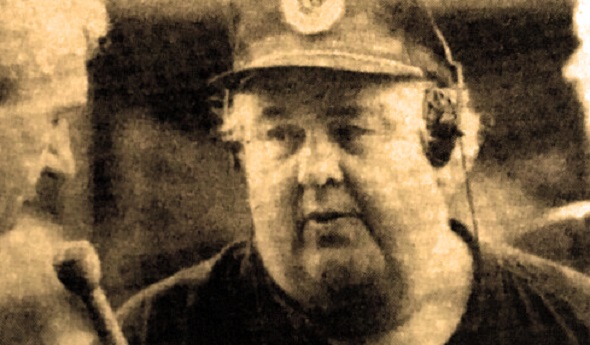
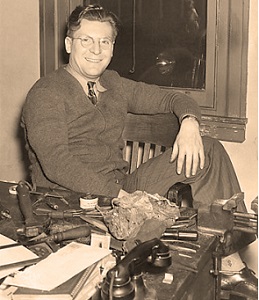
PHOTOS: (Top) Longtime WJMS broadcaster Harry Rizze conducts an interview. (Middle) Late WTCM owner Les Biederman.
Century of School Sports: Sharp Leadership Synonymous with MHSAA's Success

By Geoff Kimmerly
MHSAA.com senior editor

April 2, 2025

Just as an organization often will rise and remain successful when there is consistent leadership, so is consistent leadership often a hallmark of a successful organization.

In celebrating a “Century of School Sports,” it’s no stretch to say the Michigan High School Athletic Association has been successful in its continued promotion and administration of educational athletics thanks in part to consistent excellent leadership in the form of only five fulltime executive directors, and two more directors who also took turns leading the organization through some of its most difficult moments.

Two of the MHSAA’s first four executive directors (who are retired, and therefore eligible for the honor) have been inducted into the National High School Hall of Fame by the National Federation of State High School Associations (NFHS). The first fulltime director – Charles E. Forsythe – became Michigan’s first Hall of Fame selection in 1983. The most recently-retired executive director – Jack Roberts – was selected in 2022.

All five executive directors have had monumental impacts on the direction of school sports in Michigan, not just during their time leading the MHSAA but in their various roles leading up to their service at the top of the organization. The below summaries do not come close to stating their full contributions, but merely some of the highlights for which they are most remembered:

Charles E. Forsythe (1931-42, 1945-68)

The MHSAA’s first fulltime executive director literally wrote the book on leadership of school sports programs – “The Administration of High School Athletics” was first published in 1939 and in five more editions as it became a popular college-level textbook. Previously an accomplished athlete, coach, official and athletic director, Forsythe joined the MHSAA staff in 1929 as an assistant director – and during his long tenure leading the office, school sports became part of the lifeblood of communities large and small all over the state. High school membership increased under his leadership, from 600 to 750 schools, and attendance for the MHSAA Boys Basketball Tournament – the headlining high school event of the day – increased from 126,000 for all rounds in 1930 to more than 775,000 at the time of his retirement. While advances were made in football and boys basketball, and in less-visible sports as well – all driving increased participation – the most notable work under Forsythe’s leadership made sports safer for all participants. Many of the most publicized safety initiatives came in football – including significant equipment requirements – but under his leadership the MHSAA in 1940-41 became just the second state nationally to add an accident benefit plan for participants. Forsythe died unexpectedly in December 1968, only a few months after his retirement. He is the namesake for the MHSAA’s annual lifetime achievement award.

Allen W. Bush (1968-78)

The MHSAA’s second fulltime executive director is the namesake for annual awards presented to contributors to school sports whose accomplishments are often behind the scenes and outside of the attention paid to championships and other high achievements. But Bush’s most-known accomplishments have received some of the greatest attention in MHSAA history, and deservedly so. During his tenure, the MHSAA added its first nine championship tournaments in girls sports, created the Football Playoffs and also began awarding Finals championships in baseball, ice hockey and skiing. Bush joined the MHSAA staff in 1960, serving under Forsythe as an assistant and then associate director.

Vern L. Norris (1978-86)

Norris, who died in 2018 at the age of 89, was known especially for his work with coaches and officials. He had coached at three high schools and was a tremendous official himself, having refereed the 1963 Class A Boys Basketball Final. The MHSAA’s annual Vern L. Norris Award honors an official who has been especially active in mentoring and training officials. Norris joined the MHSAA in 1963 and served under both Forsythe and Bush – the latter as associate director – also playing key roles in the creation of girls sports championships during the 1970s and expansion of those opportunities during the 1980s. He also played a significant role in rules-making nationally, contributing on several NFHS committees, and after leaving the MHSAA served as commissioner of the Great Lakes Intercollegiate Athletic Conference.

John E. “Jack” Roberts (1986-2018)

At the time of Roberts’ retirement, he was the nation’s longest-serving executive director – and with accomplishments in his state and nationally that were arguably unmatched. Under his leadership, the MHSAA grew more than 15 percent to more than 1,500 high schools and junior high/middle schools, and the state’s high school sports participation grew 10 percent and annually ranked higher than states with larger high school-aged populations. The MHSAA again became a national leader in health and safety, setting the pace in concussion care, heat management and CPR certification requirements and policies. The MHSAA also took national leads in coaches education and sportsmanship. Three girls sports and two boys sports were added to the tournament lineup during his tenure, as were 8-player football playoffs and an expansion of the 11-player tournament. Roberts had grown up studying the example of his father John, who served as executive director of the Wisconsin Interscholastic Athletic Association for 29 years, and Jack Roberts also served at the NFHS and Fellowship of Christian Athletes before taking over the MHSAA. Few have given their voice to school sports more prevalently: At the time of his retirement, Roberts had spoken in support of educational athletics in nearly every state and five Canadian providences.

Mark Uyl (2018-)

While his tenure as executive director has not yet reached a decade, Uyl already has steered the MHSAA through one of its most challenging times – the COVID-19 pandemic, which led to the cancelation of the end of the Winter 2019-20 season and all sports the ensuing spring. However, under Uyl’s direction – and while other states remained sidelined – MHSAA schools safely returned to activity during the fall of 2020-21, and despite delays completed their championship events for all three seasons that school year. Also a highly-respected game official on a national scale – and past coach and administrator in Michigan – Uyl joined the MHSAA staff in 2004 and has led the way as participation and officials registrations both have continued to rebound from significant decreases during COVID. His tenure also has seen the addition of an Individual Finals division for girls wrestling and the addition of girls field hockey and boys volleyball set for the 2025-26 school year.

Additional notes of recognition must be paid to two more leaders whose contributions came at some of the most delicate times over this successful century:  

Julian W. Smith served as interim executive director while Forsythe served in the U.S. Navy during World War II. Smith – who had served on the MHSAA Representative Council for 10 years – received a three-year leave of absence from his role as principal at Battle Creek Lakeview High School and led the MHSAA through an unpredictable wartime era that included the cancelation of statewide championship events in boys basketball and track & field in 1943, but also their return a year later. He continued the promotion of physical fitness that was emphasized as a mission of school sports especially in preparation for service in the military, and during his time as executive director was named to the National Council of Physical Fitness.

Then there is Alden W. “Tommy” Thompson, perhaps the most influential yet forgotten leader in MHSAA history. Thompson had served on the Board of Control for the MHSAA’s predecessor organization, the Michigan Interscholastic Athletic Association (MIAA) and was then appointed as the first state director of interscholastic athletics, under supervision of the state superintendent and Michigan Department of Public Instruction, about three weeks before the official start of the MHSAA in December 1924.

Charles Forsythe credited Thompson with building the MHSAA “from scratch,” and legendary Lansing State Journal sports editor George Alderton praised Thompson for developing “an eligibility code that was positively fool proof,” classifying schools by enrollment to provide equal opportunities for small and large to win championships, organizing the state basketball tournament to make it financially beneficial to schools which in turn allowed them to spend to develop other sports, and giving a statewide stage to some of those less-visible sports including cross country, tennis and golf. Alderton wrote, “Tommy was the fellow who paved the way, ironed out the humps and gave the machine a push before the motor of popular interest began running.”

Forsythe served as Thompson’s assistant for two years before taking over as state director of athletics in 1931 as Thompson became the state director of physical and health education. However, both would lose their employment with the state’s department of public instruction in 1933 due to budgetary cuts – Thompson, to go on to several more pursuits in athletics, but Forsythe to remain as state director of athletics but now paid fully by the MHSAA, making him officially the association’s first fulltime executive director.

Previous "Century of School Sports" Spotlights

March 25: Athletic Directors Indispensable to Mission of School Sports - Read
March 18:
2025 Finals Begin Next Half-Century of Girls Hoops Championships - Read
March 11:
Boys Basketball's Best 1st to Earn MHSAA Finals Titles - Read
March 5:
Everything We Do Begins with Participation - Read
Feb. 25:
Slogans & Logos Remain Unforgettable Parts of MHSAA History - Read
Feb. 19:
MHSAA Tickets Continue to Provide Fan-Friendly Value - Read
Feb. 11:
We Recognize Those Who Make Our Games Go - Read
Feb. 4:
WISL Conference Continues to Inspire Aspiring Leaders - Read
Jan. 28:
Michigan's National Impact Begins at NFHS' Start - Read
Jan. 21:
Awards Celebrate Well-Rounded Educational Experience - Read
Jan. 14:
Predecessors Laid Foundation for MHSAA's Formation - Read
Jan. 9:
MHSAA Blazes Trail Into Cyberspace - Read
Dec. 31: 
State's Storytellers Share Winter Memories - Read
Dec. 17: 
MHSAA Over Time - Read
Dec. 10:
On This Day, December 13, We Will Celebrate - Read
Dec. 3:
MHSAA Work Guided by Representative Council - Read
Nov. 26: 
Finals Provide Future Pros Early Ford Field Glory - Read
Nov. 19:
Connection at Heart of Coaches Advancement Program - Read
Nov. 12:
Good Sports are Winners Then, Now & Always - Read
Nov. 5:
MHSAA's Home Sweet Home - Read
Oct. 29:
MHSAA Summits Draw Thousands to Promote Sportsmanship - Read
Oct. 23:
Cross Country Finals Among MHSAA's Longest Running - Read
Oct. 15:
State's Storytellers Share Fall Memories - Read
Oct. 8:
Guided by 4 S's of Educational Athletics - Read
Oct. 1:
Michigan Sends 10 to National Hall of Fame - Read
Sept. 25: MHSAA Record Books Filled with 1000s of Achievements - Read
Sept. 18:
Why Does the MHSAA Have These Rules? - Read
Sept. 10: 
Special Medals, Patches to Commemorate Special Year - Read
Sept. 4:
Fall to Finish with 50th Football Championships - Read
Aug. 28:
Let the Celebration Begin - Read

PHOTOS Clockwise from top left: (1) Left to right, Al Bush, Charles Forsythe and Vern Norris take a photo together. (2) Norris, left, and Bush hold up Finals trophies. (3) Jack Roberts, left, stands with Mark Uyl during Roberts' induction into the National High School Hall of Fame. (4) Roberts, left, and Norris sit for a photo as Roberts began his tenure after Norris retired. (MHSAA file photos.)
