

Speakers Bureau Helps Generate Conversation
December 30, 2019
By Rob Kaminski
MHSAA benchmarks editor
As student mental health climbs the list of health and safety concerns, the MHSAA and state associations across the country are taking measures to provide resources and guidance aimed to keep school sports an enjoyable and valuable experience.
In sports, coaches and athletes learn to expect the unexpected. It’s the nature of competition; constructing gameplans tailored to utilize team strengths and expose opponents’ weaknesses. Often times this entails doing things that opponents won’t expect. Participants then learn and prepare for the next time; it’s one of the ways athletics prepares participants for life, as educational leaders often preach.
Today’s ever-changing culture recently threw such a curveball at the young people who populate our hallways and playing surfaces, calling for statewide associations and organizations to shift focuses and prepare for a new opponent while attempting to keep school sports one of the best means to a healthy adolescent lifestyle.
“I was at the NCAA summer meeting in 2017, discussing health and safety issues and the topic of concussions came up, as it often does. I assumed that concussions was the No. 1 health and safety issue,” said MHSAA Executive Director Mark Uyl. “I was quickly corrected that it’s student mental health; that knocked me back.”
It would not be an uncommon reaction, given the amount of information, media coverage and programs designed to recognize and reduce concussion incidents in recent years.
All the while, anxiety, depression and stress had been creeping into the picture beneath the surface. Such disorders are much more difficult to detect, as there are few visible symptoms when compared to sprains, fatigue, head injuries and other physical ailments.
“I became interested and began to research the topic. The more I read, the more concerned I became,” Uyl said. “The MHSAA, with a great deal of help and cooperation from our school leaders, has done a tremendous job educating and providing resources for health-related issues such as heat management, concussion reporting and practice policies, and now we have a new challenge.”
Fortunately, as has often been the case, there are knowledgeable and qualified people throughout Michigan’s roster of educational leaders who are willing to assist.
As word spread regarding the student mental health initiative, the MHSAA was able to establish a Mental Health Speakers Bureau composed of several experienced individuals willing to assist (see below).
“Our speakers bureau really grew by word of mouth,” Uyl said. “A school would bring in a speaker, or a league would invite a speaker, and once we were connected with them, then those people would share names and it grew from there.”
The resources range from former professional athletes, to behavioral specialists, to current MHSAA coaches.
Dave Ingles, basketball coach at Kent City, is one such individual. His credibility comes from first-hand experience.
“I privately struggled with deep depression for six years,” Ingles said. “Be alert. Talk to your athletes and students and actually listen to what they are saying. I always used the phrase, ‘I’m fine;’ that is not an acceptable answer to me anymore when I hear it.”
The National Institute of Mental Health reveals that most mental health conditions begin around the time children are transitioning from middle school to high school. The more people trained to identify symptoms and behavior, the better the chance to reduce or reverse some of the following numbers:
• 50% of all lifetime cases of mental illness begin by age 14
• 37% of students with a mental health condition age 14 or older drop out of school
• 20% of students ages 13-18 live with a mental health condition
• 11% of youth have a mood disorder and 8% have an anxiety disorder
• Suicide is the third leading cause of death for ages 10-24
Non-visible ailments always have been most difficult to detect, and today’s proliferation of technology – from streaming to social media – can serve to further mask symptoms.
“The more kids spend time with their devices, staring at their screens, isolation can be quick to take hold,” Uyl said. “Everything is instant. It used to be if our friends didn’t invite us somewhere, we didn’t worry about it; we probably wouldn’t find out for a couple days and had already moved on. Today, in about 10 minutes, there’s a picture on Instagram or Snapchat and kids instantly know, ‘I’m not included.’ Isolation leads to depression and anxiety, and in the worst cases can even lead to suicide.”
That message might sound familiar. Segments of the 2019-20 MHSAA online rules meetings include Uyl emphasizing student mental health and a video clip produced by benice.org promoting a mental health action plan endorsed by four of the state’s most recognized collegiate coaches.
It’s all part of the plan to promote awareness and generate conversation surrounding this serious health and safety issue during 2019-20 and beyond.
“We’re not going to try to do this all by ourselves,” Uyl said. “There are plenty of experts in the field, and we’re going to utilize their knowledge. We’ll build relationships and align ourselves with these people to provide a foundation. We need to become a resource center for our membership.”
In addition to the rules meetings messages, the MHSAA also partnered with the Michigan Association of Secondary School Principals Student Mental Health Summit on Oct. 8 in Lansing. This event – sold out within weeks of posting – invited principals, counselors, student leadership advisers and student leaders to come together to discuss and seek solutions for student mental health concerns impacting schools. The MHSAA lined up Eric Hipple, one of its speaker bureau members, who delivered a keynote, “Depression and Suicidal Awareness.”
Student mental health was among topics during the MHSAA Update and AD In-Service tour around the state this fall as well. The meeting at Comstock Park on Sept. 30 included a presentation from the Mental Health Foundation of West Michigan to introduce the be nice® action plan and encourage schools to take advantage of that and other resources the group has to offer.
The rise of mental health as one of the more prominent medical concerns nationally has occurred, as Ingles sees it, “because more people are talking about it now.”
Leaders like Ingles and those in numerous organizations have begun to assist the MHSAA in identifying and treating cases in our schools.
MHSAA Mental Health Speakers Bureau
Below is a list of individuals and organizations partnering with the MHSAA to assist in promoting mental well-being for students around the state. The MHSAA encourages school personnel to reach out to any of these experienced leaders in the field for programming in your buildings and districts.
• Christy Buck, Executive Director – Mental Health Foundation of West Michigan - be nice.® [email protected]
• Brooke Buys, Mental & Behavioral Health Specialist – BLND Health [email protected]
• Eric Hipple, former Detroit Lions quarterback [email protected]
• Dave Ingles, Basketball Coach & Speaker – Kent City High School [email protected]
• Cat Lanting, Program Coordinator – Mental Health Foundation of West Michigan - be nice.® [email protected]
• Halle Wangler, former University of Michigan basketball player [email protected]
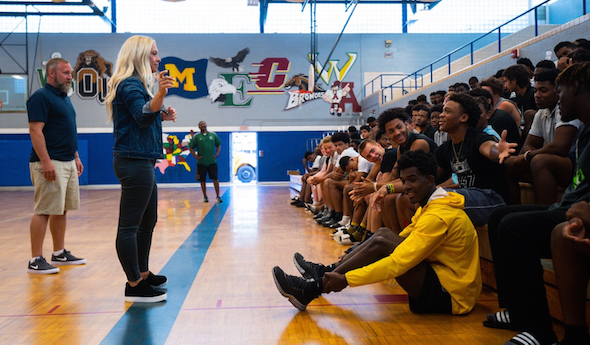
PHOTO: Brooke Buys, a mental and behavioral health specialist and founder of BLND Health, speaks with students. (Photo courtesy of BLND Health.)
English's Hall of Fame Contributions to St. Francis Continue Behind Camera Lens
By
Tom Spencer
Special for MHSAA.com
October 9, 2025
The name Julie English is now synonymous with Traverse City St. Francis football.

English spent her first two decades contributing to the school behind the scenes, helping the Gladiators launch boys and girls soccer programs, and scoring volleyball and basketball. She served as team manager for boys and girls soccer and even bus driver, so to speak, for the latter.
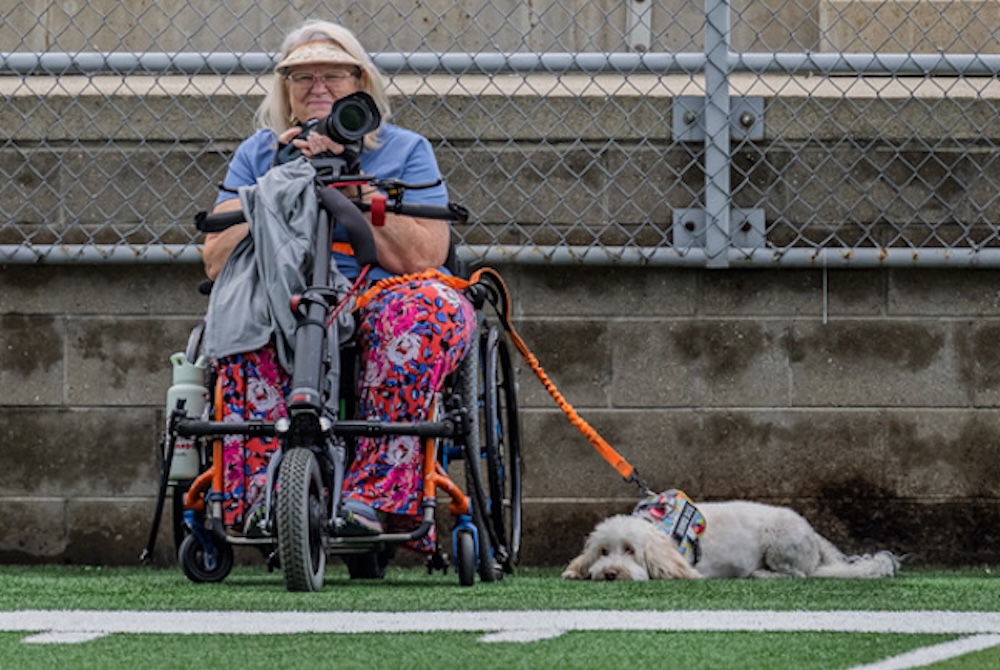
She’s also very noticeable on the sidelines of football, soccer and volleyball games, taking pictures with the aid of a motorized wheelchair.
This past Saturday, she was front and center. She was inducted into the Grand Traverse Area Catholic Schools Hall of Fame – established in 2007 to recognize individuals who inspire others by being exemplary role models.
English was paralyzed 10 years ago as she reached the end of a zip line while chaperoning a girls soccer team trip weeks ahead of the 2015 season. Many recall snow on the ground as she went first, intending to take pictures of the team as they planned to follow. She decided to go first that March day despite a fear of heights.
“It was all part of God's plan because I am afraid of heights – I really had to talk myself into going on the zip line,” said English, who considers it a freak accident and doesn’t discourage anyone from giving zip lining a try. “I was thinking, you know, I'm trying to convince these girls to step outside their comfort zone. And if I'm too afraid to do something like that, what kind of an example am I? So I breathed it and went up and actually it was fun – until it wasn't.“
Past TCSF athletic director Tom Hardy introduced English at the induction ceremony last weekend. He lauded the “amazing women he had the privilege” of working with during his 18-year tenure.
“While such a devastating event might have broken many, it only served to strengthen Julie's unwavering faith,” Hardy said. “She approaches each day with grace, fully aware of the challenges ahead, yet she embraces them with joy, love, and laughter. Following her accident, Julie dove deeper into her passion of photography.”
English now generously volunteers her time capturing St. Francis athletic events and creating lasting memories for students and their families through her lens, leaving school officials, coaches, players and supporters in awe.
Current TCSF athletic director Aaron Biggar has personally been touched by English’s work, through her photographs of his boys playing football for St. Francis. He’s thrilled to have English for home game, and she also travels to – and is welcomed by – volleyball, football and soccer opponents.
 “Julie’s ability to capture those life events for parents who are watching the game and not taking pictures, has been such a gift for our community,” Biggar said. “She's been around so long and (is) so accepted by our community. And even by opposing teams, they allow her to be on the field and make precautions and stuff so she can. Our opponents in other schools have also been so accommodating of her and helping.”
English was at Thirlby Field last week capturing the Glads’ big Homecoming win over Boyne City, 20-13. She won’t be on the road tonight as the Glads put their undefeated football record on the line against Pontiac Notre Dame Prep. But she will be back on the football sidelines Oct. 18 when St. Francis hosts Jackson Lumen Christi. And she’ll also be on the sidelines next week when the boys soccer team continues what it hopes will be another deep run into the postseason.
English’s humility, deep faith, and enduring optimism have had a profound and lasting impact, supporters note. Not surprisingly, her biggest concern as she takes pictures today is not her safety – it is the safety of the home and visiting athletes.
“I think sometimes I make people nervous, but I am always cognizant of what's going on, because the last thing I want to do is hurt anybody, like, have them run into me and then get hurt,” English said. “I want to be where I can get a good picture, but definitely not where someone could get injured if they ran into me.”
English’s photos are treasures for St. Francis families, points out Mike Kanitz, who was inducted into the Hall of Fame alongside English. In fact, he nominated her. Kanitz is the junior varsity girls basketball coach, volleyball game manager, volleyball announcer and volleyball scorekeeper, football press box manager, and the Glads’ soccer game manager.
“Julie’s ability to capture time for SF families, I mean, is priceless,” said Kanitz, who also can be found at the scorer’s table for boys basketball. “She catches kids in their level of joy, and it's cool. It's a snapshot in time, and she does it for every family. I mean, this is all free. She posts it all free. She doesn’t charge anybody. And she she's such a hard worker. She's everywhere.”
Kanitz vividly recalls English’s efforts to bring soccer to St. Francis. It happened in 2002. The Glads first had a club team coached by volunteer Reggie Rix.
“She had to fight some hurdles and it was a lot of work, and to start a new sport – her vision was the correct vision,” Kanitz said. “There were coaches, but Julie was really the one that took care of everything. Julie was fair to all children. She wanted all kids to have that good experience of high school sports.”
Kanitz, one of many who regularly see English’s photos and read her inspiring messages on social media, finds it difficult to think about the zip line accident. His daughter was one of the St. Francis soccer players waiting to come down the line next.
 “It's still hard for me to actually think about and talk about, but Julie's handled it better than anybody,” he said. “Her faith in God is so strong, and her message she writes … these Facebook stories about where she's at in her journey … they're moving and people read them, and it affects people.”
Early on, Julie recognized the vital importance of a Catholic education for her children and committed herself wholeheartedly to making it a reality, Hardy recalled. In addition to operating a full-time in-home daycare for more than 30 years, she worked weekends to help make ends meet and ensure that her four children – Ian, Caitlin, Jordan and Chelsea – remained enrolled in the Catholic schools.
As the owner of a daycare business, English drove a 12-passenger blue van. She often emptied the car seats in time to get 11 players – including Caitlin and Chelsea – to soccer games wherever TCSF was playing.
Caitlin English played on the first TCSF girls soccer team in 2002. She presented Hardy with a petition to offer soccer, signed by St. Francis athletes. As a club, English is proud to say, the team won all 17 of its games. When soccer became a school-sponsored varsity sport a year later, it was a cooperative with Traverse City Christian called Liberty.
Ian English was on the field for St. Francis boys’ first game, played through a co-op also with TC Christian during the fall of 2008. Chelsea English also played soccer for the Glads. Jordan English played rugby.
Ian, Jordan and Chelsea were at Julie’s induction ceremony. Caitlin, now living in the Grand Rapids area, was unable to attend because she is coaching soccer for her own daughter, Emilia, although Julie’s son-in-law did attend.
English gets around today with a vehicle adapted for her. She is supported regularly by Ian and Chelsea, along with a mother of nearby Kingsley High School athletes. She’s been spotted on the sidelines taking pictures at Kingsley volleyball and soccer matches, too. English also has been able to get to Grand Rapids and capture her granddaughter’s early soccer days with her camera.
She is enjoying a new beginning with soccer as well as her newer role for the Glads.
“Back in the day, I was able to run the clock, take pictures and do the book,” English said. “I don't think my brain would handle all of that now, but, you know, it was it was fun to do at the time. Not being able to do daycare anymore and not being able to do the things I did at St. Francis are the hardest things about being in a wheelchair – just not being able to do all the things I used to do.”
This spring marked the 10-year anniversary of the accident. English said she never asks, “Why me?” Rather, she is determined to can find the good and take advantage it.
Hardy agreed.
“Julie has said, ‘Never doubt who and what God puts in front of you,’” Hardy said. “This encapsulates the guiding ethos of her life.”
 Tom Spencer is a longtime MHSAA-registered basketball and soccer official, and former softball and baseball official, and he also has coached in the northern Lower Peninsula area. He previously has written for the Saginaw News, Bay County Sports Page and Midland Daily News. He can be reached at [email protected] with story ideas for Manistee, Wexford, Missaukee, Roscommon, Ogemaw, Iosco, Alcona, Oscoda, Crawford, Kalkaska, Grand Traverse, Benzie, Leelanau, Antrim, Otsego, Montmorency, Alpena, Presque Isle, Cheboygan, Charlevoix and Emmet counties.
PHOTOS (Top) Longtime Traverse City St. Francis supporter Julie English readies for her next shot while attending a Gladiators football game this season. (Middle) English captures a few frames. (Below) English recently was inducted into the Grand Traverse Area Catholic Schools Hall of Fame. (Top two photos by Rick Sack/TC Rick Photo. Below photo by Tom Spencer.)