

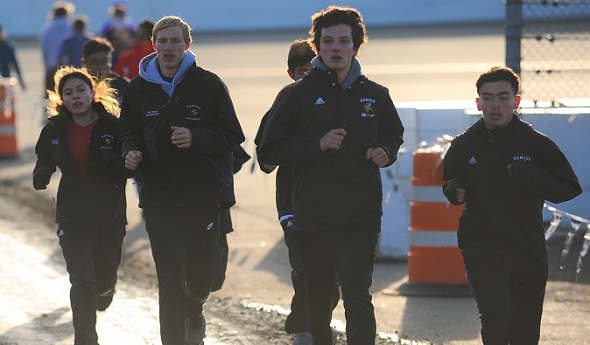
Workout Basics: Warm-Ups & Cool-Downs
February 3, 2021

By Nick Parkinson, M.Ed., AT, ATC, TSAC-F
Henry Ford Health Systems
You may know a good warm-up — and cool-down — are essential to getting a good workout. You may also know that warming up your muscles and stretching them out after exercise can help prevent injury and keep you at the top of your game.
They’re the two bookends that help maximize a workout. Unfortunately, a lot of exercise enthusiasts don’t know how to warm up and cool down correctly.
Warm-Up Basics
A warm-up is exactly what it sounds like: The goal is to warm up your muscles and prepare your body for whatever you’re asking it to do. Warming up increases your body temperature and helps blood flow to the muscles that you’re using.
So if you’re going to play soccer, your warm-up should touch all of the muscles in your legs and core. Shooting hoops? You’ll need to add shoulders and arms to your routine. Circuit training at the gym? Choose a warm-up that flexes all of the muscles you’re about to use.
The thing that all warm-ups have in common is that they require dynamic (or constantly moving) motion, not static stretching (holding poses for a certain amount of time). In fact, static stretching prior to a workout can inhibit power and strength, especially if you’re doing something like weightlifting.
The anatomy of a solid warm-up:
• Before any activity, do about 10 minutes of light cardiovascular activity, whether walking, biking or jogging.
• Dynamic stretches. After you get your muscles moving, do a series of lunges, jumping jacks or toe touches to stretch a bit.
• Dive in. When you start your workout, begin slowly and gradually increase power and speed.
Cool-Down Basics
After you’ve put your body through a challenge, a good cool-down is essential. It helps slow down your heart rate gradually, relax your muscles and stretch them out.
Cool-down routines should always include some type of motion before you get to static stretching, especially if you’ve just finished a high-intensity workout. Static stretching improves flexibility and performance and it can also help stave off future injury.
As with warm-ups, the right cool-down exercises depend on the activity you engaged in. If you biked for 20 miles, you might coast on your cycle for a while before coming to a stop. If you ran, you might jog or walk before you begin stretching. As with your warm-up, the key is addressing every muscle group you worked during your workout.
The anatomy of a solid cool-down:
• At the end of your workout, slow the pace and intensity of whatever activity you’re doing. So, if you’re running, slow to a jog and then a walk for 5 to 10 minutes before stopping.
• Stretch out the muscles you work, but don’t push past the point where you feel tight. Then, hold the position for at least 30 seconds. That’s how long it takes for the body to overcome its stretch reflex.
• Breathe through your stretches and make sure to finish your cool-down with deep, belly breaths.
Running short on time? Target muscle groups you may have injured in the past or that tend to get sore after activity. Cooling down will preserve your athleticism — and your ability to participate in daily activities — over the long term.
Be Good to Your Body
While there’s some controversy about whether warming up and cooling down can help prevent injury, there’s little dispute that they can help you ease in and out of activity.
The key is to find something that works for you. Your warm-up could be as simple as walking to the gym and doing a set of jumping jacks when you arrive. Your cool-down might just involve ending your workout 10 minutes early so you can slow down.
It doesn’t have to be complicated. It just has to give your heart and blood vessels a chance to breathe before and after activity.
Nick Parkinson, M.Ed., AT, ATC, TSAC-F, is the Supervisor of Athletic Training with Henry Ford Sports Medicine and also leads Sports Performance training at the William Clay Ford Center for Athletic Medicine. Learn more about Nick.
Want to learn more? Henry Ford Health System sports medicine experts are treating the whole athlete, in a whole new way. From nutrition to neurology, and from injury prevention to treatment of sports-related conditions, they can give your athlete a unique game plan.
Visit henryford.com/sports or call (313) 972-4216.

NFHS Voice: Planning with Patience
May 30, 2020
By Karissa Niehoff
NFHS Executive Director
For several weeks, Americans have been awaiting answers to several questions. When will restaurants restart dine-in services? When will hair salons and gyms be open? When will people be able to congregate for worship services? And, of course, when will education-based sports and performing arts programs return?
And the answer to the all-important last question is the same as the first three – it varies from state to state.
If there was ever any doubt about the popularity and interest in high school sports and performing arts – and how much these programs have been missed during the past three months – it was erased last week as the NFHS released its Guidance for Opening Up High School Athletics and Activities document.
The response was non-stop through the mainstream media as well as our social media platforms as the first nationwide discussion about the return of high school sports and other activities was in full swing.
Since that disappointing week in mid-March when it seemed like all of life came to a halt, millions of people – from high school students, coaches, parents, administrators, officials and fans – have been looking forward to the return of school-based sports and other activity programs. And the guidance document offered some hope that soon the light at the end of tunnel will not be the oncoming train we have felt for many weeks.
Now, state high school associations are developing timetables and protocols for return of activities in their states. And those guidelines will be different from state to state. This is not a one-size-fits-all plan. Depending on the specific circumstances of a state with respect to the containment of the virus, its progression through the various phases of returning to activities could be much different than another state.
As the guidance document developed by the NFHS Sports Medicine Advisory Committee noted, our hope is that students can return to school-based athletics and activities in any and all situations where it can be done smartly. When it comes to education-based sports and performing arts within our nation’s schools, nothing is more important than the health and safety of the participants AND the individuals conducting those programs.
Some individuals have expressed concern that our guidance document is too cautious, noting that some non-school youth programs have already restarted in some areas.
In one state this past week, a non-school sports program was allowed to restart because the “data shows children are less affected by the coronavirus.” While the preponderance of evidence shows that to be true, plans in education-based activities will include also protection for adults who coach, officiate and administer those events, which may be seen as a more conservative approach.
Within high school sports, the drive of coaches and dreams of parents cannot run ahead of player safety. Last week, a successful high school football coach with three previous state titles was suspended for allegedly holding practices. And there have been reports of parents considering moving to another state with fewer COVID-19 cases to enhance the chance of their son playing football and earning a college scholarship.
The NFHS, through its Sports Medicine Advisory Committee, took action in developing its Guidance for Opening Up High School Athletics and Activities document. The various state high school associations are taking action in the coming weeks in developing plans for a return to activities at the state level.
Now, we would ask parents and other fans to take action – and that action is patience. The urge to return to normal is understandable, but the path back to where we were three months ago will take time, and that “time” will not happen at the expense of the safety and well-being of everyone involved in high school sports and performing arts programs.
Dr. Karissa L. Niehoff is in her second year as executive director of the National Federation of State High School Associations (NFHS) in Indianapolis, Indiana. She is the first female to head the national leadership organization for high school athletics and performing arts activities and the sixth full-time executive director of the NFHS, which celebrated its 100th year of service during the 2018-19 school year. She previously was executive director of the Connecticut Association of Schools-Connecticut Interscholastic Athletic Conference for seven years.