

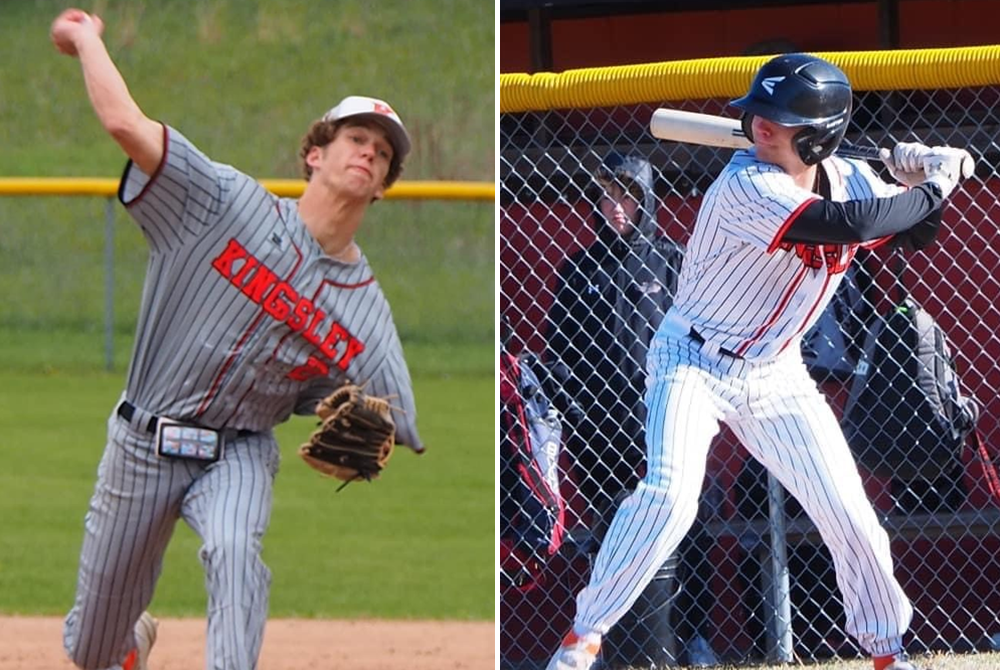
Kingsley Standouts Big Hits on Diamond, as Friends to 4th-Hour Classmates
By
Tom Spencer
Special for MHSAA.com
April 19, 2024
When Eli Graves or Gavyn Merchant takes a swing this spring for Kingsley, a special group of friends are not worried how they’ll connect with the ball.
 That group of friends and classmates — students in Joel Guy’s fourth-hour special education class — feel like the two senior standout athletes already hit a home run at school that day. It might even feel like a grand slam from Graves or perhaps a hole-in-one for Merchant.
And the Kingsley baseball and golf coaches feel similarly – and sentiment that may extend through the entire Kingsley community.
Merchant and Graves are playing their final baseball seasons with Stags. Merchant is dual-sporting, adding golf to his incredible athletic career.
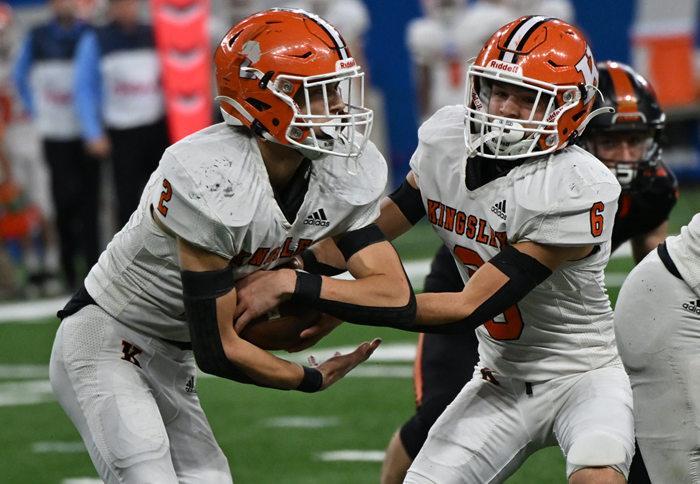
Together, they led the Stags to Division 6 football championship in the fall despite battling through extensive injuries. Graves, the star running back, and Merchant, the outstanding quarterback, then fought through long, hard rehabilitations to get back and lead the Stags on the hardcourt and wrestling mats this winter.
But before stepping up to the plate or the tee to compete for Kingsley on any given day this spring, the pair spend time in Guy’s class and share lunch with the Kingsley cognitively impaired (CI) students.
“You can’t say enough good things about these young men,” said Guy, who also is in his fourth year as the Kingsley golf coach. “I get teary-eyed talking about it – they just kind of took a hold of some of my students making contact at lunch and in the hallway.”
That contact began midway the football season. Graves and Merchant were joined by fellow golfer Ty Morgan and football teammate Skyler Workman.
 A few more senior athletes have been a part of the adoption of Guy’s students intermittently as well. But Guy’s students can count on seeing Graves, Merchant, Morgan and Workman in the classroom each and every day and then at lunch. The time was made possible, Guy notes, because the athletes are ahead in their own academic pursuits or participants in the school’s Teacher Academy program.
How those seniors are contributing is rare for accomplished athletes in a high school setting, Guy is happy to point out.
“Gavin and Eli are state champions in football,” said Guy. “They are the stars of their winter sports basketball and wrestling, and you you think that being seniors with those kinds of credentials at lunch they would sit in a table with all their buddies and talk about their accomplishments.
“They sit with my special education students,” Guy continued. “They make my students feel like they’re the ‘in’ crowd, and I am so proud of them.”
Bruce Graves, father of Eli and coach of the Stags’ baseball team, recalls learning from Guy what that group of seniors was doing with their fourth hour. He wasn’t really surprised to hear from someone else what his senior leaders were doing.
“They wouldn’t tell anybody they were doing it,” the 22-year veteran coach said. “They don’t do it for a pat on the back – they just do it because they like being good guys.”
There are various reports of exactly how the athletes started getting involved with the special education students. But everyone in the school located 15 miles south of Traverse City seems happy they did.
Eli Graves, one of the Stags’ five pitchers, roams center field when he’s not on the mound. He is 1-0 as the Stags are off to a 9-0 start following a conference sweep of Kalkaska, 3-0, 15-0, on Thursday. The right-hander is slated to pitch this weekend and has hopes of the Stags finishing the year with a conference baseball title and a deep postseason run.
Graves and Merchant have raised money all year to get birthday and Christmas gifts for their classmates in Guy’s room. They’ve become particularly close to a couple of his students.
“They don’t really see us as helpers or anything like that — they see us more as friends,” said Graves, now playing his third year on the varsity baseball squad. “We go into the special ed room, and basically just help the students with whatever work they are doing.”
 After recovering from football injuries, Graves averaged more than 15 points per game this basketball season and earned all-conference. Merchant also recovered from postseason surgeries and got back on the mat to place fourth at 132 pounds in Division 3 and became an all-state wrestler for the fourth time.
The pair’s in-season football injuries were not known to many. They wanted to compete for the state title and tend to the injuries later. Graves rushed for almost 2,000 yards, tying and breaking some of his brother Owen’s school records along the way. He also had 20 tackles, two interceptions and four touchdowns on defense during the 2023 campaign.
Graves sprained a shoulder joint during the Semifinal win over Reed City but a week later carried the ball 33 times and ran for 210 yards in the title game. He had four touchdowns that day in the Stags' 38-24 victory over Almont.
Merchant has had various injuries over the course of his career, undergoing wrist surgery as a sophomore for a carpal tunnel injury and having floating cartilage taken out of a knee following his junior wrestling season.
But what he endured on the way to Ford Field was the topper as he endured two torn ligaments in his knee, a fractured leg, a torn meniscus — and, later on — a pair of broken ribs sustained late in the championship game.
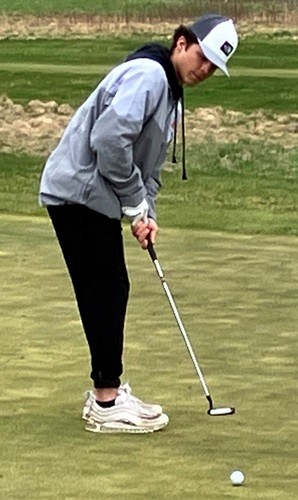
“When you’re in the game, it’s all about adrenaline,” said Merchant, who is facing another surgery in May but shot a 95 to lead Kingsley in its first tournament of the season Thursday at the Frostbite Open in Manton. “You don’t even think about the injury until you get off the field, and that’s when you get ice bags and fight it off.”
They have been close friends since elementary school and credit the Kingsley coaching, teaching and counseling staffs with preparing them for life after graduation.
Graves and Merchant call football their favorite sport. Graves hopes to also play football at the college level, and Merchant expects to continue on the wrestling mat.
 Tom Spencer is a longtime MHSAA-registered basketball and soccer official, and former softball and baseball official, and he also has coached in the northern Lower Peninsula area. He previously has written for the Saginaw News, Bay County Sports Page and Midland Daily News. He can be reached at [email protected] with story ideas for Manistee, Wexford, Missaukee, Roscommon, Ogemaw, Iosco, Alcona, Oscoda, Crawford, Kalkaska, Grand Traverse, Benzie, Leelanau, Antrim, Otsego, Montmorency, Alpena, Presque Isle, Cheboygan, Charlevoix and Emmet counties.
PHOTOS (Top) Eli Graves, left, and Gavyn Merchant are among standouts for Kingsley’s baseball team again this spring. (Middle) Merchant (6) hands the ball off to Graves during the Division 6 championship win at Ford Field. (Below) Merchant putts during Thursday’s golf opener. (Baseball photos by Karen Middleton.)
Newberry Follows Record-Setting Medalist to 1st Boys Golf Finals Team Title
By
Jason Juno
Special for MHSAA.com
May 27, 2026
HOUGHTON — Newberry usually doesn’t bother with the mobile app utilized for scoring at the Upper Peninsula Finals because there isn’t cell service on most of the courses they play during the regular season.
But the technology worked fine at Portage Lake Golf Course in Houghton on Wednesday, and when the Division 2 Finals came down to one stroke, being able to track the score in real time made for high drama.
Coach Kenn Depew said it was the most nervous he’s ever been on a golf course. The players, he said, knew one bad shot could ruin the day for the entire team.
It also made the ending even sweeter.
When Newberry freshman Austin Boulton got out of the bunker and made the putt on the final hole, Depew, and the team, could finally exhale.
And celebrate.
“When Austin made that putt, I went up and gave him a big hug and said, ‘You just won a state championship,’” Depew said.
Newberry edged Hancock 316-317, putting an end to the Bulldogs’ two-year reign. The championship also was Newberry’s first in boys golf, with its previous high MHSAA Finals finish second in UP Class C-D in 1992.
“We knew we were in for a tough battle,” Depew said. “We had to play real good because Hancock was the defending champs, I think they returned everyone and they were on their home course. We knew we were in for a battle; we had to shoot some really good numbers.”
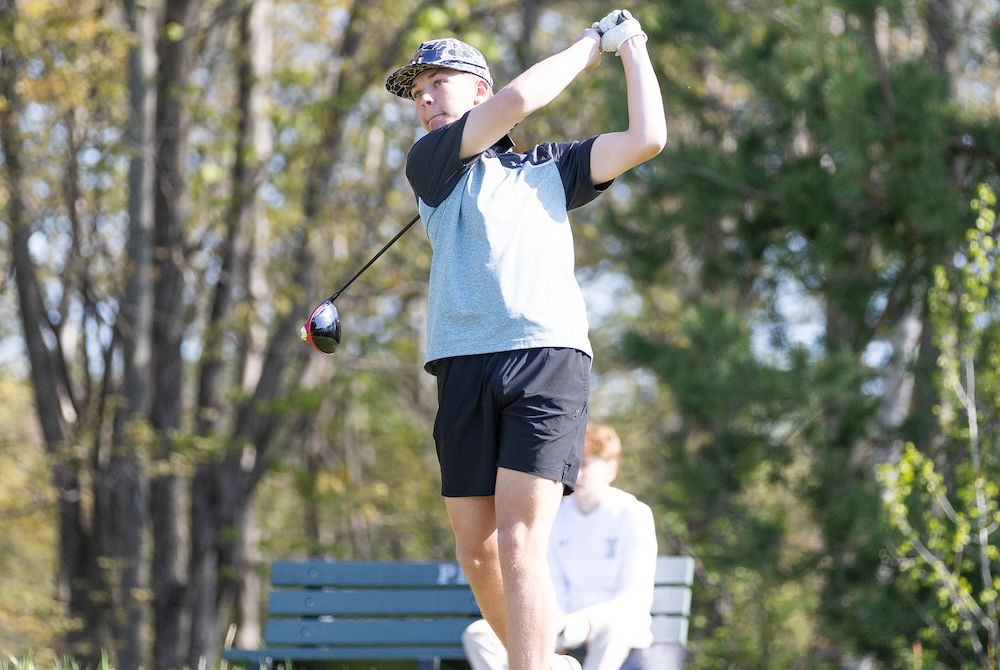
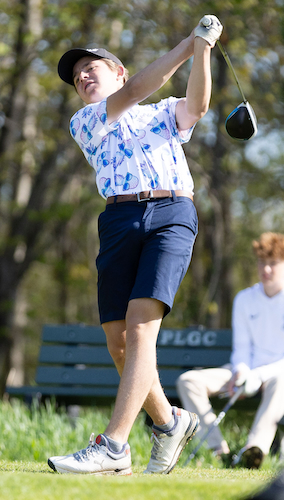
Sophomore Jarrett Zellar certainly did that. He shot a 4-under-par 68, the first time anyone in the U.P. in Division 2 had shot in the 60s at the Finals. He ended five shots ahead of Boulton, who finished runner-up with a stellar round of his own.
 “Basically my putting was a big factor,” Zellar said. “I never really putted that good before. Somehow everything was clicking.”
Depew stayed away from Zellar as it was pretty apparent early on the kind of day he was going to have.
“I’ve played quite a bit of golf with Jarrett and he was in a zone,” Depew said. “I went and dealt with the other four players because it became very apparent that every stroke was going to matter to us.”
Zellar will be an upperclassmen next year.
“Last year Jarrett was the best freshman I ever coached, and now this year he’s the best sophomore,” Depew said. He didn’t quite finish the word “sophomore,” continuing instead, “He’s the best player I ever coached.”
And Zellar does far more than putt.
“He’s really the total package,” Depew said. “He hits it good off the tee. He hits irons good, he chips good and today he really got hot with the putter as well. So that’s a great combination to have.”
For Zellar, it was also a great combination to win the U.P. Division 2 title individually and with his team.
“It felt pretty good,” he said. “It was the defending team that we beat; we beat them on their home course.”
Everyone stepped up to do that, Depew said, including their No. 4 golfer, Oliver Sevarns, who also hit a big putt late.
Nine golfers finished the day shooting under 80. Ironwood’s Caleb Sprague shot a 76 in a tie for third place with Kirby Storm, who led the way for runner-up Hancock and was the only senior among the top five.
Baraga’s Alden Leiter and Painesdale Jeffers’ Tage Rajala rounded out the top five with 77s.
PHOTOS (Top) Newberry's Jarrett Zellar follows a drive during Wednesday’s Upper Peninsula Division 2 Final at Portage Lake. (Middle) Jeffers' Carson Lesperance tracks one of his shots. (Photos by Jason Juno.)