


- Baseball
- Girls Soccer
- Softball
- Girls Track & Field
- Boys Track & Field
- Boys Tennis
- Girls Tennis
- Girls Golf
- Boys Golf
- Girls Lacrosse
- Boys Lacrosse
- MHSAA News
Lacrosse Finals Move to U-M Among Headlines as Spring Sports Ramp Up
By
Geoff Kimmerly
MHSAA.com senior editor
April 9, 2024
The Girls & Boys Lacrosse Finals will be played at University of Michigan Lacrosse Stadium for the first time, one of the most notable changes for this season as sports ramp up for more than 100,000 athletes anticipated to participate this spring for Michigan High School Athletic Association member schools.
The MHSAA sponsors postseason competition each spring in baseball, girls and boys lacrosse, girls soccer, softball, girls and boys track & field, boys golf (Lower and Upper Peninsula) and girls golf (UP), and girls (LP) and boys (UP) tennis.
The U-M Lacrosse Stadium opened for competition in 2018 and seats 2,000 spectators. The Girls Lacrosse Finals will be played Friday, June 7, with Division 1 at 4 p.m. and Division 2 at 7 p.m. The Boys Lacrosse Finals will be played the following day, June 8, with Division 2 at 11 a.m. and Division 1 at 2 p.m.
Girls lacrosse also has a significant format adjustment this season, as games will be played with four 12-minutes quarters instead of the previous two halves, in part to allow coaches more opportunities to provide direct instruction during a game. Two more rules changes are expected to improve flow of play – players awarded a free position outside of the critical scoring area no longer must come to a stop and settled stance before self-starting, and false start penalties outside the critical scoring area have been eliminated.
Several more rules changes will be noticeable this spring:
In boys lacrosse, a change was made to enhance player safety. Play will stop immediately any time a player’s helmet comes off, and that player may not return until the next dead ball after play continues.
Fair and legal starts are a continued emphasis for track & field, and a rule change will allow for movement before the start of the race as long as a competitor does not leave their mark with a hand or a foot after the “set” command, or make forward motion before the starting device is activated.
A significant rule change in softball alters pitch delivery mechanics. The pitcher may now have both feet off the ground at the same time when releasing the ball as long as both feet remain within the 24-inch width of a pitching plate and the pitcher does not replant the pivot foot before delivering the pitch.
Another change in softball requires that a playbook/playcard be worn on the wrist or kept in a back pocket to reduce distractions. If worn by the pitcher, the equipment must be worn on the non-pitching arm. Similarly in baseball, a wristband with plays or instructions will be permitted but must be a single, solid color, and for pitchers may not contain the colors white or gray or be otherwise distracting. Baseball players must wear this wristband on the wrist or forearm, and pitchers may wear one only on their non-pitching arm.
Also in baseball, a rule change allows for one-way communication devices worn by the catcher to receive instructions from the dugout while on defense, for the purpose of calling pitches. The coach must be inside the dugout/bench area to use the communication device.
Golfers now are required to participate in at least four competitions for the high school team prior to representing that school team in an MHSAA Regional or Final. Those four regular-season competitions may be 9 or 18-hole events.
In tennis, for the first time in Lower Peninsula play, a No. 1 doubles flight from a non-qualifying team will be able to advance from its Regional to Finals competition. To do so, that No. 1 doubles flight must finish first or second at its Regional, and the No. 1 singles player from that team also must have qualified for the Finals individually by finishing first or second in Regional play.
On the soccer pitch, two officiating-related changes will be especially noticeable. Officials now may stop the clock to check on an injured player without that player being required to leave the match – previously that player would have to sub out. Also, categories for fouls have been redefined: careless (which is a foul but does not receive a card), reckless (a foul with a yellow card) and excessive force (foul with red card).
The 2023-24 Spring campaign culminates with postseason tournaments, as the championship schedule begins with the Upper Peninsula Girls & Boys Golf and Boys Tennis Finals during the week of May 27 and wraps up with Girls Soccer, Baseball and Softball Finals on June 15. Here is a complete list of winter tournament dates:
Baseball
Districts – May 23-June 1
Regional Semifinals – June 5
Regional Finals, Quarterfinals – June 8
Semifinals – June 13-14
Finals – June 15
Golf
LP Boys Regionals – May 28-June 1
UP Girls & Boys Finals – May 29, 30, 31 or June 1
LP Boys Finals – June 7-8
Boys Lacrosse
Pre-Regionals – May 10-15
Regionals – May 16-29
Quarterfinals – May 31 or June 1
Semifinals – June 5
Finals – June 8
Girls Lacrosse
Pre-Regionals – May 16-18, or May 20
Regionals – May 22-June 1
Semifinals – June 5
Finals – June 7
Girls Soccer
Districts – May 22-June 1
Regionals – June 4-8
Semifinals – June 11-12
Finals – June 14-15
Softball
Districts – May 23-June 1
Regionals – June 8
Quarterfinals – June 11
Semifinals – June 13-14
Finals – June 15
Tennis
LP Girls Regionals – May 15-18
UP Boys Finals – May 29, 30, 31 or June 1
LP Girls Finals – May 31-June 1
Track & Field
Regionals – May 16-18
Finals – June 1
Gorno & Tanis Complete Careers Filled with Friendship, Record-Setting Success
By
Dean Holzwarth
Special for MHSAA.com
October 23, 2026
HOLLAND – It was a bittersweet moment for Holland Christian seniors Michael Gorno and Graham Tanis last weekend as they walked off the court at Midland Tennis Center for the final time.
A straight-set loss at No. 1 doubles against Detroit Country Day in the semifinals of the Lower Peninsula Division 3 Finals marked the end of their high school careers together.
And while the finality of it all was unsettling, the pair took solace in the bond that was formed and the success garnered from playing together and racking up more than 100 victories.
“It’s been a tremendous gift to play with Graham over the last four years,” Gorno said. “We’ve had some amazing success, and although it wasn’t the ending we were hoping for, I wouldn’t trade these last four years with Graham for the world.”
Although a Finals title would’ve been the ideal close to their banner careers, Tanis also appreciated the time spent with his close friend.
“At the moment we were both really bummed,” Tanis said. “We gave it our all and we left it all out there, but I think we both know we could’ve played a touch better. But stepping back, I’m so thankful for the four years, especially playing with Michael. I’m sad we are done, but our friendship is still a big part of our lives.”
Gorno and Tanis, who went an astounding 106-6 over their four years together, never imagined that this would be the path they would follow.
As freshmen, neither even considered doubles. They wanted to play singles.
“Both of us tried out for singles originally as freshmen, and both of us were very successful, but our coach ended up putting us down to (play) doubles together,” Gorno said. “It seemed really weird at the start because neither of us were looking to play doubles or expecting to play doubles, but it couldn’t have worked out better for both of us.”
Said Tanis: “I did want to play singles, and that was my goal since middle school, but I played with Michael that first year and I really enjoyed doubles, especially playing with him. We had a great time. I know coach wanted us to make the sacrifice for the betterment of the team.”
Holland Christian tennis coach Steve Gorno – Michael’s father – saw early on that the pairing had the potential for success.
“From the first time I paired Michael and Graham together, their games and their on-court personalities complemented each other,” Steve Gorno said. “Michael brought consistency, intensity and an analytical approach that kept them focused, while Graham brought athleticism, brilliant shot-making and a fun-loving personality that kept them loose.
“That chemistry made them one of the most dominant doubles combinations in recent memory. There have been better players in doubles over the years, but there have been very few doubles players (better) than those two.”
The learning process didn’t take long.
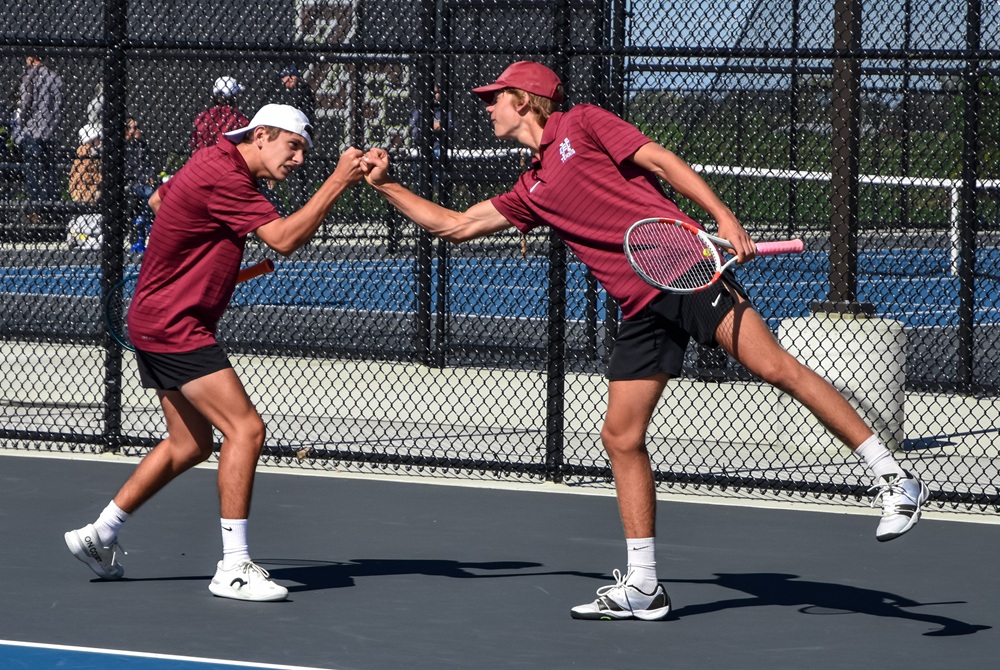
Michael Gorno and Tanis developed quick chemistry on the court and eventually emerged as a dominating force that few teams could overcome.
As freshmen, playing at No. 3 doubles, they finished 29-2 and advanced to the Division 4 semifinals at their flight.
The following year, they went 31-2 and advanced even farther, winning a Finals championship at No. 3 while also helping the Maroons to a Division 4 team title.
“We found a lot of raw success and raw chemistry together, which was really fun for us to see,” Michael Gorno said. “Especially since (we’ve been) good friends outside of tennis and close friends all through high school. To come down and try something new and find that immediate success was definitely really fun.
“After making it to the semifinals as freshmen, we saw that we still had a lot of work to do to make that transfer from good to great, and we both put in an absurd amount of work in the offseason. Coming into that sophomore season, we both came in with the goal of a state championship in mind and we executed it very well, I would say.”
Tanis said the thrill of winning a Finals championship with his team and his good friend was the highlight of his career.
“It was really fun, and what a blessing to be in that position,” he said. “To have that opportunity and then pull through and win was pretty cool.
“We both just really love playing tennis and have great chemistry. We played really well when we were just having fun out there. He has a great forehand, I have a good serve, and we both are good at the net. Pair that together with the great coaching we had, and it brought out the best in us.”
Holland Christian moved to Division 3 two years ago, but the success didn’t stop as the standouts also shifted to No. 1 doubles.
Michael Gorno and Tanis were unbeaten entering the Finals as juniors, but were upset in the semifinals.
This past season, Gorno was slated to play No. 1 singles but suffered a tear in his hip flexor during his second match.
“I was out a couple weeks, and we decided it was safer to run back doubles with Graham again,” Gorno said. “I love playing with him, and there’s no one else I would want to play with on the court. Obviously, our aim was for a No. 1 doubles title.
“We were the one seed our junior year and came up short, and this year undefeated, too. Unfortunately, we fell just short of that, but after the match I think we were more sad that our run of two almost-undefeated seasons was over.”
The duo will go down as the winningest doubles tandem in MHSAA history.
“Just an amazing accomplishment, and having 106 wins together and only six losses is an amazing record for both of us to think about,” Michael Gorno said.
The Maroons finished third as a team for the second straight year at this season’s Division 3 Finals behind champion Detroit Country Day and runner-up Bloomfield Hills Cranbrook Kingswood.
Holland Christian seniors Jonathan Haig and Carter Leep won their flight at No. 3 doubles despite entering the Finals as the fourth seed.
“While Graham and I were upset by how we did, it was so fun to watch those guys win that match,” Michael Gorno said. “Coming back from a set down and watching them lock back in and win that match … they both deserved it so much. Jon put in so much work over this season, and Carter's serves were some of the best I’ve seen. It was truly an amazing accomplishment for both of them.”

Dean Holzwarth has covered primarily high school sports for Grand Rapids-based WOOD-TV for five years after serving at the Grand Rapids Press and MLive for 16 years along with shorter stints at the Ionia Sentinel and WZZM. Contact him at [email protected] with story ideas for Allegan, Kent and Ottawa counties.
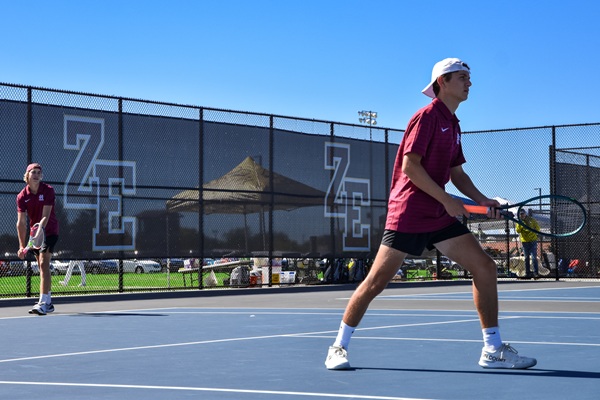
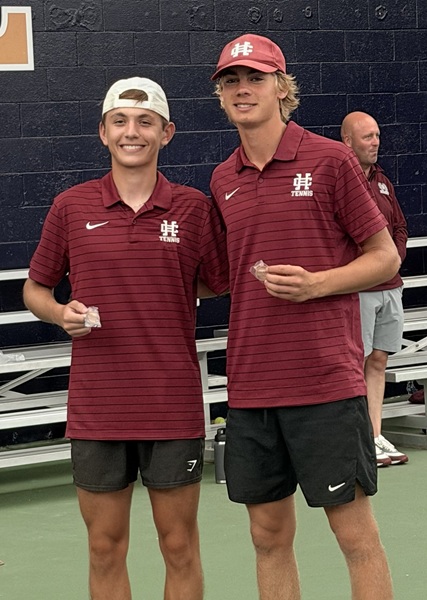
PHOTOS (Top) Holland Christian’s Michael Gorno and Graham Tanis bump fists in celebration during a match this fall. (Middle) Tanis prepares to serve with Gorno playing the net. (Below) The pair completed their career together with a 106-6 record over four seasons. (Photos courtesy of the Holland Christian boys tennis program.)